What Is Japanese Knotweed and Why Does It Matter on Development Sites?

There’s a particular sinking feeling that comes with finding Japanese knotweed on a site you’re about to develop. It’s not quite panic – more a resigned recognition that the programme just got more complicated and the budget conversation is about to become interesting. Anyone who’s worked in development, construction, or land management in the UK long enough has had that feeling at least once.
Japanese knotweed – Reynoutria japonica, though you’ll still see it listed as Fallopia japonica in older references – is the invasive non-native plant that has genuinely earned its fearsome reputation. It arrived in Britain in the mid-nineteenth century, introduced as an ornamental plant and used in Victorian gardens, and has been spreading steadily ever since. It’s now present across virtually every part of the UK, colonising riverbanks, roadsides, brownfield sites, and the kind of neglected urban fringe land that tends to get picked up for development.
Understanding what it is, what it does, and why it causes such specific problems on development sites is the starting point for managing it properly.
Identification – Getting It Right Before Anything Else
Misidentification is more common than you’d expect, and it matters. Treating the wrong plant wastes money and time. Missing Japanese knotweed because it was confused with something else – and there are several species it’s regularly confused with – creates legal and programme risk further down the line.
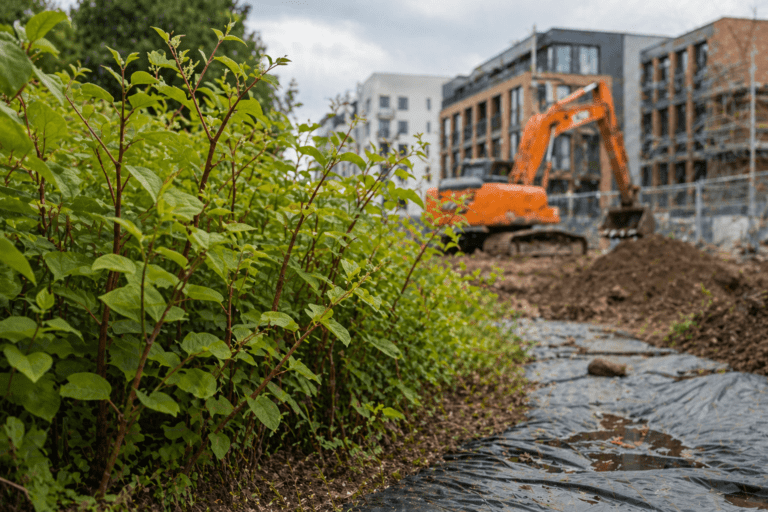
In summer, Japanese knotweed is distinctive enough. Hollow, bamboo-like stems with clearly visible nodes. Large, heart-shaped leaves with a flat or slightly indented base – not rounded like some lookalikes. Stems can reach two to three metres in height through the growing season, dying back completely to ground level in autumn. In late summer, small creamy-white flowers appear in dense clusters from the leaf axils.
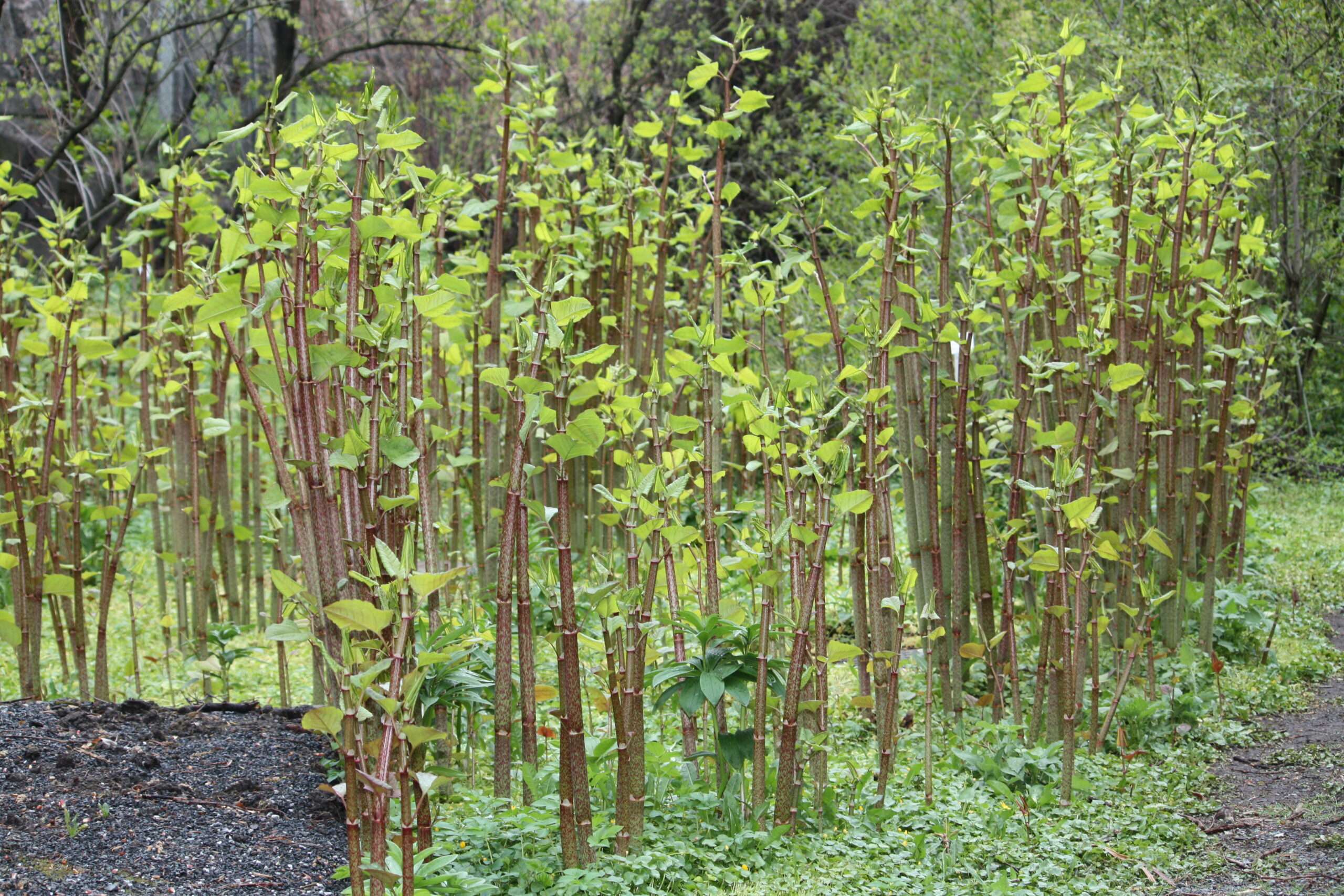
In spring, the emerging shoots are red or purple – again distinctive once you know what you’re looking for, though they can be confused at this stage with Russian vine or, occasionally, with dogwood. In winter, the dead canes remain standing and are identifiable by their hollow stems, nodes, and the zig-zag branching pattern. An experienced eye can identify it in any season. A less experienced one can get caught out, particularly in early spring or in mixed stands where other vegetation is present.
Common misidentifications include: Himalayan knotweed (a related but separate species with narrower leaves), bindweed (which climbs rather than standing), common dock (much larger, less structured leaves), and on brownfield sites, buddleia at a distance. None of those carry the same legal and programme implications as Japanese knotweed. Worth getting a confirmed identification before raising the alarm – or before assuming a plant that looked concerning isn’t actually a problem.
Why It’s Such a Problem on Development Sites
The short version: it’s almost impossible to fully eradicate, it spreads from tiny fragments of rhizome, it’s classified as controlled waste, and it can affect property values, mortgageability, and programme on any site where it’s present.
The rhizome system is the key to understanding why knotweed behaves the way it does. The above-ground canes are almost incidental – they die back each year. What persists and spreads is the underground network of rhizomes, which can extend three metres below the surface and seven or more metres laterally from the visible canes. A fragment of rhizome as small as a fingernail – around one gram in weight – is sufficient to establish a new plant. This is what makes careless excavation on knotweed-affected sites so dangerous: disturbing the rhizome mass and spreading contaminated spoil can create multiple new infestations across a site and beyond it.
Structural damage is another concern – though I’d say it’s somewhat overstated in the popular press, which has a tendency to describe knotweed as capable of breaking through concrete foundations like some sort of supervillain plant. The reality is more nuanced. Knotweed can exploit existing weaknesses in structures – cracks in masonry, gaps in paving, drainage joints – and cause damage by growing through them. It can displace block paving and damage poorly constructed walls. It doesn’t typically break through solid, well-constructed foundations. But it does cause real damage to infrastructure in poor repair, and on a development site where foundations and drainage are being installed, the rhizome network needs to be understood and managed.
How It Spreads – and Why That Matters for Site Management
Japanese knotweed doesn’t spread by seed in the UK – it’s effectively sterile here, being a single clone (or a very small number of clones) that arrived without the male plants needed for viable seed production. All spread in Britain is vegetative – through rhizome fragments and, to a lesser extent, through stem cuttings.
That has a very specific implication for development sites: the main vector for knotweed spread on and around sites is excavation and spoil movement. Rhizome material in excavated soil, moved around site by earthmoving equipment or transported off-site in lorries, creates new infestations wherever it goes. That’s how knotweed from one corner of a brownfield site ends up colonising a field three miles away where the spoil was tipped – and that’s why contaminated soil is classified as controlled waste under the Environmental Protection Act 1990 and must be handled, transported, and disposed of accordingly.
Fluvial spread – seeds or rhizome fragments transported in watercourses – is a significant natural dispersal mechanism, which is why knotweed is so prevalent along riverbanks and drainage channels. For development sites adjacent to watercourses, that’s relevant both as a source of reinfestation risk and as a reason why management of knotweed on or near watercourses needs to be planned carefully to avoid spreading material into the water system.
Seasonal Behaviour – Knowing What You’re Dealing With Through the Year
Understanding how knotweed behaves through the seasons matters for both identification and treatment planning. Here’s the annual cycle in broad terms:
| Season | Above-Ground Appearance | Rhizome Activity | Treatment Window |
|---|---|---|---|
| Early spring (March-April) | Red-purple shoots emerging from ground; asparagus-like tips | Rhizomes mobilising stored energy for shoot growth | Poor – plant not yet transpiring effectively |
| Late spring (May-June) | Rapid stem growth; large leaves developing; height increasing fast | Active growth drawing heavily on rhizome reserves | Moderate – foliar treatment beginning to be effective |
| Summer (July-August) | Full height 2-3m; large leaves; flowers in late summer | Rhizomes storing energy produced by photosynthesis | Best – plant at peak photosynthetic activity; herbicide most effective |
| Autumn (September-October) | Leaves yellowing and falling; canes beginning to die back | Maximum energy storage in rhizomes; sugars moving down into root system | Good – translocated herbicide moves into rhizomes with stored sugars |
| Winter (November-February) | Dead canes standing; no visible above-ground growth | Dormant; energy stored in rhizome network | Poor for foliar; stem injection possible but limited effect |
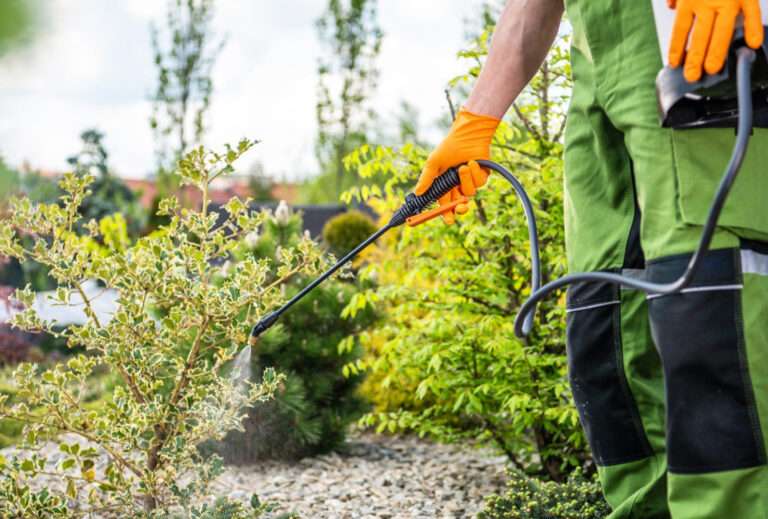
The treatment window information here is for herbicide-based management, which requires the plant to be actively growing and transpiring to move chemical through the system into the rhizomes. This is why a management programme typically needs to run across multiple growing seasons rather than being a single-visit treatment.
The Development Site Specific Problem
On a development site, knotweed creates problems at almost every stage of the project. Pre-purchase, its presence affects value and can complicate mortgage lending – several major lenders apply restrictions to properties where knotweed is present within a defined distance of the structure, though the specifics vary and the guidance has evolved over time. During planning, some local planning authorities require knotweed surveys and management plans as planning conditions or pre-commencement requirements. During construction, contaminated spoil has to be managed as controlled waste – which means it can’t just be pushed around site or sent to a standard tip. Post-construction, ongoing management commitments may run for years.
Our Japanese knotweed identification and removal work starts with a proper survey – establishing the extent of infestation, mapping rhizome spread, and producing the information needed to plan management that’s proportionate to what’s actually there rather than based on assumptions. Because the extent of a knotweed infestation is rarely obvious from looking at the above-ground canes alone, and managing it without that information tends to produce either over-expensive solutions or under-effective ones.
Lookalikes Worth Knowing
Misidentification causes genuine problems – either unnecessary expense if a non-invasive plant gets treated as knotweed, or missed knotweed if a real infestation is dismissed as something else. A few species are worth specifically knowing:
Himalayan knotweed (Persicaria wallichii) is a related invasive species that’s also listed under Schedule 9 of the Wildlife and Countryside Act. It has narrower, more lance-shaped leaves than Japanese knotweed and is generally smaller in stature. It carries essentially the same legal status and management requirements.
Russian vine (Fallopia baldschuanica) is in the same genus as Japanese knotweed and has similar flowers and a superficially similar appearance at distance. It climbs rather than standing upright and has a woody stem – once you’re close enough to see the plant clearly, the difference is obvious. It’s not invasive in the same sense and carries no legal obligations.
Bindweed, dock, and bramble are all regularly confused with knotweed by non-specialists. None carries the same implications. If there’s any genuine doubt about identification, a specialist survey rather than a lay judgement is the right call.
Frequently Asked Questions
How far can Japanese knotweed rhizomes spread underground?
Rhizomes can extend up to seven metres laterally from the visible canes and three metres vertically below the surface. This means the below-ground extent of an infestation is typically considerably larger than the above-ground footprint suggests. Excavation within that zone, without prior planning, risks fragmenting and spreading the rhizome network.
Can Japanese knotweed spread from a neighbouring property?
Yes, and this is a common source of new infestations on development sites – particularly brownfield sites adjacent to railway land, riverbanks, or other areas where knotweed has been present for years. Rhizomes don’t respect property boundaries. A survey that looks only within the site boundary without considering adjacent land can miss an encroaching infestation that will return regardless of what’s done within the site itself.
Is Japanese knotweed dangerous to human health?
No. Japanese knotweed is not toxic to humans or animals. The concern is purely about its invasive spread, structural impact, and legal status. Handling the plant – cutting, pulling, or moving material – carries no health risk, though standard PPE appropriate to the work context applies, and any herbicide treatment needs to follow the relevant COSHH and pesticide legislation requirements.
Does Japanese knotweed affect property value?
It can, yes – though the extent varies depending on proximity to the structure, the severity of the infestation, whether a management plan is in place, and the lender involved. Some mortgage lenders have historically declined to lend on properties with knotweed present, though RICS guidance updated in recent years has moved towards a more nuanced, risk-based approach rather than blanket exclusion. A management plan with insurance-backed guarantee can significantly mitigate the impact on mortgageability.
Know What You’re Dealing With
Japanese knotweed on a development site isn’t automatically a crisis. It is always a complication that needs to be understood and managed systematically rather than ignored, rushed, or dealt with informally. The extent of the infestation, the programme for the site, the planning authority’s requirements, and the lender’s position all shape what the right response looks like.
What makes the difference between a knotweed problem that’s manageable and one that derails a project is usually how early it’s identified, how thoroughly it’s surveyed, and how well the management is planned around the site programme. Finding it during a pre-purchase survey, with time to incorporate management into the project plan, is a very different situation from finding it during groundworks when the programme is already running.
Early identification. Proper survey. Clear plan. In that order.

Killingley Insights is the editorial voice of NT Killingley Ltd, drawing on decades of experience in landscaping, environmental enhancements, and civil engineering projects across the UK.