Japanese Knotweed Removal: What Your Legal Obligations Are

The legal position on Japanese knotweed is one of those areas where there’s a significant gap between what people think the law says and what it actually says. The plant has acquired a kind of mythological status in the UK property and development world – stories of six-figure legal battles, properties that can’t be sold, prosecutions for leaving it unmanaged. Some of those things have happened. But the actual legislative framework is rather more specific, and rather more navigable, than the folklore suggests.
Worth getting the facts straight.
What the Law Actually Says
Japanese knotweed is listed on Schedule 9 of the Wildlife and Countryside Act 1981. That schedule lists species that are prohibited from being planted or otherwise caused to grow in the wild. It does not make having knotweed on your land illegal. It does not require you to remove it. It does not impose a mandatory treatment obligation on landowners.
What it does prohibit is causing or allowing it to spread into the wild – which in practice means allowing it to spread beyond your land boundary, particularly onto neighbouring land, public land, or into the natural environment. There’s no automatic criminal liability simply for having knotweed present on private land, provided reasonable steps are being taken to prevent its spread.
The Environmental Protection Act 1990 is the other key piece of legislation. Under this Act, Japanese knotweed contaminated soil and plant material is classified as controlled waste. It cannot be fly-tipped, cannot be deposited at a standard household or commercial waste facility, and cannot be moved off-site without compliance with controlled waste regulations – which means using a licensed waste carrier and disposing at a licensed facility. Breaching controlled waste regulations is a criminal offence carrying significant fines.
Importantly – and this catches people out – even moving contaminated soil within the same site can constitute waste handling that needs to be managed appropriately if the site boundary is crossed or if the material is being deposited in a location where knotweed was not previously present.
The Antisocial Behaviour, Crime and Policing Act 2014
This is the legislation that introduced Community Protection Notices, and it’s relevant to knotweed because local authorities can use CPNs to require landowners to take action to control knotweed where its spread is causing, or is likely to cause, nuisance or harm to the local community. Failure to comply with a CPN is a criminal offence.
CPNs have been issued in relation to Japanese knotweed infestations, particularly where knotweed is spreading from one property to another and the affected neighbour has complained to the council. It’s not a mechanism that gets used frequently, but it exists and is a route through which having unmanaged knotweed can result in legal action even where the Wildlife and Countryside Act doesn’t directly apply.
Separately, civil nuisance claims between neighbours over knotweed encroachment have been brought and won – most notably in the Network Rail case where the company was successfully sued for allowing knotweed to spread from their land onto adjacent residential properties. Civil liability for allowing knotweed to encroach on a neighbouring property is a real and established legal risk.
Obligations on Development Sites Specifically
Development sites sit in a slightly different legal context from simple landowner obligations. Planning conditions frequently require knotweed surveys and management plans as pre-commencement conditions – meaning development cannot lawfully begin until those requirements are met. Environmental Impact Assessment for larger schemes may require invasive species management as part of the ecological mitigation. Contaminated land assessments may include knotweed as a material consideration.
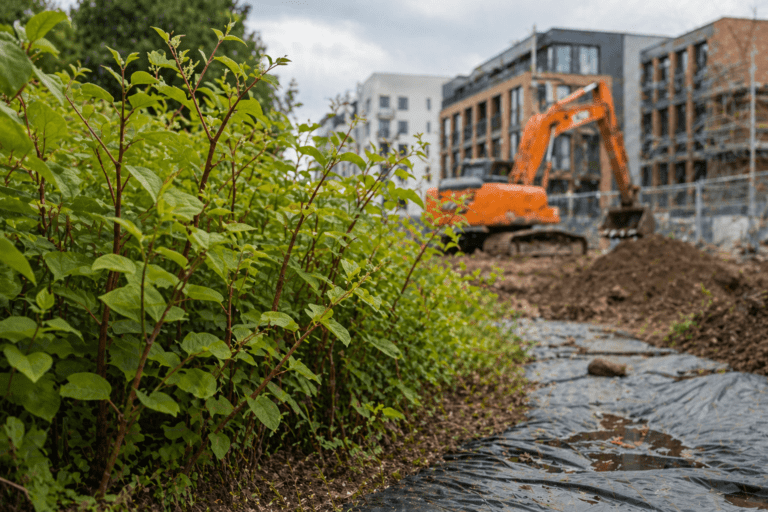
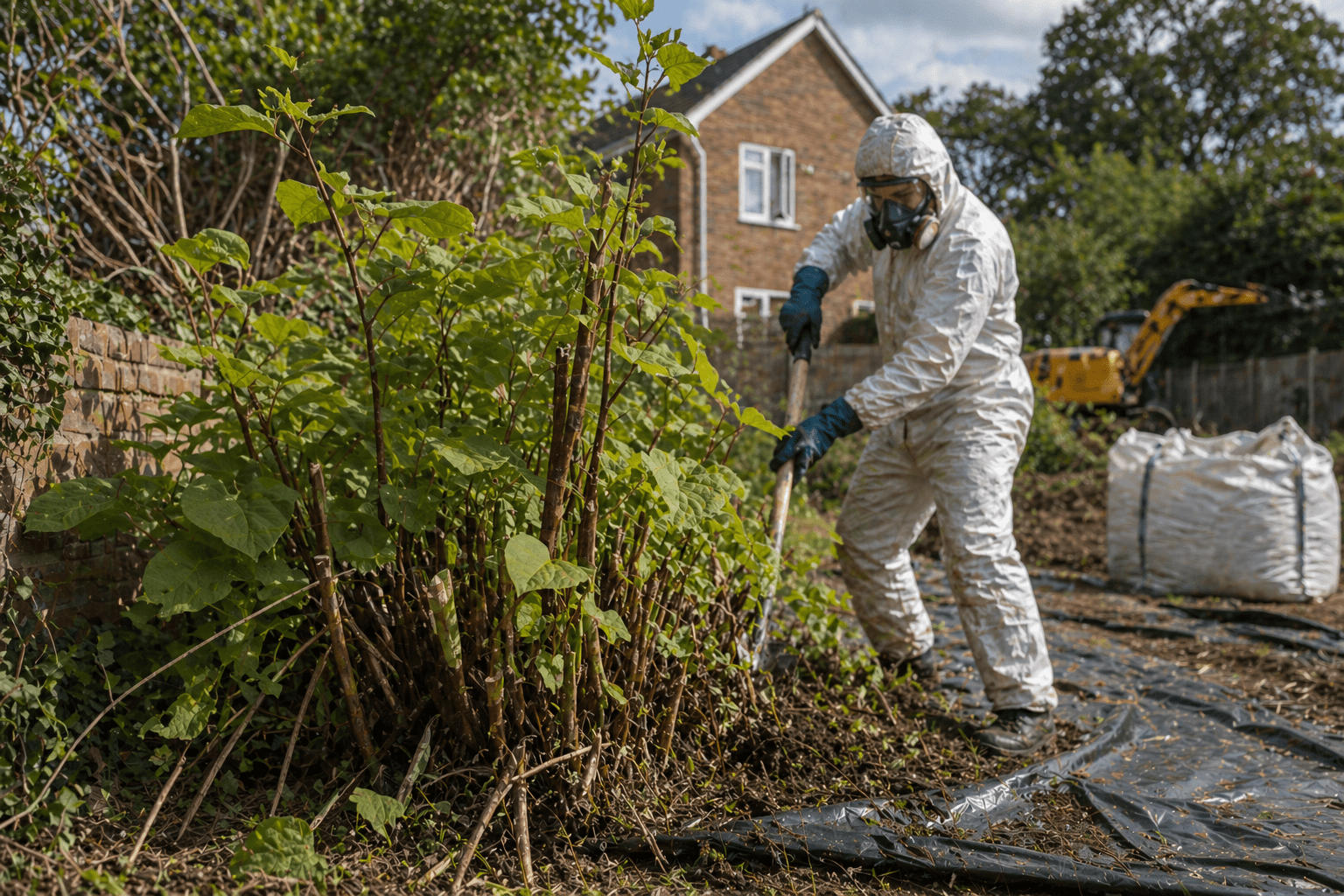
Controlled waste obligations are the most consistently applicable legal requirement on active development sites. Any excavation that disturbs knotweed rhizomes produces contaminated spoil that is controlled waste. That material cannot be moved off-site in a standard tipper without a waste transfer note identifying it as contaminated waste and a licensed carrier with the appropriate waste carrier registration. Disposal must be at a licensed facility – typically a permitted landfill or a specialist treatment facility. The costs involved are real and need to be in the project budget rather than discovered during earthworks.
Our Japanese knotweed legal obligations for developers work covers both the survey and management planning that meets planning condition requirements, and the practical on-site management of contaminated material during works – because those two things need to work together, and getting one right while ignoring the other doesn’t achieve legal compliance.
The Property Transaction Context
Japanese knotweed has significant implications for property transactions – buying, selling, and mortgaging. The legal position here isn’t primarily criminal law; it’s about disclosure, misrepresentation, and lender requirements.
In residential conveyancing, the TA6 property information form specifically asks sellers whether they are aware of Japanese knotweed on the property or within three metres of the property boundary. Failing to disclose known knotweed, or deliberately misrepresenting its absence, can constitute fraudulent misrepresentation – which has been the basis of successful legal claims by buyers against sellers and, in some cases, against surveyors who failed to identify it.
Mortgage lenders have their own policies, which have evolved. The RICS guidance note on Japanese knotweed, updated in 2022, introduced a risk-based assessment framework – categorising infestation into four categories based on proximity to the property and severity, with different implications for each. Lenders use this framework differently, with some still applying blanket restrictions and others taking a more graduated approach.
| RICS Risk Category | Description | Typical Lender Response |
|---|---|---|
| Category 1 | Knotweed present on neighbouring land only; not within 3m of property boundary | Generally no restriction on lending; may note in report |
| Category 2 | Knotweed within 3m of property boundary or on boundary; no structural impact | Management plan with insurance-backed guarantee typically required before lending |
| Category 3 | Knotweed within 7m of a habitable space or outbuilding; no current structural damage | Management plan with IBG required; some lenders may decline or require further survey |
| Category 4 | Knotweed causing damage to structures, paths, or drainage; or in close proximity to foundations | Remediation and management plan with IBG required; some lenders decline regardless |
An insurance-backed guarantee (IBG) attached to a professional management plan – providing a guarantee that the management programme will be completed and warranting against reinfestation – is the standard mechanism for enabling transactions to proceed where knotweed is present. They’re available from specialist treatment companies, typically covering a ten-year period, and can be transferred to a new owner on property sale.
Contractor Obligations During Works
Construction and groundworks contractors working on sites with knotweed have specific legal obligations that flow from the controlled waste classification and from general health and safety duties.
Operatives need to be briefed on how to identify knotweed, what to do if they encounter it during excavation (stop work in that area, report to site manager), and how contaminated material must be handled. This is a site induction item on any site where knotweed is known or suspected to be present. Proceeding with excavation in a knotweed-affected area without a plan for the contaminated spoil is both a legal risk and a practical one – spreading rhizome material across a site creates new infestations that then need managing.
Plant and machinery used in knotweed-affected areas should be cleaned before moving to other parts of the site. Rhizome fragments can be transported on the tracks of excavators or the tyres of dumpers and deposited in areas that were previously clean. A simple wash-down procedure for plant moving out of a knotweed zone prevents inadvertent spread and is a reasonable precaution on any site where the infestation is being actively managed.
What Doesn’t Create Legal Liability
It’s worth being clear about what isn’t illegal, because the mythology around knotweed sometimes creates disproportionate responses to manageable situations.
Having knotweed on your land is not illegal. Not treating it is not illegal, provided you’re not allowing it to spread beyond your boundary and you’re not in breach of a planning condition or a specific legal notice. Allowing it to die back naturally over winter without taking any action is not illegal. Cutting it – as opposed to treating or removing it – is not illegal, though cutting without treatment doesn’t control the plant and may spread material if the cut stems aren’t handled appropriately.
The legal obligations are specifically: don’t cause it to spread into the wild, handle and dispose of contaminated material as controlled waste, comply with any planning conditions or legal notices requiring management, disclose it in property transactions, and don’t allow it to encroach on neighbours’ land. None of those are unreasonable. Together, they frame what responsible knotweed management looks like.
Frequently Asked Questions
Can I be prosecuted for having Japanese knotweed in my garden?
Not simply for having it present, no. Prosecution under the Wildlife and Countryside Act requires causing or allowing it to spread into the wild – onto neighbouring land, into the natural environment, or along public land. Prosecution under the Environmental Protection Act requires unlawful disposal of contaminated material as controlled waste. Neither applies to knotweed that’s present but contained on private land and not being disturbed or moved.
If I treat Japanese knotweed, can I dispose of the dead material in general waste?
No. Treated Japanese knotweed plant material – even dead material – is still classified as controlled waste under current guidance. It cannot be composted at home, cannot go in general waste bins, and cannot be taken to a standard household waste recycling centre. It must be disposed of at a licensed facility. Some specialist knotweed contractors can arrange for deep burial or incineration at appropriate facilities – this should be confirmed before disposing of any volume of treated material.
Am I liable if Japanese knotweed spreads from my land to my neighbour’s?
Potentially yes, under civil nuisance law, particularly if you were aware of the infestation and took no steps to manage it. The Network Rail case established that allowing knotweed to encroach on adjacent properties can found a successful claim in nuisance. The key factors are whether you knew or should have known about the knotweed, and whether you took reasonable steps to manage it. An active management programme is your best protection against a civil claim from a neighbour.
Do planning authorities always require a knotweed management plan?
Not always, but increasingly. It depends on the local planning authority, the type of development, and whether knotweed is known or suspected to be present on the site. Pre-application engagement with the LPA on sites where knotweed is present is strongly advisable – establishing what they will and won’t require before the planning application is submitted avoids conditions that come as a surprise after consent is granted. Some LPAs have standard conditions for knotweed management on brownfield sites; others deal with it on a case-by-case basis.
The Practical Upshot
The legal framework around Japanese knotweed is more specific and less draconian than its reputation suggests – but it does impose real obligations on developers, contractors, and landowners that need to be understood and planned for rather than discovered mid-project.
Controlled waste obligations during excavation, disclosure requirements in property transactions, planning condition compliance, and civil liability for allowing spread to neighbours – these are the areas where getting it wrong has real consequences. None of them are difficult to comply with when they’re planned for. All of them can create significant problems when they’re not.
Understanding the legal position is the foundation. Having a management plan that reflects it is the next step.

Killingley Insights is the editorial voice of NT Killingley Ltd, drawing on decades of experience in landscaping, environmental enhancements, and civil engineering projects across the UK.