Landscaping at Scale: What It Really Takes to Deliver Major Infrastructure Landscapes

Big landscapes don’t fail because of planting.
They fail because of logistics. Interfaces. Timing. One trade getting ahead of another. Or worse, something simple being left too late because everyone assumed someone else had it covered.
Large infrastructure landscapes look calm when they’re finished. Broad swathes of green. Clean edges. Everything tying together nicely. But getting there is rarely calm. It’s noisy, messy, weather-dependent, and full of moving parts that don’t always want to line up.
This is a practical look at how large-scale landscaping actually gets designed and delivered on major infrastructure schemes. Not the glossy version. The real one. Coordination, phasing, access constraints, and the quiet decisions that stop everything unravelling halfway through.
Scale changes everything
A housing estate landscape and an infrastructure landscape are not the same beast.
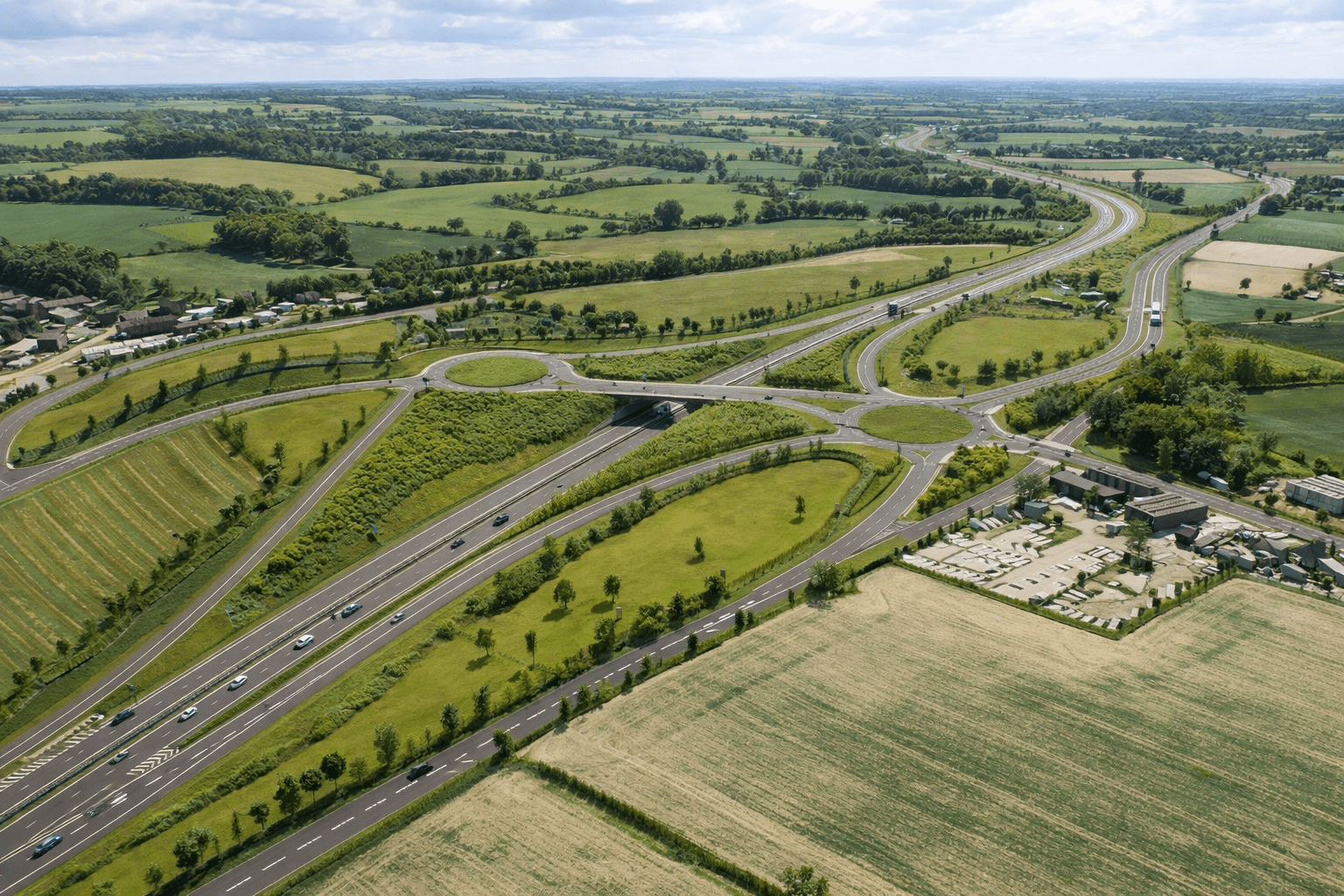
Once you’re dealing with highways, rail corridors, energy schemes, flood works, or major regeneration projects, the rules shift. You’re no longer just designing for appearance or amenity. You’re designing around engineering tolerances, safety zones, maintenance access, programme pressure, and future-proofing.
And that changes the conversation early.
Planting becomes sequencing. Softworks become logistics. Maintenance becomes a design constraint rather than an afterthought.
Miss that shift and things start to creak.
Early design is really about coordination
The drawings might show planting beds and grassed areas, but the early work is mostly about coordination.
Who’s building what. When. And how landscaping fits in without clashing.
At scale, landscaping doesn’t sit neatly at the end of the programme. It weaves in and out of it. Sometimes it starts early to stabilise soils or manage water. Sometimes it pauses for months while civils do their thing.
Key coordination points usually include:
- Earthworks completion and settlement periods
- Drainage installation and testing
- Utility corridors and easements
- Temporary access routes that become permanent scars if you’re not careful
Ignore any of those and the landscape pays for it later.
Phasing isn’t optional on large schemes
On major infrastructure projects, phasing isn’t a nice-to-have. It’s survival.
You can’t landscape everything in one go. Access shifts. Areas open and close. Programmes slide. Weather intervenes.
Good phasing plans accept that reality. They build flexibility in.
Bad ones assume best-case scenarios and then unravel the first time something slips.
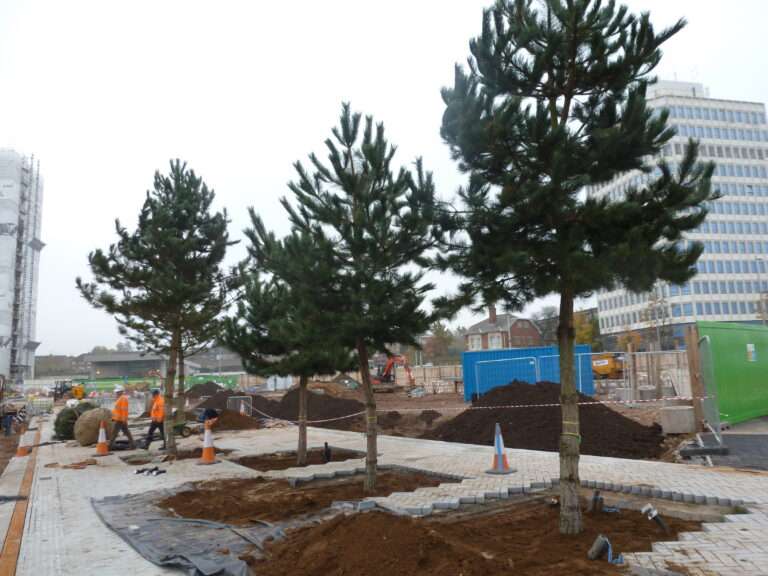
I’ve found that the most resilient schemes treat landscaping as a series of controlled releases rather than one big package. Area by area. Function by function. With clear handover points.
Messy on paper. Effective on site.
Logistics: the part nobody wants to talk about
Large-scale landscaping lives or dies on logistics.
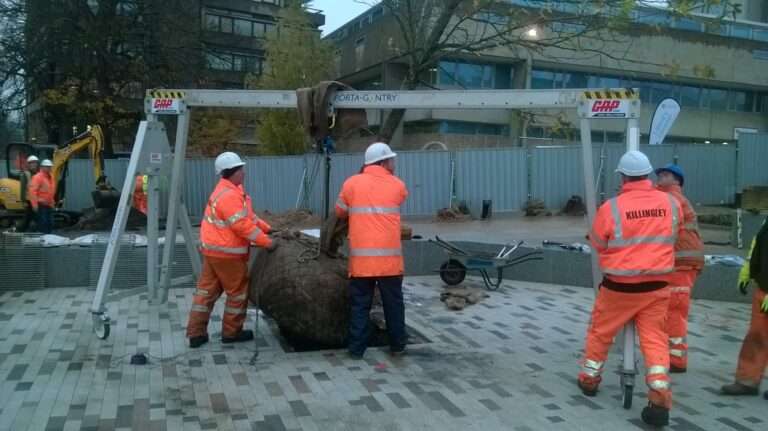
Plant deliveries. Storage areas. Access routes. Protection of completed works. All of it matters more than species selection ever will.
Some very real questions crop up:
- Where are materials stored without compacting soils?
- How do you get plant to site when access roads disappear?
- What happens when a crane pad sits exactly where the final landscape is meant to be?
If those aren’t answered early, they get answered later by accident. Usually badly.
And once soil structure is damaged, no amount of topsoil dressing really fixes it. You just hide the problem for a while.
Weather is a programme driver, whether you like it or not
British weather doesn’t care about your Gantt chart.
Wet winters delay earthworks. Dry summers stress new planting. Late frosts wipe out carefully planned schedules.
On large infrastructure schemes, weather risk multiplies because of scale. One delayed phase can cascade across the site.
Smart programmes work with the seasons. They accept slower progress at certain times and plan around it.
Trying to force landscape delivery in the wrong conditions is a false economy. Everything looks fine at handover. Then it struggles. Or fails. Or needs replacing.
Which nobody enjoys explaining.
Soil is the quiet foundation of everything
Soil rarely gets the attention it deserves on big schemes.
It’s stripped, stockpiled, compacted, moved again, then expected to perform like new. That expectation is… optimistic.
At scale, soil management needs to be deliberate. Tested. Protected. Reinstated properly.
Good practice usually involves:
- Controlled stripping and storage
- Limiting trafficking on prepared areas
- Timed reinstatement to avoid saturation
- Remedial works where compaction is unavoidable
None of this is glamorous. All of it matters.
I’ve seen excellent planting plans undone by poor soil handling more times than I’d like to admit.
Interfaces cause most of the pain
Landscaping touches everything.
Highways. Drainage. Structures. Utilities. Ecology. Maintenance teams. Clients. Local authorities.
Every interface is a risk point.
On large infrastructure projects, interface management becomes as important as design quality. Sometimes more so.
Clear responsibilities help. Defined tolerances help. Early conversations help most of all.
Assumptions are the enemy here. “We thought you were doing that” is never a good sentence on site.
Temporary works that turn permanent
Here’s a classic problem.
Temporary access routes. Construction compounds. Storage areas. They’re meant to disappear. But deadlines loom, budgets tighten, and suddenly those temporary features start looking permanent.
Unless landscape teams are involved early, they’re often asked to “make good” areas that were never designed to be reinstated.
Which leads to compromised outcomes. Thin soils. Poor drainage. Awkward shapes that don’t function properly.
Early planning reduces that risk by designing with reinstatement in mind from day one.
Designing for maintenance, not just handover
Large infrastructure landscapes aren’t gardens. They’re operational environments.
Maintenance access. Sightlines. Safety requirements. Long-term management budgets. All of these shape what’s realistic.
Designs that look great but cost a fortune to maintain don’t survive long. They get value-engineered post-handover. Sometimes brutally.
The better schemes design maintenance in from the start. Simpler forms. Robust planting. Logical access routes.
Not dull. Just durable.
A brief word on scale and public perception
Large infrastructure landscapes are often highly visible.
Road corridors. Flood defences. Rail routes. People notice when they work. And when they don’t.
There’s little tolerance for failure. Dead planting. Erosion. Untidy finishes.
That pressure makes early coordination even more important. Because fixing issues at scale is never cheap or discreet.
Where specialist delivery comes in
Delivering large infrastructure landscapes isn’t just about having more people or bigger machines.
It’s about experience. Knowing where schemes usually go wrong. Anticipating clashes. Sequencing work so that landscaping supports the wider project rather than fighting it.
This is why integrated delivery of large infrastructure landscapes matters, particularly on complex schemes where soft landscaping has to align with engineering, environmental mitigation, and long-term asset management. When those elements are planned together, outcomes are stronger and far more resilient.
Common questions that come up
Can landscaping really start before main construction finishes?
Yes, in phases. Often it needs to.
Is it better to plant early or late?
Neither, universally. It depends on soil condition, access, and weather.
Do large schemes always need bespoke planting?
Not always. Robust, proven palettes often outperform novelty at scale.
What causes most delays?
Interfaces, access changes, and late design decisions.
A simple comparison worth keeping in mind
| Approach | Likely Result |
|---|---|
| Landscaping treated as final task | Rushed delivery |
| Early phasing and coordination | Smoother programmes |
| Ignoring logistics | Soil damage |
| Designing for maintenance | Long-term success |
Not complicated. Just easy to forget under pressure.
Circling back, because it matters
Large-scale landscaping isn’t about planting big areas. It’s about managing complexity.
More trades. More constraints. More eyes on the outcome.
The schemes that succeed aren’t necessarily the most ambitious. They’re the most thought-through.
And that usually shows long after everyone’s left site.
Conclusion: calm landscapes come from controlled chaos
Finished infrastructure landscapes look calm because the chaos was managed earlier.
Coordination done properly. Phasing planned realistically. Logistics thought through. Soil protected. Interfaces respected.
None of it happens by accident.
Get those fundamentals right and large-scale landscaping becomes a stabilising force on major schemes rather than a constant source of friction.
And in the middle of a complex infrastructure project, that’s worth its weight in topsoil.

Killingley Insights is the editorial voice of NT Killingley Ltd, drawing on decades of experience in landscaping, environmental enhancements, and civil engineering projects across the UK.