Japanese Knotweed Management Plans: What Contractors and Developers Really Need

A Japanese knotweed management plan means different things to different people. Ask a planning officer and they’ll describe a document that satisfies a pre-commencement condition. Ask a mortgage lender and they want something with an insurance-backed guarantee attached to it. Ask a groundworks contractor and they want to know what they’re supposed to do when they hit rhizome during excavation and where the contaminated spoil goes. Ask a developer and they want to know how long the whole thing is going to take and what it’s going to cost.
All of those are legitimate questions. A good management plan answers all of them – or at least, the ones relevant to the specific project context. A bad one answers the immediate question in enough detail to get past the next hurdle without actually giving anyone a clear picture of what’s going to happen, when, and at what cost.
The difference matters, because Japanese knotweed management typically runs for multiple years and involves a sequence of decisions and actions that each depend on what came before. A plan that doesn’t think through the whole sequence tends to produce surprises at awkward points in the programme.
What a Management Plan Needs to Cover
The starting point for any management plan is a proper survey. Not a drive-by assessment. Not a desktop search of the Environment Agency’s knotweed dataset. A properly conducted ground survey by someone who knows how to identify knotweed in all seasons, understands rhizome spread and infestation extent, and can produce a mapped record of where it is and how extensive the infestation is.
On development sites, that survey should include assessment of the likely extent of rhizome spread beyond the visible above-ground growth – because the underground network is almost always larger than the canopy footprint suggests. On sites adjacent to watercourses, railway land, or other areas where knotweed is prevalent, the survey should consider the risk of reinfestation from adjacent land even after on-site management is complete.
From the survey, the plan then needs to specify:
– The treatment method or methods to be used, with justification – The treatment programme – timing across growing seasons, number of treatment cycles – How contaminated material will be handled, stored, transported, and disposed of – How the management interfaces with the construction programme – Monitoring requirements and success criteria – Contingency for areas of unexpected infestation found during works – Long-term management and monitoring after the active treatment period
That last point gets dropped from a lot of plans. The treatment period ends, the site is developed, and the ongoing monitoring obligation quietly disappears. On sites where rhizomes remain in the ground – which is the case with herbicide treatment; it kills the plant but doesn’t remove the rhizome – ongoing monitoring for regrowth is important, particularly in the first few years after treatment ends.
Treatment Methods – What’s Available and When Each Is Appropriate
There’s no single right treatment method for all situations. The appropriate approach depends on the infestation size, the site programme, the planning requirements, and what the land is going to be used for afterwards. Here’s a practical comparison:
| Treatment Method | How It Works | Programme | Best Suited To | Key Limitations |
|---|---|---|---|---|
| Herbicide foliar spray | Glyphosate or other approved herbicide applied to leaves; translocated into rhizomes | Multiple applications per season over 3-5 growing seasons | Sites with time for long-term management before development; open ground | Requires active growing season; slow to achieve control; not suitable near watercourses without consent |
| Herbicide stem injection | Herbicide injected directly into hollow stems | Annual treatment; more targeted than foliar | Near watercourses; sensitive areas where foliar spray would affect surrounding vegetation | More labour-intensive per stem; still requires multiple seasons |
| Excavation and off-site disposal | Rhizome mass excavated and removed as controlled waste to licensed landfill | Single operation; immediate clearance | Sites with tight programmes; small infestations; where long-term herbicide programme isn’t viable | High cost; contaminated soil is controlled waste with associated transport and disposal costs; risk of spreading material if not managed carefully |
| Dig and bury (on-site encapsulation) | Rhizome mass excavated and buried at depth on-site within a root barrier membrane | Single operation; requires suitable on-site location | Sites where off-site disposal is prohibitively expensive; where sufficient space exists for encapsulation cell | Material remains on-site; may affect future development potential of encapsulation area; requires long-term monitoring |
| Combination approach | Herbicide treatment to reduce vigour, followed by excavation of weakened rhizome mass | 1-2 seasons herbicide then excavation | Larger infestations where complete excavation alone is too extensive; where programme allows some lead time | Requires planning ahead; still produces controlled waste from excavation phase |
Herbicide treatment near watercourses requires consent from the Environment Agency under the Water Framework Directive – glyphosate in particular requires specific approval for use near water. That consent takes time to obtain and needs to be built into the programme before treatment is scheduled, not discovered as an obstacle when the treatment team arrives on site.
The Programme Integration Problem
This is where most knotweed management plans fall short in a development context. The management plan for the knotweed exists in one document. The construction programme exists in another. The two are written by different people and never quite reconciled.
Knotweed treatment has a seasonal dependency that construction programmes often don’t accommodate. Herbicide treatment only works during the growing season – roughly May to October, with peak effectiveness in late summer. If the programme calls for ground clearance in November, the first treatment season has already passed and you’re looking at a year’s delay before effective treatment can begin. If excavation of knotweed-affected areas is scheduled ahead of the treatment programme rather than after it, the programme benefits of the treatment are lost.
Integrating the knotweed management plan with the construction programme – establishing which areas need to be treated before excavation can proceed, which treatment method allows the fastest route to workable ground, and how the contaminated spoil management fits into the earthworks programme – is the conversation that needs to happen at the project planning stage. It’s a bit of a faff to retrofit once the programme is fixed and the earthworks contractor has been appointed.
Our Japanese knotweed management and treatment plans are written with the construction programme in mind, not in isolation from it – because a management plan that doesn’t account for the programme constraints is a plan that will create problems rather than solve them.
Contaminated Spoil Management – The Practical Detail
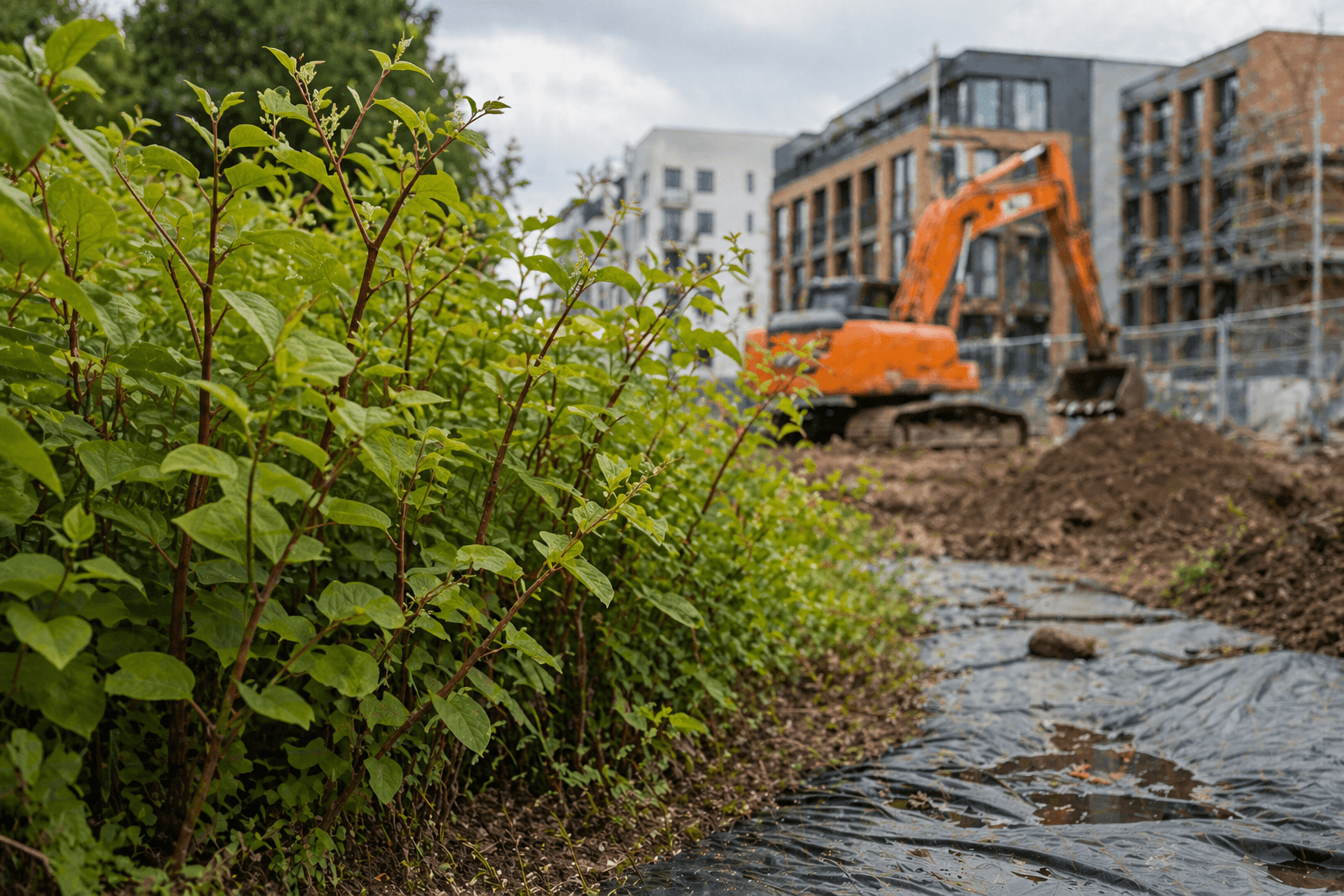
On development sites where excavation is taking place in or near knotweed-affected areas, the practical management of contaminated spoil is where the legal obligations of controlled waste handling meet the operational reality of a busy construction site. Getting this right requires a clear procedure that everyone on site understands.
Contaminated material from knotweed zones should be segregated from clean spoil from the point of excavation. Mixing contaminated and clean material creates a larger volume of controlled waste than necessary and increases disposal costs. A designated temporary storage area for contaminated spoil – away from clean material stockpiles, clearly signed, and with ground protection to prevent rhizome contact with clean ground – is standard practice on well-managed sites.
Waste transfer documentation needs to accompany every load of contaminated material leaving site. The waste transfer note must identify the material as Japanese knotweed contaminated soil, identify the licensed carrier, and identify the receiving facility. Copies of all transfer notes should be retained as part of the site environmental management documentation. This isn’t paperwork for its own sake – it’s the evidence trail that demonstrates legal compliance if the Environment Agency or anyone else asks.
Plant leaving the knotweed zone should be cleaned – tracked plant in particular – before moving to clean areas of the site. A designated plant wash-down point with provision for collecting and disposing of wash water containing rhizome fragments is the fully correct approach; in practice, a visual check and brush-down of tracks and buckets is the minimum. The purpose is to prevent inadvertent spread of rhizome material to areas of the site that are currently clean.
Insurance-Backed Guarantees – What They Cover and What They Don’t
An insurance-backed guarantee (IBG) attached to a professional knotweed management plan provides an insured warranty that the treatment programme will be completed and that the contractor will return to treat any regrowth within the guarantee period – typically ten years. It’s transferable on property sale, which is what makes it valuable for property transactions.
Worth being clear about what it doesn’t cover. An IBG guarantees the management programme, not eradication. Herbicide treatment reduces knotweed to levels where regrowth is manageable and typically not detectable above ground within a few growing seasons – but rhizome material in the ground may persist for longer, and in some circumstances regrowth can occur years after the treatment programme is apparently complete. The IBG means there’s a contractor obligated and insured to respond to that regrowth, not that it won’t happen.
IBGs are only as good as the company that issues them. A guarantee from a company that goes out of business in year three of a ten-year guarantee is a guarantee that no longer functions. The insurance backing is supposed to cover this eventuality, but the quality of the insurance product varies. Checking that the guarantee is underwritten by a named insurer and that the policy terms cover contractor insolvency is worth doing before relying on the guarantee for a property transaction.
Frequently Asked Questions
How many years does a herbicide treatment programme take?
Typically three to five growing seasons for a well-established infestation, with two to three herbicide applications per season. Smaller or less established infestations can sometimes be brought under control in two seasons. The programme length depends on the infestation size, the vigour of the plant, whether treatment is being applied consistently and at the right time in the growing season, and whether there are complicating factors like proximity to watercourses that limit treatment options.
Can Japanese knotweed be fully eradicated?
Complete eradication – in the sense of removing every last viable rhizome fragment from the ground – is very difficult to achieve and probably impossible to verify. Herbicide treatment kills the plant and prevents regrowth to the point where no above-ground growth is detectable, but rhizome material may persist in the soil. Excavation and off-site disposal is the closest thing to true removal, but even then, ensuring every fragment has been captured in the excavation is not guaranteed. “Control to a level where it no longer causes problems” is a more honest objective than “eradication” for most sites.
What does a knotweed management plan cost to produce?
Survey and plan preparation for a straightforward single-site infestation might cost from around £500 to £1,500 depending on the size of the site and the complexity of the infestation. For larger sites, multi-phase developments, or sites with complex programme requirements, specialist survey and management planning costs can be significantly higher. The cost of the plan is a small proportion of the overall management cost, which over a three-to-five-year treatment programme will typically be the larger number.
Does the management plan need to be produced by a specialist?
For planning condition compliance and for IBG purposes, yes – the plan needs to be produced by someone with the relevant competence to survey, specify treatment, and provide the guarantee. The Property Care Association (PCA) and the Invasive Non-Native Specialists Association (INNSA) both have accreditation schemes for knotweed management companies. Using an accredited specialist is strongly advisable for any plan that will need to satisfy a planning authority, a mortgage lender, or a legal obligation.
A Plan That Actually Gets Used
The best knotweed management plan is one that people actually refer to during the project – that the site manager has read, that the groundworks contractor understands the relevant sections of, that the ecologist or environmental consultant can check compliance against. A plan that exists to satisfy a planning condition and then sits in a drawer does half the job.
Getting the plan right means getting the survey right first. Getting the survey right means doing it at a time when the plant is identifiable – which generally means spring through autumn rather than mid-winter. Building the treatment programme around the site programme rather than in isolation from it. And being realistic about what the treatment will achieve and over what timescale.
Done properly, a knotweed management plan turns an awkward complication into a managed programme with clear milestones, clear costs, and clear accountability. Which is, on a development project, about the best you can ask for from any problem you inherit with the land.

Killingley Insights is the editorial voice of NT Killingley Ltd, drawing on decades of experience in landscaping, environmental enhancements, and civil engineering projects across the UK.