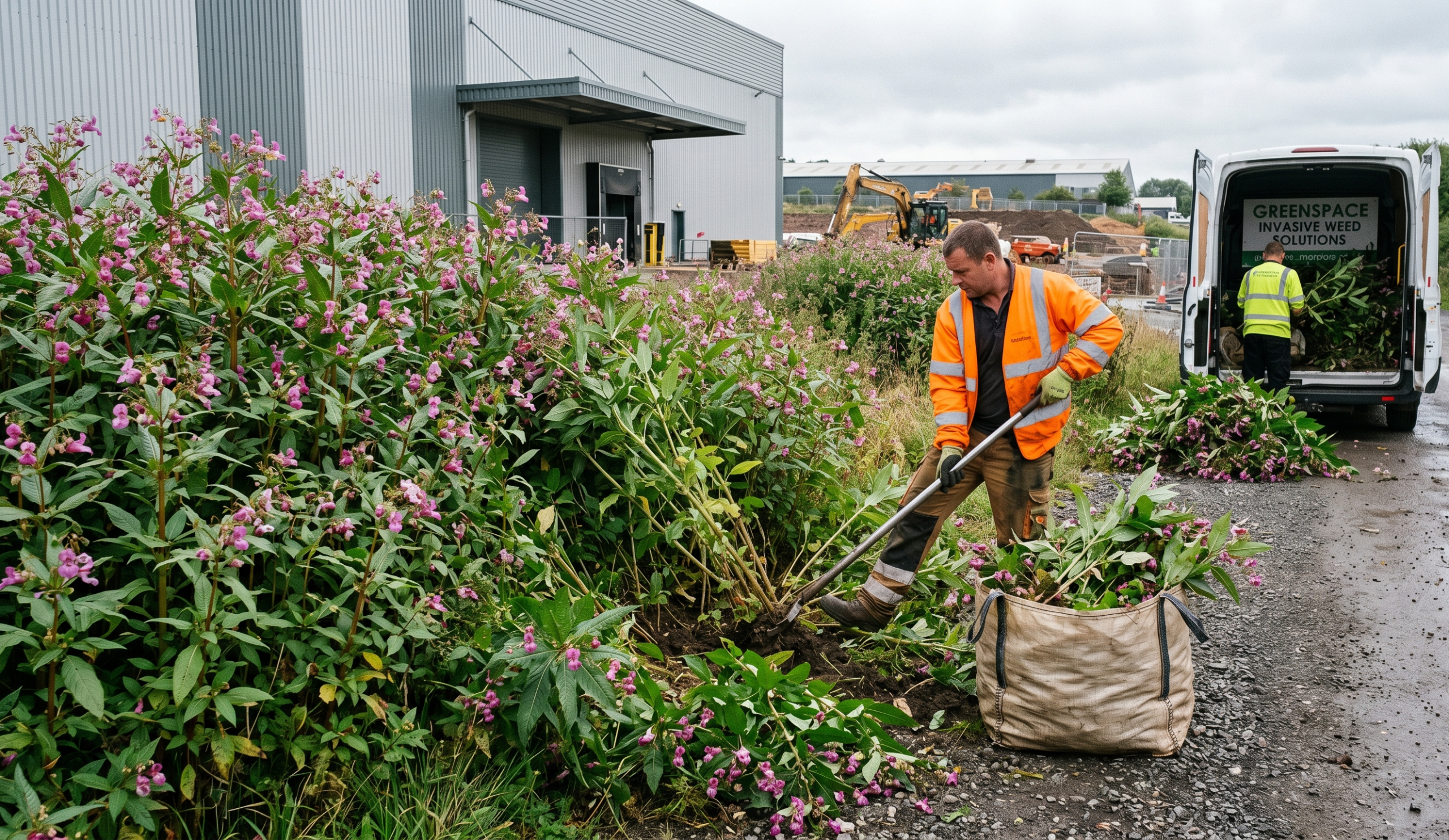
Himalayan Balsam on Commercial Land: Control, Removal and Your Responsibilities

Himalayan balsam has a particular talent for appearing in places people don’t check until it’s already a problem. Riverbanks, obviously – it’s been colonising watercourses across Britain for decades. But also scrubby field margins, derelict land, brownfield sites, the edges of industrial estates, utility corridors, and anywhere that gets disturbed and then left alone long enough for the seeds to get established. Which, on commercial land especially, is quite a few places.
It’s not Japanese knotweed. That comparison gets made, and it’s worth clearing up. Himalayan balsam (Impatiens glandulifera) is a different species with different characteristics, different control methods, and a somewhat different legal position. It’s an annual, not a perennial – it grows from seed each year rather than from a persistent rhizome system. That makes control more achievable, in principle. It also seeds explosively – the name “touch-me-not” comes from the seed pods that fling seeds up to seven metres when disturbed – which is precisely why an untreated stand can expand rapidly and why doing nothing isn’t really an option on commercial land where spread matters.
Why It Matters on Commercial Sites
Himalayan balsam is listed on Schedule 9 of the Wildlife and Countryside Act 1981 – the same schedule as Japanese knotweed. That listing makes it an offence to plant it or cause it to grow in the wild. In practice, on commercial land, the relevant risk is allowing it to spread from your site into the wider environment – particularly into watercourses, where it’s at its most ecologically damaging.
Once established in riparian habitat, Himalayan balsam forms dense stands that shade out native bankside vegetation, reduce structural diversity, and leave riverbanks bare in winter when the plants die back – increasing erosion risk. The Environment Agency regards it as a significant threat to riparian habitat quality across England and Wales, and it features in catchment-scale management programmes on many river systems. If your site is adjacent to a watercourse or drains into one, unmanaged balsam is a risk that goes beyond aesthetics.
Beyond the regulatory position, commercial landowners have a straightforward duty of care consideration. If balsam from your land spreads onto neighbouring property and the neighbour can demonstrate it came from your site, the civil liability question starts to look uncomfortably similar to the nuisance cases that have been brought over Japanese knotweed. It hasn’t been tested in exactly that way for balsam, as far as I’m aware – but the principle isn’t a comfortable one to rely on.
Planning conditions on development sites increasingly include requirements for invasive species management – including balsam where it’s present. If you’ve got a site with a planning condition requiring management of invasive species and balsam is present and unmanaged, that’s a condition breach, which is a problem in its own right.
Identification – Getting It Right Early in the Season
Himalayan balsam is straightforward to identify in summer. Tall – routinely reaching two metres or more – with hollow, reddish-pink stems and large, toothed, lance-shaped leaves. Flowers from June to October in pink, purple, or white depending on the individual plant. Seed pods develop through summer and ripen from August onwards, becoming increasingly explosive as they mature – hence the need to avoid working in stands of ripe plants with any kind of machinery that might disturb the pods.
In spring, the seedlings are less distinctive and could be confused with other plants before the characteristic stem colour and leaf shape develop. Early identification – when plants are still small and before they’ve set seed – is where control is most effective and most efficient. A stand of foot-high seedlings in April is considerably easier to deal with than a two-metre-high thicket with ripe seed pods in August.
Worth walking sites in April and May specifically to identify balsam early. It’s a habit that pays back disproportionately in easier management through the rest of the season.
Control Methods – What Works and When
Because Himalayan balsam is an annual, control is fundamentally about preventing seed set. Kill or remove the plants before they flower and set seed and you stop the cycle. Leave them until the pods are ripe and any disturbance – cutting, spraying, workers moving through the stand – scatters seed and perpetuates the problem. Timing is therefore the critical variable in any control programme.
| Method | Best Timing | Effectiveness | Considerations |
|---|---|---|---|
| Hand pulling | April to June – before flowering | Excellent when done thoroughly; plants pull cleanly when soil is moist | Labour-intensive on large stands; pulled plants must be left to desiccate or removed as waste; not practical at scale |
| Cutting / strimming | April to June – before flowering; repeat if regrowth occurs | Good if plants are cut below the lowest node; regrowth possible if cut too high | Arisings must not be spread; near watercourses, material must be kept out of water; not effective after seed set |
| Herbicide (glyphosate) | April to June on young growth; can be used later if pre-seed-set | Very effective on young plants; less reliable on mature growth | Requires pesticide certificate; consent needed near watercourses; not suitable in all locations; follow COSHH requirements |
| Herbicide (approved alternatives) | As per product label | Variable by product; check label for balsam-specific efficacy | Specialist products for near-water situations; always check Environment Agency consent requirements |
The near-watercourse constraint on herbicide use deserves emphasis. Glyphosate is not approved for use in or near water without specific Environment Agency consent – and Himalayan balsam is, very commonly, found in exactly the riparian locations where herbicide use is most restricted. Hand pulling and cutting are the primary control methods in those situations, which is why balsam management near watercourses tends to be more labour-intensive than it looks from a distance.
The Multi-Year Commitment
A single year of control doesn’t eradicate Himalayan balsam. Seeds remain viable in the soil for two years – sometimes longer under the right conditions – which means plants will continue to germinate from the existing seed bank even after a thorough first-year treatment programme. A realistic management programme runs for a minimum of three years, with annual treatment timed to catch emerging seedlings before they flower. By year three or four on a well-managed programme, the seed bank is largely depleted and the infestation is under control.
Reinfestation from adjacent land or watercourses is the other complication. Himalayan balsam seeds travel in water, which means a riverside site that’s been cleared can be reinfested from upstream in a single season if balsam remains unmanaged in the wider catchment. On sites where this is a realistic risk, ongoing monitoring and prompt treatment of any new plants is part of the long-term management rather than a sign that the previous year’s control failed.
Our Himalayan balsam removal and control services are programmed across the growing season – typically two or three visits timed to coincide with seedling emergence, pre-flowering growth, and a late-season check for any plants that were missed or that germinated later. That structure is more reliable than a single annual clearance visit and reflects how the plant actually behaves through the year.
Waste Disposal – a Practical Note
Himalayan balsam doesn’t carry the controlled waste classification that Japanese knotweed does – cut material can go into green waste composting at a licensed facility or be left on-site to desiccate, provided it’s not near a watercourse and won’t be picked up and spread by wind or water. Ripe seed pods are the obvious exception – material carrying viable seeds should be bagged or left to dry well away from the stand before disposal, not composted where seeds could survive the process.
Near watercourses, cut material needs to be kept out of the water – floating stems and pods can carry viable seeds significant distances downstream. Working in riparian balsam stands without a clear plan for arisings management creates the risk of inadvertently seeding areas further downstream that were previously clear. It’s a straightforward precaution to take, but it needs to be in the method statement rather than worked out on the day.
Frequently Asked Questions
Is Himalayan balsam as serious a problem as Japanese knotweed?
For property values and mortgage lending, no – Himalayan balsam doesn’t carry the same implications. For programme disruption on development sites, it’s considerably less problematic because it doesn’t have the rhizome system and controlled waste status of knotweed. But for riparian ecology and as a land management liability, it’s a real issue that deserves a proper management response rather than being treated as a cosmetic problem.
Can I just strim it down in autumn once it’s finished flowering?
If the plants have already set seed, cutting in autumn does nothing useful for control – the seeds are already in the ground or have already been dispersed. Autumn cutting removes the dead stems, which tidies the site but doesn’t reduce next year’s germination. Control needs to happen before flowering – typically April to June – to have any meaningful effect on the following year’s emergence.
Do I need to notify anyone before carrying out Himalayan balsam control?
Not in the way Japanese knotweed requires formal waste carrier documentation. However, if herbicide treatment is planned near a watercourse or on land adjacent to a watercourse, you need to check whether Environment Agency consent is required before application. For works on or adjacent to ordinary watercourses, the local authority (as Lead Local Flood Authority) may also need to be notified. Works near main rivers are subject to Environment Agency flood risk activity regulations. A quick check before treatment in sensitive locations avoids unintentional regulatory breaches.
What’s the difference between Himalayan balsam and Indian balsam?
Nothing – they’re the same species. Impatiens glandulifera goes by both common names, as well as policeman’s helmet and a handful of others depending on who you ask and where in the country you are. Same plant, same Schedule 9 listing, same management requirements.
Manageable, With the Right Approach
Himalayan balsam is genuinely more controllable than Japanese knotweed – the annual life cycle means that consistent early-season treatment, sustained over three to four years, can reduce an infestation to a level where it’s no longer a management problem. That doesn’t happen with a single visit or a one-year programme, but it does happen with a properly structured approach.
The key is getting the timing right – before flowering, before seed set – and being realistic about the commitment needed. Treat it as a three-year project rather than a single season’s task and the outcomes are consistently better. Treat it as something to deal with when it gets bad enough and you’re always chasing the problem rather than getting ahead of it.

Killingley Insights is the editorial voice of NT Killingley Ltd, drawing on decades of experience in landscaping, environmental enhancements, and civil engineering projects across the UK.