What Is a MUGA and Why It Works All Year Round for Shared Community Use

You’ll have seen them. Probably without thinking too much about what they are.
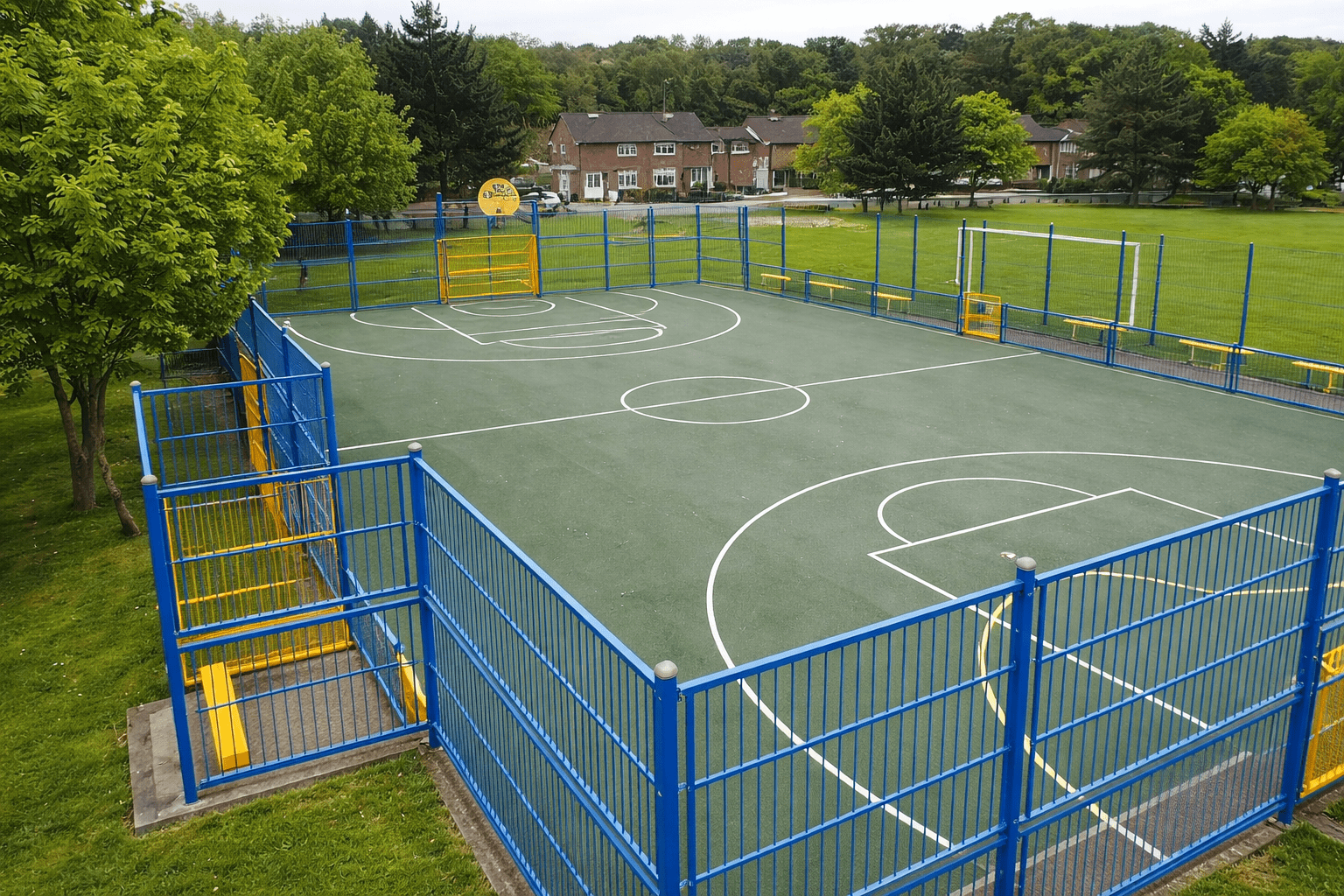
A fenced pitch behind a school. A hard-surfaced court in a housing estate. Floodlights humming on a winter evening while a five-a-side game carries on regardless of the drizzle. That, more often than not, is a MUGA.
Multi-Use Games Areas have been quietly shaping how communities stay active for decades. No fuss. No frills. Just robust spaces that get used. And used again. By different people, for different reasons, in different weather.
Funny thing is, they’re often misunderstood. Some see them as football cages. Others think they’re only for schools. A few assume they’re seasonal, or limited, or a bit of a compromise. In practice, they’re usually the opposite.
This piece unpacks what a MUGA really is, how it supports year-round activity, and why shared use is where it really earns its keep. Not theory. Real-world use. British weather included.
First things first. What does MUGA even mean?
MUGA stands for Multi-Use Games Area.
That’s the official bit. But the meaning sits in the name. One space. Multiple activities. Shared by different groups, often on the same day.
A typical MUGA can support:
- Football
- Basketball
- Netball
- Tennis
- Hockey
- Informal play and training
Sometimes all of the above. Sometimes just two or three. It depends on size, markings, surface, and local need.
And before anyone asks, no, they’re not all the same. A MUGA in a Nottingham primary school will look very different to one on a new housing development in Derbyshire or a parish park in Leicestershire. Same principle. Different execution.
Why MUGAs suit shared use better than most sports spaces
Let’s be blunt. Space is limited. Budgets are tight. Land values aren’t coming down anytime soon.
A single-use pitch that only works for one sport, in one season, at certain times of day… that’s a hard sell now. Especially for local authorities, schools, and developers under pressure to justify every square metre.
MUGAs solve that problem neatly.
One surface, many users
Because the surface is hard-wearing and non-specialist, it doesn’t care who turns up next. A PE lesson at 10am. After-school basketball at 4pm. Casual kickabout at 7pm. Same space. Different markings. No reconfiguration needed.
I’ve seen sites where three different clubs use the same MUGA across a single week. Nobody owns it. Everyone benefits.
That flexibility is the whole point.
Year-round use. The quiet superpower
This is where MUGAs really pull ahead.
Grass pitches look great in summer. Less so in February. We all know how that ends. Mud. Cancellations. Tape across the gate.
A well-designed MUGA doesn’t have that problem.
Surfaces built for British weather
Most MUGAs use one of three surface types:
| Surface Type | All-Weather Performance | Maintenance Level | Typical Use |
|---|---|---|---|
| Porous macadam | Excellent drainage | Low | Football, basketball |
| Polymeric rubber | Good shock absorption | Low–medium | Multi-sport, schools |
| Artificial grass | Good play feel | Medium | Football, tennis |
Porous macadam drains fast. Artificial grass plays consistently. Polymeric surfaces offer comfort and resilience.
None of them turn into a bog after three days of rain. Which, let’s be honest, matters.
I find that drainage is the unsung hero here. People talk about markings and fencing, but water management is what keeps a MUGA open in winter. Get that wrong and you’ve got a shiny skating rink instead of a sports space.
Lighting changes everything
Without lighting, year-round use is theoretical.
With it, the space becomes a genuine community asset.
Floodlighting extends use into evenings and darker months. That’s not a luxury add-on. It’s what makes shared use practical.
Think about it. School hours end mid-afternoon. Adults finish work later. Without lights, only one group wins. With lights, everyone gets a turn.
Modern LED systems keep running costs sensible too. Directional, low-spill, programmable. None of the old orange glow nonsense lighting up half the street.
Residents complain far less when lighting is done properly. That’s worth saying.
Schools, housing estates, and public parks. Different settings, same logic
MUGAs show up in all sorts of places. The reasoning is similar, but the pressures change.
Schools
In schools, MUGAs are about timetable efficiency.
PE lessons, clubs, break-time play. All-weather reliability matters because cancelling sessions plays havoc with schedules. Headteachers like certainty. MUGAs offer it.
They also reduce wear on grass areas, which quietly saves money long term.
Housing developments
On new estates, MUGAs do something else. They provide a focal point.
Instead of informal play spilling into car parks or cul-de-sacs, activity gets directed somewhere sensible. Contained. Safer. Easier to manage.
I’ve noticed that developments with decent communal facilities settle better. Fewer complaints. More informal social mixing. People bump into each other.
Not a bad thing.
Public parks and community spaces
Here, shared use is the whole point.
Youth groups. Casual users. Sports clubs. All dipping in and out. A MUGA doesn’t need bookings to function, though some councils introduce them anyway.
Even without formal management, they tend to self-regulate. People take turns. Or come back later. Most of the time.
How MUGAs support different age groups without drama
One concern that comes up a lot is mixing ages. Fair enough.
A ten-year-old and a group of teenagers on the same space could be an issue. Sometimes.
Design helps.
Clear sightlines. Sensible fencing heights. Multiple entry points. And, crucially, size. A cramped MUGA forces conflict. A properly sized one absorbs it.
I’ve seen sites where younger children naturally use one end while older players claim the other. No signs. No enforcement. Just… behaviour adapting to space.
Doesn’t always happen. But it happens more often than people expect.
Shared use does mean shared responsibility
Here’s the less glossy bit.
Shared spaces need oversight. Not heavy-handed control, but basic management.
- Occasional inspections
- Surface cleaning
- Fence checks
- Line repainting when needed
Ignore maintenance and small issues grow. Loose fixings become hazards. Algae becomes slippery. People stop respecting the space.
On the flip side, well-maintained MUGAs tend to look after themselves. Users notice effort. They respond to it.
Funny how that works.
Planning, noise, and neighbour concerns
Let’s not pretend MUGAs are always welcomed with open arms.
Noise complaints are common at planning stage. Balls hitting fencing. Shouting. Evening use.
Some of it is inevitable. Some of it is avoidable.
Acoustic fencing, sensible orientation, restricted hours, and good lighting design all help. So does early consultation.
I’ve seen projects sail through planning because residents were brought into the conversation early. I’ve also seen tiny schemes get bogged down for years because nobody bothered explaining what was being built.
Communication isn’t technical. It’s human.
Are MUGAs inclusive? Mostly. But design matters.
A MUGA can be inclusive. It isn’t automatically.
Level access. Smooth transitions. Clear routes. Seating nearby. These details decide whether everyone feels welcome or not.
Hard surfaces help mobility users. Clear markings help neurodiverse users. Lighting helps everyone feel safer.
Inclusivity isn’t about adding special features. It’s about not creating barriers in the first place.
That’s usually cheaper too.
Costs, value, and long-term thinking
MUGAs aren’t cheap. Let’s get that out there.
But they’re cost-effective when viewed properly.
One surface. One fence. One lighting system. Supporting multiple sports for 15–20 years with manageable upkeep.
Compare that to maintaining multiple grass pitches, seasonal closures, and constant repair work. The maths isn’t complicated.
In funding terms, MUGAs also tick a lot of boxes. Health. Community cohesion. Youth engagement. Active travel routes nearby. That helps with grants and Section 106 obligations.
Developers know this. Councils know it. Schools definitely know it.
Who should be involved early on
If you’re planning a MUGA, the people involved at the start shape the outcome more than any product choice.
Designers. Groundworks specialists. End users. Maintenance teams. All of them see different risks.
That’s why working with experienced MUGA installers in the East Midlands can make a real difference. Local knowledge matters. Soil conditions, weather patterns, planning expectations. They’re not the same everywhere.
And no, I’m not saying that because it sounds nice. I’ve seen what happens when national specs get dropped onto local sites without adjustment. It’s rarely pretty.
Common questions people keep asking
Can a MUGA really be used all year?
Yes. Assuming drainage, surface choice, and lighting are done properly. Snow aside, they’re designed for it.
Do MUGAs encourage antisocial behaviour?
Sometimes they attract it. More often, they replace worse behaviour elsewhere. Well-used spaces tend to self-police.
Are they noisy?
They can be. Design and location reduce that. So does sensible use policy.
How long do MUGAs last?
With decent maintenance, 15–25 years isn’t unusual for the base structure. Surfaces may need renewal sooner.
Circling back to shared use
What makes a MUGA work isn’t the surface. Or the fence. Or the lines.
It’s the fact that people can use it when they want, for what they want, without asking permission every time.
That flexibility keeps it alive. It stops it becoming someone else’s space. Or nobody’s.
Shared use isn’t a compromise. It’s the point.
Conclusion
A MUGA is more than a multi-sport court. It’s a practical response to how communities live now.
Limited space. Busy schedules. Unpredictable weather. Mixed needs.
By supporting year-round activity and shared use, MUGAs stay relevant long after the novelty fades. They earn their place. Quietly. Reliably. In rain, wind, and the odd burst of sunshine.
When they’re designed properly, people don’t really talk about them. They just use them.
Which, in my book, is the best outcome.

Killingley Insights is the editorial voice of NT Killingley Ltd, drawing on decades of experience in landscaping, environmental enhancements, and civil engineering projects across the UK.