What Does a Bat Survey Involve and When Is One Required?

Bat surveys come up in development projects more often than most people expect, and the response from clients who’ve just been told one is needed tends to follow a fairly predictable pattern. A bit of surprise. A question about whether it’s really necessary. Then a question about how long it takes and whether it’s going to hold the programme up.
The answer to the last question is: it depends entirely on when the survey requirement is identified and how quickly it’s acted on. Bat surveys have specific seasonal windows, multiple required visits, and results that take time to analyse and report. A project that identifies the need for a bat survey in October and wants to clear the building in November is going to have a problem. A project that identifies the same requirement in February and programmes the surveys for May has no problem at all.
Worth understanding what’s involved before it becomes a timeline issue rather than after.
Why Bats Have Such Strong Legal Protection
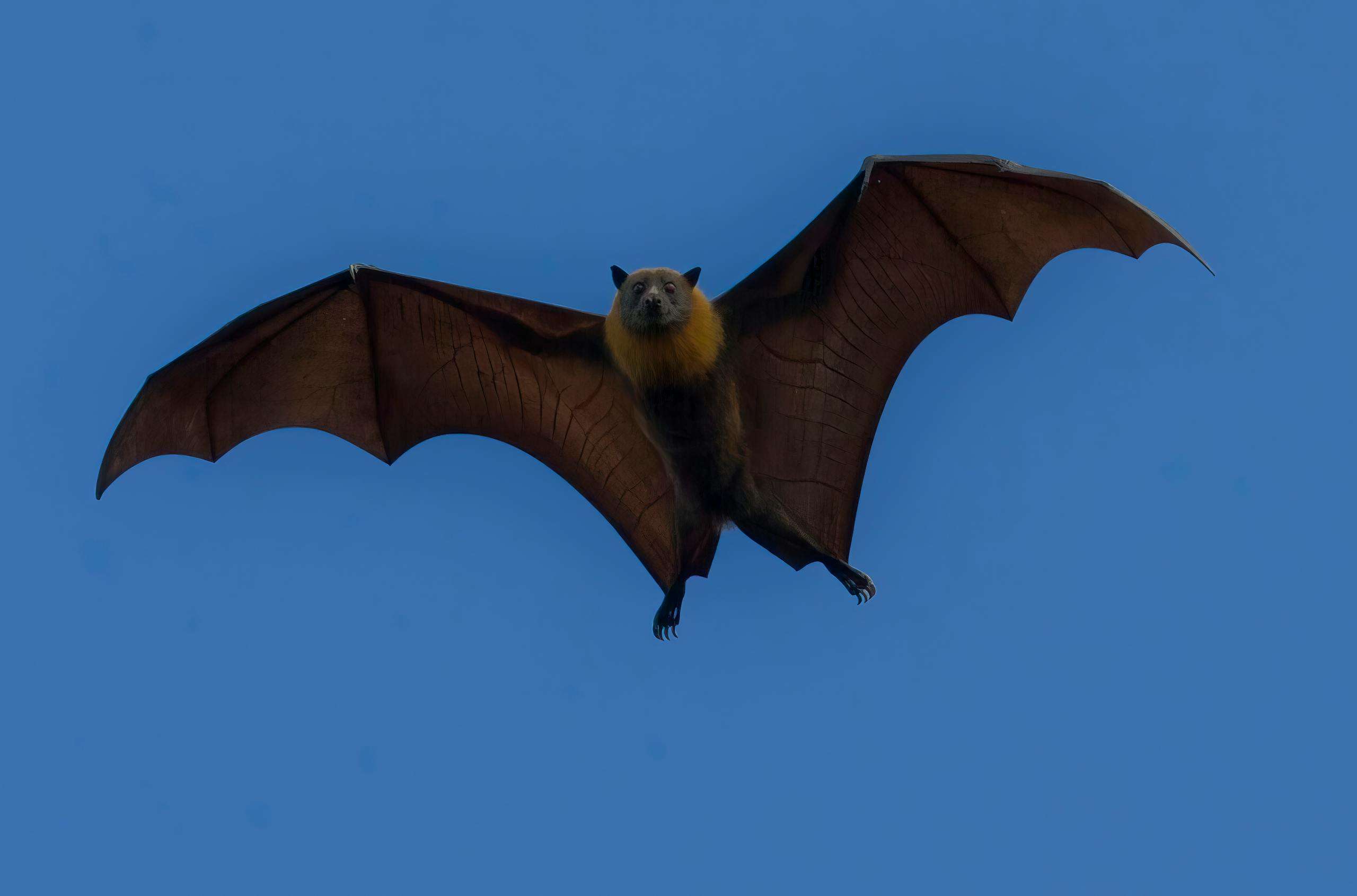
All eighteen resident bat species in Britain are European Protected Species under the Habitats Regulations 2017 – a status that predates Brexit and has been retained in domestic law. Every species, not just the rarer ones. The protection covers the bats themselves and their roosts: it’s illegal to deliberately capture, injure, or kill a bat; to deliberately disturb them; and to damage, destroy, or obstruct access to any roost, whether or not bats are currently using it.
That last point – protection of roosts even when unoccupied – is particularly significant for development. A building that supported a bat roost last summer but is currently empty in January is still a protected roost. Demolishing it in January, when no bats are visible, without having surveyed for roost use and obtained the necessary licence, is still a criminal offence. Plenty of prosecutions have proceeded on exactly that basis.
Britain holds significant populations of several bat species at European scale, which is part of why the protection is maintained robustly. Bats are also slow to reproduce – most species produce only one pup per year – which means population recovery from disturbance is slow and the consequences of roost destruction can persist for years.
When a Bat Survey Is Required
Any development that affects, or might affect, a building, structure, or tree with potential to support bat roosts requires a bat survey before works proceed. Potential is assessed based on the features present – it’s not necessary to have confirmed bat use to require a survey; probable or possible roost potential is sufficient to trigger the requirement.
Features that indicate roost potential in buildings include: gaps in roof tiles or under eaves, holes in external render or brickwork, spaces between roofing felt and the roof structure, accessible voids in walls, gaps around window frames, and any access point into a roof void or loft space. Ivy or dense climbing vegetation on walls provides additional roost potential. Age of the building matters – older buildings, particularly pre-war residential properties and agricultural buildings, tend to have more features of roost potential than modern construction.
For trees, features of roost potential include: cavities and hollows, loose or raised bark, woodpecker holes, splits and cracks in major limbs, and dense ivy growth. Ancient and veteran trees typically have higher roost potential than young trees. Even relatively small trees can support roosts if the right features are present.
The Preliminary Roost Assessment (PRA) – a daytime inspection by a licensed ecologist – is the initial step. It establishes whether potential is negligible (no further survey needed), low, moderate, or high, and recommends the appropriate next steps.
The Survey Process – Stage by Stage
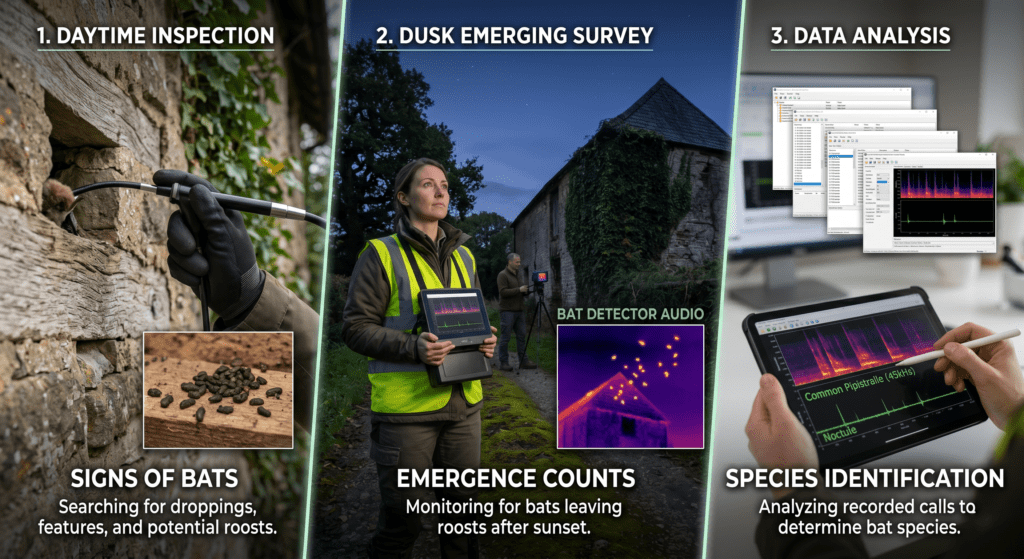
A full bat survey typically progresses through several stages depending on what the PRA finds:
| Survey Stage | What It Involves | When | Required If |
|---|---|---|---|
| Preliminary Roost Assessment (PRA) | Daytime internal and external inspection of the building or tree; assessment of roost potential features | Year-round, though best May to September for access and visibility | Any building or tree potentially affected by development works |
| Dusk emergence survey | Surveyors positioned around the building at dusk recording bats emerging, exit points, species, and numbers using bat detectors | May to September; at least 30 minutes before sunset to 2 hours after | PRA concludes low, moderate, or high potential |
| Pre-dawn re-entry survey | Equivalent to emergence survey but at dawn; bats recorded returning to roost | May to September; 2 hours before sunrise to 30 minutes after | Often required alongside emergence surveys; some roosts more detectable at re-entry |
| Static detector deployment | Automated bat detectors left in position over multiple nights; records bat activity patterns across the site | May to September for most purposes | Wider site activity assessment; habitat connectivity; where roost location uncertain |
| Bat Activity Transect | Walked transect with bat detector recording species and activity along set route | May to September | Where habitat loss or fragmentation is proposed; landscape-scale impact assessment |
Emergence and re-entry surveys need to be repeated – typically a minimum of two surveys, ideally three for buildings with moderate or high potential, at least one of which must be in the optimal period (May to August). Each survey is a separate visit at the right time of day, in suitable weather conditions. Cold, wet, or very windy nights produce suppressed bat activity and surveys conducted in those conditions may not be accepted as adequate. Getting two or three good survey nights into a programme requires some flexibility in scheduling.
Species Matter – Not All Roosts Are Equivalent
Finding bats is one thing. Knowing which species, in what numbers, and what type of roost it is determines the mitigation required and the licence conditions that will apply. A common pipistrelle roost of a dozen individuals in a roof void is managed very differently from a maternity roost of greater horseshoe bats or a hibernation roost of brown long-eared bats.
Roost type classification – day roost, commuting roost, maternity roost, hibernation roost, transitional roost – affects both the seasonal timing of any licensed works and the scope of the mitigation required. Maternity roosts, where females gather to give birth and raise pups, are particularly sensitive and carry the most restrictive conditions – licensed disturbance of a maternity roost is generally only permitted outside the maternity season (broadly June to August).
Rarer species attract more stringent mitigation requirements and more careful scrutiny from Natural England when the licence application is assessed. Lesser horseshoe bats, barbastelle, and Bechstein’s bat are among the rarer species whose roosts require particularly careful management – finding any of these on a development site changes the scale of the mitigation conversation considerably.
What Happens When Roosts Are Found
Confirmed roost presence triggers the need for a mitigation strategy and a European Protected Species licence from Natural England before any works affecting the roost proceed. The mitigation strategy sets out how the works will be timed to minimise disturbance, how the roost will be replaced or compensated for, and how bats will be excluded from the working area before works begin.
Exclusion – fitting one-way devices to roost entry points so bats can leave but not re-enter – is the standard pre-works measure. It needs to be timed correctly: bats must not be excluded during hibernation (roughly November to March) or during the maternity season when pups are present and flightless. The installation of bat boxes or bat bricks in replacement structures is almost always a licence condition.
Our bat survey and assessment services cover the full sequence from the Preliminary Roost Assessment through emergence surveys, licence application, and on-site supervision of licensed works – which keeps the project moving through each stage without gaps between consultants or handover delays.
Frequently Asked Questions
Do I need a bat survey for a domestic extension?
If the extension affects the roof or roof void of an older property, or involves removing trees or garden structures with roost potential, then yes – a PRA at minimum is advisable. Planning officers in many local authorities now routinely request bat surveys for householder applications affecting older buildings or trees. A PRA that concludes negligible potential is quick and cheap. Being asked to commission one after planning is submitted delays discharge of conditions unnecessarily.
Can bat surveys be done in winter?
A Preliminary Roost Assessment can be done year-round. Emergence and re-entry surveys cannot be done in winter – bat activity is too low and the surveys won’t produce results that meet the methodology standards required for planning and licensing purposes. Hibernation surveys of known hibernation roosts can be done in winter but require a licence to access the hibernation site. For most development projects, the practical survey window is May to September.
How long does it take to get a bat licence from Natural England?
Natural England’s standard determination period is thirty working days from receipt of a complete application. Processing times can vary depending on workload and the complexity of the application. Adding the survey programme, report writing, and mitigation strategy design to the licence application timeline, the full process from commissioning surveys to receiving a licence typically runs to several months. Planning this into the programme from the moment a bat survey requirement is identified is what prevents it from becoming a critical path delay.
What if bats are found in a building during works?
Works stop in the affected area. The supervising ecologist is contacted immediately. A licensed bat worker assesses the situation and handles the bat if necessary. Works don’t resume until the ecologist confirms the area is clear and advises on how to proceed. This is the correct response regardless of what species is found or how inconvenient the timing is. Continuing works after a bat is found without a licence is a criminal offence – the risk is not worth taking.
Early Identification, No Programme Impact
Bat surveys are one of those ecological requirements that cause entirely avoidable programme problems when they’re identified late and entirely manageable ones when they’re identified early. The surveys themselves are straightforward. The window is predictable. The licensing process is established. None of it is a mystery – it just needs to be in the programme at the right point rather than discovered as an afterthought.
Commission the PRA as soon as any building or tree with roost potential is identified as being within the scope of works. If the PRA recommends further surveys, get them programmed for the nearest suitable survey window. Don’t wait for planning to be submitted, don’t wait for pre-commencement conditions to be issued. The earlier the surveys happen, the more options remain open for how the development proceeds.

Killingley Insights is the editorial voice of NT Killingley Ltd, drawing on decades of experience in landscaping, environmental enhancements, and civil engineering projects across the UK.