How Long Does Tar and Chip Last? Durability, Maintenance, and Getting the Most from Your Surface

People ask about lifespan early in the conversation. Understandably – if you’re surfacing a long driveway or a stretch of access road, you want to know roughly how long the investment lasts before it needs significant attention. And tar and chip does have a lifespan that varies considerably depending on how it’s installed, what it’s used for, and how it’s looked after in between.
The honest answer is somewhere between eight and twenty years – which is a broad range, and deliberately so. A well-specified, properly installed tar and chip surface on a lightly trafficked rural driveway, with a sound base and occasional maintenance, can perform well for two decades without major intervention. The same process applied over a questionable base, on a surface that takes regular heavy vehicles, and left completely unattended, will be showing significant deterioration inside a decade. Sometimes quite a bit sooner.
What determines which end of that range you end up at is worth understanding from the outset.
What Actually Degrades a Tar and Chip Surface
Several things work against the surface over time, and they don’t all operate at the same rate or through the same mechanism. Understanding them makes the maintenance decisions clearer.
UV degradation is the slow one. Bitumen binder oxidises in sunlight over time – it becomes more brittle, loses its flexibility, and its grip on the aggregate weakens. On south-facing surfaces that get strong direct sun for much of the day, this process is faster than on shaded north-facing approaches. It’s why surfaces in warm, sunny climates like southern Europe need re-dressing more frequently than equivalent surfaces in the north of England. Not a major concern in most of the UK, but it’s the baseline mechanism behind eventual surface wear.
Water infiltration is the more acute problem. Water that gets into the surface – through cracks, through areas where aggregate has been lost, through poorly maintained edge details – works its way down to the binder layer and, over freeze-thaw cycles, expands and contracts in ways that accelerate deterioration. British winters are specifically good at this. A surface that looks fine in September can develop visible cracking and localised failure by March if water has been getting in during the autumn.
Traffic stress is the third factor, and the most controllable. Light domestic traffic on a well-specified surface is relatively gentle. Repeated HGV movements, tight turning, braking and acceleration on gradients – these apply forces that the binder layer has to resist. Where those forces exceed what the specification allows for, the surface fails faster.
Base failure is a separate category – and when this is the cause of surface deterioration, no amount of surface maintenance will fix it. If the sub-base settles, shifts, or becomes waterlogged, the surface above it will crack and rut regardless of how good the original surface dressing was. This is why the base condition is so important at the installation stage and why a thorough assessment of the existing base is essential before any resurfacing work.
Routine Maintenance – What’s Involved and When
Tar and chip is genuinely low maintenance compared to many surface types – but low maintenance isn’t no maintenance. A few relatively simple actions, carried out at the right time, make a significant difference to how the surface performs over its lifespan.
Vegetation control along edges and joints is probably the most important ongoing task. Grass and weeds growing up through edge details or into cracks don’t just look untidy – their root systems physically lift and break the surface as they grow. Keeping edges trimmed and dealing with any vegetation growth promptly prevents minor surface blemishes from becoming structural problems. It’s the sort of thing that takes ten minutes with a strimmer on a quarterly basis. Neglected for a few years, it can become an expensive reinstatement.
Crack sealing. Small cracks – the early-stage oxidation cracking that develops after several years – should be sealed before water gets in. Bitumen-based crack filler is inexpensive and straightforward to apply. The time to do it is when the crack is still narrow and superficial, not after a winter has widened it and the edges have started to delaminate. A surface with well-maintained crack sealing can extend its serviceable life by several years compared to one where cracks are left to progress.
Localised pothole and failed area repair. Where small sections of surface have deteriorated – lost their aggregate cover, developed potholes, or cracked significantly – cutting out the failed area and patching it properly prevents the failure spreading. Pothole repair on tar and chip is straightforward as a small-scale operation and considerably cheaper than waiting until the failed area has grown to a point where a larger resurfacing operation is needed.
Re-Dressing – Extending Lifespan Without Full Replacement
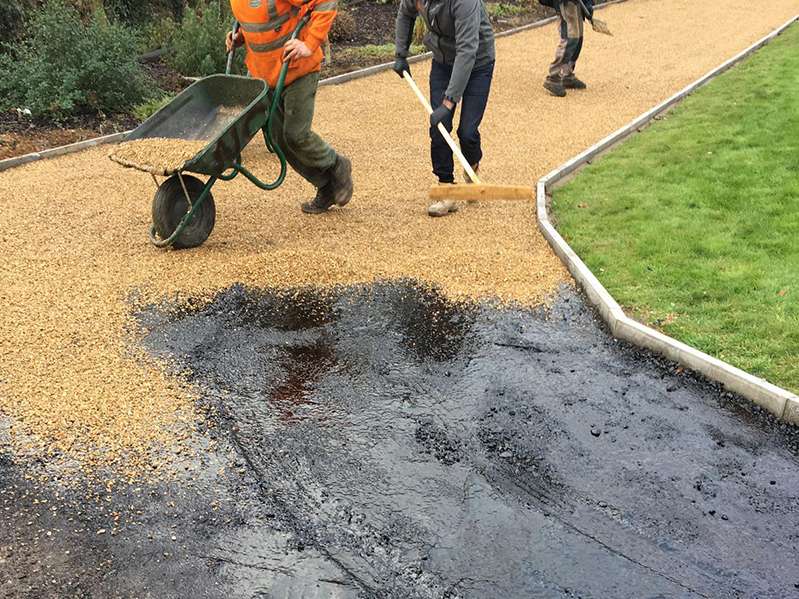
One of the genuine advantages of tar and chip over tarmac is the ability to apply a fresh surface dressing over the existing surface – a re-dress – when the original surface is showing wear but the base and binder layer are still structurally sound. It’s essentially a new wearing course applied over the existing one: fresh bitumen, fresh aggregate, rolled in. It renews the surface texture, restores the waterproofing of the binder layer, and extends the serviceable life of the surface by another ten to fifteen years without the cost of a full strip and replacement.
The timing matters. Re-dressing works when the underlying surface is sound but worn. It doesn’t work when the binder layer has failed structurally, when there’s significant cracking through the full depth of the surface layer, or when the base beneath has settled or failed. A surface that needs re-dressing is one that looks tired and has lost its aggregate cover in places, but where the surface is still intact and stable when you walk on it. A surface that needs reconstruction is one where it’s visibly breaking up, where the base is visible, or where significant areas have potholed through.
Our professional tar and chip installation services include condition assessment of existing surfaces to establish whether re-dressing is viable or whether more substantial work is needed – because recommending a re-dress on a surface that actually needs base work is a short-term fix that creates a longer-term problem.
Maintenance Schedule by Surface Age
Here’s a rough maintenance timeline for a typical well-installed tar and chip surface in normal residential or light commercial use:
| Surface Age | Expected Condition | Recommended Action |
|---|---|---|
| 0 to 6 weeks | Loose chippings settling; some displacement normal | Sweep loose chippings; avoid sharp turns; no heavy vehicles |
| 6 months to 2 years | Surface fully bedded; binder cured; chippings stable | Edge vegetation control; check drainage channels clear |
| 3 to 5 years | Early oxidation may appear; minor edge cracking possible | Seal any cracks; repair edge damage; continue vegetation control |
| 5 to 10 years | Surface wear developing; aggregate cover thinning in trafficked areas | Crack sealing; localised patching; consider condition assessment |
| 10 to 15 years | Significant wear in trafficked zones; possible binder oxidation cracking | Full condition survey; re-dress if base sound; patch repairs as needed |
| 15 to 20 years | Surface approaching end of functional life; dependent on original quality | Re-dress or full resurfacing depending on base condition |
That schedule is for guidance – sites with heavier traffic, steeper gradients, or more challenging ground conditions will move through these stages faster. Sites with lighter use, better drainage, and consistent maintenance will sit at the slower end of the range.
Winter Maintenance Considerations
British winters are the main challenge for any bituminous surface, and tar and chip is no exception. Freeze-thaw cycles do most of the damage – water in cracks expands on freezing, widening the crack, and contracts on thawing, allowing more water in. That cycle repeated over a winter season can turn a hairline crack into a pothole fairly efficiently.
Grit salt used for winter traction doesn’t harm tar and chip in the way it affects some surface types – bitumen-based surfaces are relatively resistant to salt deterioration. So domestic gritting is fine. The risk with grit is actually mechanical rather than chemical – sharp grit particles can accelerate aggregate loss if they’re being driven over repeatedly under tyre pressure. Fine grit rather than coarse is preferable where there’s a choice.
Snow ploughing on tar and chip surfaces needs to be done carefully. A metal plough blade running too low can catch aggregate chippings and strip them from the surface in a way that causes visible damage. Rubber-edged or adjustable-height plough blades set to leave a thin snow layer rather than scraping to bare surface are the right approach. Worth mentioning to whoever manages winter maintenance on the property if that’s not immediately obvious.
Frequently Asked Questions
How do I know when my tar and chip surface needs professional attention?
Key signs are: cracks wider than about 5mm that have been present for more than one season, areas where aggregate has been lost exposing bare bitumen, potholes or depressions forming, and edge details beginning to break up or separate from adjacent features. Any of those warrant a professional assessment rather than just routine maintenance. Early intervention is almost always cheaper than waiting until the problem has spread.
Can I carry out DIY repairs on a tar and chip surface?
For small cracks, cold-pour bitumen crack filler from a builder’s merchant is straightforward to apply and effective. For pothole repairs or areas where the aggregate has been lost, cold-lay bituminous repair material can work for small areas. For anything larger – significant failed areas, edge reinstatement, or preparation for a re-dress – professional repair is more reliable and cost-effective over the long term. DIY repairs with the wrong materials or insufficient preparation tend to fail faster than the original surface.
Does tar and chip need sealing?
Not routinely – the bitumen binder provides its own waterproofing. Specialist bitumen sealer products exist and can extend the surface life by retarding UV oxidation, but they’re not a standard maintenance requirement in the way that, say, block paving jointing sand is. On a surface that’s starting to show oxidation cracking, a bitumen rejuvenator product can help – but at that stage a professional assessment of whether re-dressing is needed is probably more useful than a sealer application.
Will oil or fuel spills damage the surface?
Yes, over time. Petroleum products soften bitumen. A single small oil spill cleaned up promptly won’t cause lasting damage. Repeated or sustained exposure – a regular parking spot where a vehicle with an oil leak sits for months – will soften and eventually degrade the binder in that area, causing the aggregate to loosen and the surface to become tacky. Clean up spills promptly and, if a vehicle has a persistent leak, either fix the leak or use an oil drip tray.
A Surface That Rewards a Little Attention
Tar and chip isn’t demanding. It doesn’t need annual treatment, specialist products, or frequent professional intervention. What it does need is a bit of attention when the signs of wear first appear – cracks sealed before water gets in, vegetation kept off the edges, damage repaired while it’s still small. That level of upkeep isn’t a burden. It’s the difference between a surface that gets to twenty years in decent condition and one that needs expensive work at twelve.
The re-dressing option is genuinely valuable and underused. Most tar and chip surfaces reach the end of their original wearing course life with a base that’s still perfectly sound – throwing away that base investment by going straight to full replacement, when a re-dress would have extended the life by another decade, is a decision worth reconsidering. A proper condition assessment before any resurfacing work is commissioned will establish which approach is right for the specific site.
Get the installation right, maintain it sensibly, and tar and chip will look after itself for a long time. Which is, in the end, exactly what you want from a surface.

Killingley Insights is the editorial voice of NT Killingley Ltd, drawing on decades of experience in landscaping, environmental enhancements, and civil engineering projects across the UK.