Safety Surfacing, Drainage and Layout for Play Areas and MUGAs

It’s funny how play spaces look simple from the outside. A few swings, maybe a multi-use games area, some bright colours, job done. Except it’s never that simple, is it?
Scratch the surface and you’re into compliance standards, impact absorption figures, drainage calculations, fall heights, gradients, edging details, maintenance plans. And that’s before anyone’s even kicked a ball.
I’ve spent enough time around play area and MUGA projects to know where they usually go wrong. Not in the obvious places. It’s the small decisions that seem harmless at the time but come back to bite a year later. Puddles that never quite dry. Surfacing that looks fine but doesn’t perform. Layouts that technically meet the spec but don’t work in real life, especially once British weather does what it does best.
This piece looks at safety surfacing, drainage, and layout together. Not as separate boxes to tick, but as a joined-up system. Because that’s how these spaces succeed. Or fail.
If you’re involved in specifying, funding, or maintaining a play area or MUGA in the UK, this should help you avoid the usual traps. And maybe a few unexpected ones too.
Why safety surfacing decisions matter more than people think
Let’s start with surfacing, because it underpins everything else.
Safety surfacing isn’t about looking colourful or ticking a compliance box. It’s about managing risk sensibly. Kids fall. Teenagers slide. Adults misjudge a step. That part isn’t optional.
What is optional, and often mishandled, is choosing the right surface for the right activity, location, and budget.
Compliance basics, without the fluff
In the UK, play area surfacing generally needs to comply with:
- BS EN 1177 for impact attenuation
- BS EN 1176 for playground equipment requirements
- Sport England guidance for MUGAs and sports surfaces
Those standards focus on critical fall height. In plain English, how far someone can fall before the surface stops being protective.
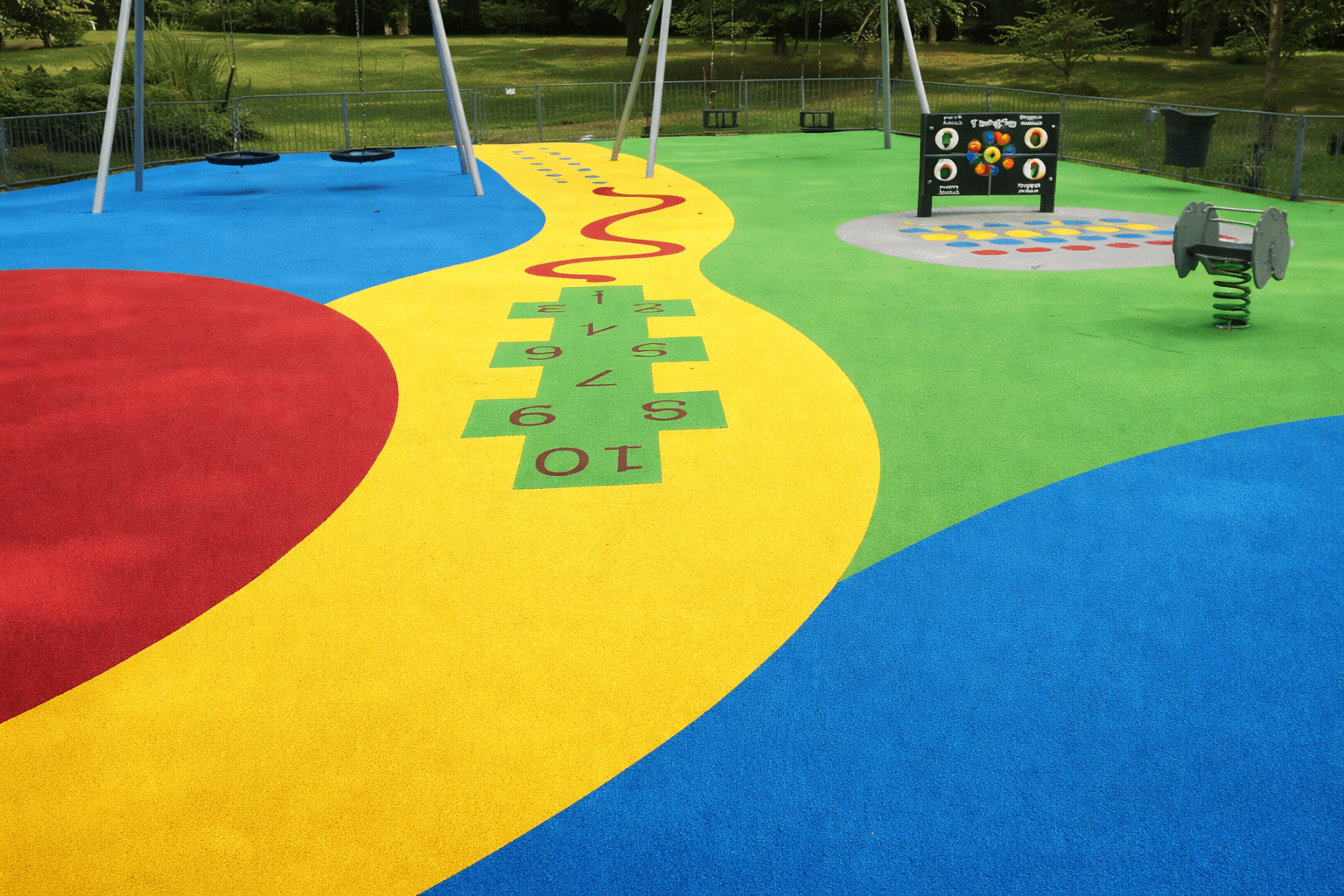
Rubber wet pour, rubber mulch, and certain tiles are commonly used because they can be engineered to meet specific fall heights. Grass matting can too, sometimes. Plain grass rarely does for long.
I was going to say grass is never suitable… but no, that’s not quite right. It can work. Briefly. Until winter arrives, the ground compacts, and suddenly you’ve got mud and exposed sub-base.
Which brings us neatly to drainage.
Drainage: the unglamorous part that decides everything
Nobody gets excited about drainage. Until it fails. Then it’s all anyone talks about.
Poor drainage is probably the single biggest reason play spaces stop being used. Standing water, algae, surface lifting, freeze-thaw damage. All predictable. All avoidable.
Surface water doesn’t disappear by magic
Hard truth: water always finds the lowest point. If your layout, falls, and outlets aren’t thought through properly, you end up funnelling water into exactly the wrong places.
Common drainage approaches include:
- Permeable surfacing systems, where water drains vertically through the surface
- Falls built into the sub-base, directing water away from activity zones
- Perimeter drainage channels to intercept run-off
- Connection to SuDS features, where appropriate
Permeable systems sound ideal. And they can be. But only if the sub-base beneath is designed properly. I’ve seen perfectly good rubber surfaces laid over poorly compacted or silty bases that block drainage within months. At that point, permeability is theoretical.
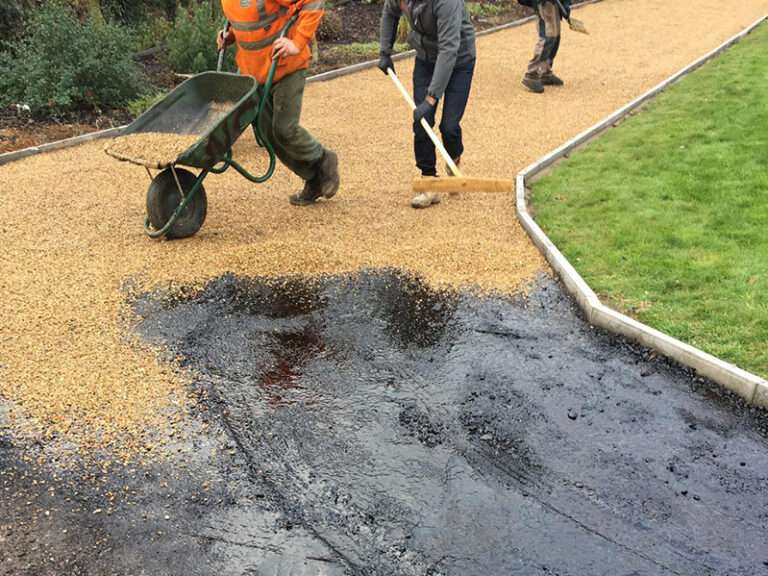
In my experience, the boring bits matter most. Aggregate grading. Compaction. Edge restraint. Things nobody sees in the opening photos.
The relationship between surfacing and drainage
Here’s where people often treat surfacing and drainage as separate decisions. They’re not.
Take wet pour rubber. It’s porous, but only to a point. Heavy rainfall, compacted sub-bases, or clay soils can overwhelm it. Without proper falls and outlets, water sits beneath the surface. Over time, that leads to frost damage and debonding.
Artificial grass for MUGAs has similar issues. Looks tidy. Plays well. But without adequate shockpad permeability and lateral drainage, it becomes a sponge.
One site I remember in the Midlands looked spot on for the first summer. By the following February, it was unusable. Puddles everywhere. Moss creeping in. Parents complaining. The surface hadn’t failed. The drainage had.
Anyway, the point is this. Surface choice should always be made alongside a drainage strategy, not after it.
Layout decisions that quietly improve safety
Layout doesn’t always get the attention it deserves. Everyone focuses on equipment and surfacing, but layout is where behaviour is influenced.
Spacing, orientation, and flow all affect how people use a space.
Separation reduces risk more than signage ever will
Mixing age groups is fine. Mixing activity types is where problems start.
A toddler zone next to a football rebound fence. Not ideal. Neither is a bench placed directly behind a goal.
Good layouts:
- Separate high-energy activities from quieter play
- Use natural movement routes rather than forcing people around obstacles
- Allow clear sightlines for carers and supervisors
- Avoid dead ends that encourage loitering or misuse
And yes, this sometimes means saying no to squeezing everything into a small footprint. More kit isn’t always better.
I’ve found that fewer, better-spaced elements get used more than cluttered layouts with twice the budget.
MUGAs: a different set of pressures
Multi-use games areas bring their own challenges. Harder surfaces, higher impact forces, and a broader age range.
Drainage becomes even more critical here because standing water isn’t just inconvenient. It changes how the surface plays and increases slip risk.
Typical MUGA surfacing options
Here’s a quick comparison, because people always ask.
| Surface Type | Drainage Performance | Maintenance | Typical Lifespan |
|---|---|---|---|
| Polymeric rubber | Moderate | Low | 8–10 years |
| Artificial grass | Good if designed well | Medium | 10–12 years |
| Porous macadam | Very good | Medium | 15+ years |
| Acrylic over asphalt | Poor unless sloped | Medium | 7–9 years |
No perfect answer here. Just trade-offs.
Porous macadam drains brilliantly but feels harder underfoot. Artificial grass is popular but needs regular brushing and inspection. Acrylic looks smart but demands precise falls.
Pick based on usage, not fashion.
Impact absorption isn’t just for playgrounds
It’s easy to forget that MUGAs also involve falls. Slips. Collisions. Especially with younger users.
Shockpads beneath artificial grass or rubberised systems can reduce injury risk significantly. Sport England guidance often recommends them, particularly for school settings.
Is it mandatory? Not always. Is it sensible? Usually, yes.
Budget pressures often squeeze these elements out. Short-term saving. Long-term regret.
Accessibility and inclusivity, done properly
Inclusive design gets mentioned a lot. Implemented properly… less so.
Smooth transitions between surfaces. Adequate turning circles. Sensible gradients. Firm, stable surfacing routes. These aren’t extras. They’re fundamental.
Rubber surfaces can work well for inclusive access, provided edges are flush and gradients stay within guidance. Loose-fill surfaces rarely do, no matter how well intentioned.
I find that when accessibility is considered early, it barely affects cost. When it’s added late, it becomes a faff.
Weather, because we’re in the UK
This feels obvious, but it still gets overlooked.
We design for rain. Persistent rain. Sideways rain. Freeze-thaw cycles. Not the brochure version of a sunny park.
Materials expand and contract. Water freezes. Leaves fall. Algae grows.
Surfaces need to cope with all of that without becoming hazardous or unusable.
If you’re specifying for a shaded site under trees, factor in leaf litter and moisture retention. If the site’s exposed, think about wind-blown debris and drainage capacity.
And if someone says “it’ll probably be fine”, that’s usually the moment to pause.
Long-term usability beats day-one appearance
Freshly installed surfaces always look good. The question is how they perform after five winters, a heatwave or two, and constant use.
Maintenance requirements should be clear from the start. Who cleans it. How often. What happens if damage occurs.
Surfaces that are slightly less flashy but easier to maintain often outlast more expensive options in real-world conditions.
That’s why decisions around safety surfacing for play areas need to be grounded in how the space will actually be used, not just how it looks in a visual.
Common mistakes I keep seeing
Some patterns repeat. Over and over.
- Ignoring sub-base design
- Flat surfaces with nowhere for water to go
- Mixing incompatible surface systems
- Poor edge detailing
- No allowance for maintenance access
None of these are dramatic errors. They’re small oversights. Which is why they slip through.
But collectively, they shorten lifespan and increase risk.
FAQs people usually ask, sooner or later
Do permeable surfaces mean no drainage is needed?
No. They reduce surface water, but they don’t replace proper falls and outlets.
Is wet pour always safer than tiles?
Not necessarily. Performance depends on thickness, installation quality, and sub-base.
Can existing surfaces be improved without full replacement?
Sometimes. Drainage retrofits, edge repairs, and localised resurfacing can extend life. But there are limits.
How long should a play surface last?
With proper design and maintenance, 8–15 years is realistic, depending on material and usage.
Bringing it all together
Good play areas and MUGAs don’t happen by accident.
They work because surfacing, drainage, and layout are designed as a system. Each decision supports the others. Each compromise is understood.
When that happens, spaces stay usable. Safer. More inviting. Less hassle for everyone involved.
And when it doesn’t… well, you’ve probably seen the results.
Conclusion
If there’s one takeaway, it’s this. Safety surfacing isn’t just about cushioning falls. Drainage isn’t just about avoiding puddles. Layout isn’t just about fitting equipment in.
They’re all connected. Miss one, and the others suffer.
In my experience, the best projects are the ones where someone slows down early, asks awkward questions, and refuses to gloss over the dull bits. Those are the spaces that still work years later, long after the ribbon-cutting photos are forgotten.
Properly sorted, they just get on with the job. Rain or shine. Probably raining.

Killingley Insights is the editorial voice of NT Killingley Ltd, drawing on decades of experience in landscaping, environmental enhancements, and civil engineering projects across the UK.