Designing Safe and Inclusive Play Spaces with Modern Play Equipment and MUGAs

Playgrounds and MUGAs have a funny habit of fading into the background. You walk past them with the dog. You cut through them on the school run. Kids pile in after lessons and spill out again an hour later. Ordinary stuff.
Except it isn’t. Not really.
Because the way a play space is designed quietly decides who feels welcome, who hangs back, and who never even bothers turning up. I’ve seen it loads of times. A shiny new park that technically ticks all the boxes, yet somehow ends up used by the same narrow group every day. Meanwhile, other kids hover at the edges. Parents sit awkwardly. Teenagers drift off somewhere else.
That’s the bit that stings. Good play spaces are social infrastructure, whether the planning documents say so or not. Get them right and you’ve got a place that works for toddlers, teens, wheelchair users, nervous parents, bored siblings, and the odd grandparent leaning on a fence. Miss the mark and you’ve built an expensive ornament.
So, let’s talk about how to design them properly. Not perfectly. Properly.
Inclusion is more than ramps and rubber surfacing
Accessibility tends to get boiled down to a checklist. Paths wide enough. Gates with the right clearance. Surfacing that meets standards. All important, obviously. But inclusion goes further than that, and pretending otherwise is a bit of a cop-out.
I find that the most inclusive play spaces think about confidence, not just compliance.
Some children charge straight into the middle of things. Others need to watch first. A quiet corner, a sensory element, somewhere to pause without feeling “in the way”. Those details don’t scream accessibility on a spec sheet, yet they make a massive difference on the ground.
And then there’s social inclusion. Spaces where kids of different ages can overlap without clashing. Where a child with additional needs isn’t isolated on a single piece of “special” equipment off to one side. Segregation, even when well-meaning, rarely works.
Sometimes inclusion looks messy. A bit untidy. Less symmetrical. That’s usually a good sign.
Modern play equipment – not just brighter plastic
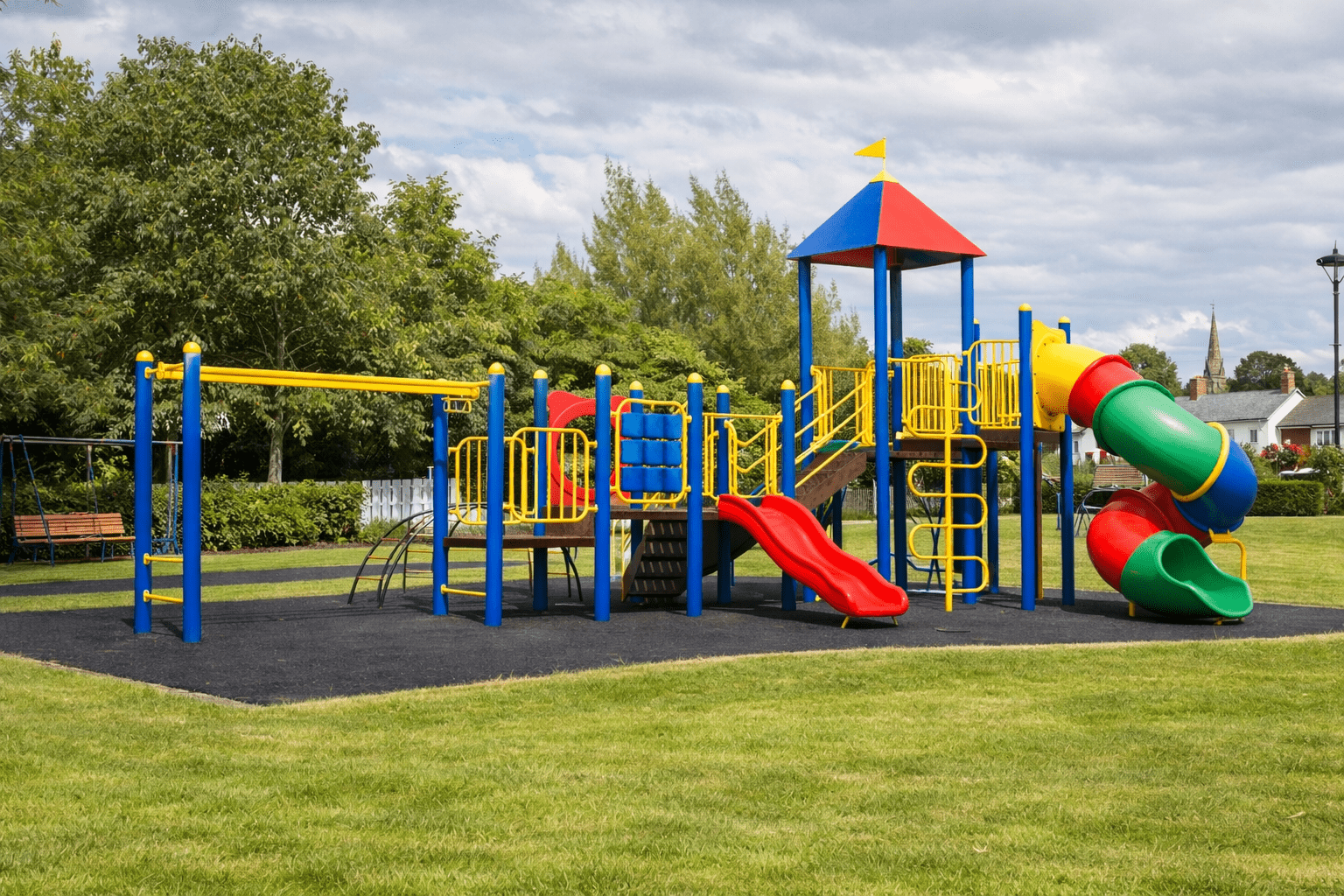
Play equipment has moved on a long way from the old days of one slide, two swings, and a roundabout that made you question your life choices.
Modern kit is more varied, more adaptable, and, when chosen well, more inclusive by default.
Think of equipment that offers different ways to engage. Climb it. Sit on it. Spin gently or go full tilt. Same structure, different experiences. That’s gold dust for mixed-ability play.
And yes, materials matter. Not just for durability, but for feel. Timber elements feel warmer and more forgiving than solid steel. Textures matter too, especially for sensory play. Smooth, rough, flexible, fixed. Variety keeps people interested.
One thing I keep coming back to is sightlines. Can carers see what’s going on without hovering? Can kids see where they’re heading next? Play spaces shouldn’t feel like obstacle courses unless that’s the point.
MUGAs – brilliant, blunt instruments if you’re not careful
Multi-Use Games Areas are everywhere now. Housing developments. School grounds. Public parks squeezed between roads and fences. They’re popular because they promise flexibility.
And they deliver. Mostly.
But MUGAs can easily become exclusive spaces if you’re not careful. Five-a-side football takes over. Loud voices dominate. Younger kids, beginners, or anyone not confident with a ball gets edged out.
Design can soften that. Multiple entry points help. Clear markings for different activities, not just football. Seating that invites spectators rather than deters them. Even the choice of fencing height changes how enclosed or intimidating the space feels.
In my experience, the best MUGAs are the ones that accept they can’t be everything at once. They’re programmed, informally or otherwise, for different uses at different times. After school chaos. Quieter mornings. Weekends that feel more relaxed.
Flexibility doesn’t mean free-for-all.
Age-appropriate design without hard lines
One of the trickiest bits is catering for different ages without carving the space into rigid zones. Toddlers here. Big kids there. Teenagers somewhere else, preferably out of sight.
Life doesn’t work like that.
Families arrive as mixed groups. Older siblings get bored watching younger ones. Younger kids want to copy what the big ones are doing. Separating everything can kill that natural flow.
Better to think in gradients. Equipment that scales in challenge. Routes that get more complex the further you go. Spaces that overlap just enough to allow interaction without constant collisions.
And yes, teenagers matter. If they’re ignored, they’ll claim the space anyway, just not in ways anyone planned for. A MUGA helps, but so do informal hangout spots. Benches that don’t scream “designed for toddlers’ parents”. Sheltered areas. Somewhere to lean, chat, mess about a bit.
Otherwise they’ll head to the bus shelter. Or the car park. You know how that goes.
Safety – sensible, not suffocating
Safety is non-negotiable. No one’s arguing for rusty bolts and ankle-breaking surfaces. But there’s a difference between managing risk and eliminating challenge altogether.
Play needs a bit of uncertainty. A wobble. A height that makes your stomach flip slightly. That’s how kids learn limits.
Modern standards allow for this, if you read them properly. The problem is fear. Fear of complaints. Fear of liability. Fear of headlines.
Good design balances perceived risk with real risk. Clear fall zones. Proper surfacing. Equipment that challenges without being reckless. Sightlines that let carers relax without hovering like nervous hawks.
Over-sanitised play spaces are dull. Dull spaces get abandoned. And abandoned spaces feel unsafe anyway. Funny how that works.
Accessibility across the whole journey, not just the equipment
One thing that gets overlooked is how people reach the play space in the first place. Paths, kerbs, gradients, crossings. All part of the experience.
A perfectly accessible playground is useless if the route to it involves navigating broken paving or a steep, cambered path that sends wheelchairs drifting sideways. I’ve seen it more times than I care to admit.
Inclusive design looks at arrival points. Where do buggies stop? Where do bikes go? Can someone with limited mobility enter without asking for help? Small details, big signals.
Once inside, rest matters. Seating at different heights. Backrests. Arms. Shade, ideally. Not everyone can stand around for an hour watching kids play, especially on one of those muggy British afternoons when the sun decides to show up just to be awkward.
Community use – designing for real life, not brochures
Here’s the thing. Play spaces don’t live in isolation. They sit in estates, villages, towns, parks. Surrounded by people with opinions.
Designing for inclusive use means thinking beyond children. Morning dog walkers. After-school clubs. Weekend kickabouts. Community events. Even the odd fitness class spilling over from elsewhere.
Lighting, for example. Enough to feel safe, not so much it annoys nearby residents. Drainage that copes with proper British rain, not the optimistic drizzle some plans seem to assume. Durable finishes that don’t look wrecked after six months.
And maintenance. Always maintenance. A space that’s a bit scruffy but cared for feels safer than one that was pristine once and then forgotten.
If you’re planning something that’s meant to last, it’s worth understanding how a professional playground installation service approaches layout, materials, and long-term usability rather than just the initial build.
Inclusive play spaces only work when design and delivery are properly joined up. It’s one thing to specify accessible equipment, age-appropriate challenges, and shared-use layouts on paper, but it’s the installation stage where those ideas either hold together or quietly fall apart. Gradients, surfacing transitions, fixing tolerances, access routes – all the unglamorous bits – are what determine whether a space genuinely works for mixed ages and abilities day to day. That’s why projects that involve an experienced playground installation service tend to feel more natural and better used once they’re open, because the design intent survives contact with real ground conditions, real users, and real British weather.
Frequently asked questions, answered without the fluff
Do inclusive play spaces cost more?
Short answer. Sometimes, a bit.
Longer answer. Not as much as people fear. Inclusive design done early saves money later. Retrofitting ramps, widening paths, or replacing unsuitable equipment costs far more than getting it right from the start.
Also, inclusive spaces tend to be better used. That’s value, even if it doesn’t show up neatly on a spreadsheet.
Are MUGAs suitable for all communities?
Probably. But not automatically.
They work best where there’s demand and enough space to avoid noise becoming an issue. In tighter residential areas, thoughtful orientation, fencing choices, and surface selection make a huge difference.
Ignoring context is where things go wrong.
How do you balance different age groups?
You don’t separate them completely. You design overlap. Gradients of challenge. Spaces that invite observation as well as participation.
And you accept a bit of messiness. Real life isn’t zoned.
What about vandalism?
It happens. Designing with robust materials, good visibility, and community buy-in helps. Spaces that are loved get looked after. Spaces that feel imposed tend not to.
There’s no magic fix. Just sensible decisions layered together.
UK context – estates, schools, and public parks
In new housing developments, play spaces often get squeezed into leftover corners. Odd shapes. Awkward boundaries. It’s tempting to treat them as obligations rather than opportunities.
That’s a mistake.
Those spaces become daily destinations. Somewhere kids can reach on foot. Somewhere parents bump into each other. Somewhere a community quietly forms.
School playgrounds face different pressures. High use. Tight budgets. Clear safeguarding concerns. MUGAs here can be brilliant, especially when they double as community facilities out of hours. Shared use spreads cost and builds connection, provided it’s managed properly.
Public parks sit somewhere in between. They need to feel open, welcoming, and safe without becoming bland. Not easy, but doable with thoughtful design.
A small tangent – weather, because Britain
Quick aside. Weather matters. More than we admit.
Sun, rain, wind. Shade structures aren’t luxuries. Neither are surfaces that don’t turn into skating rinks in winter or frying pans in summer. Covered seating gets used far more than people expect.
Designing for a mythical average day misses the point. Design for drizzle. Design for heatwaves. Design for that weird February day that’s sunny but freezing.
Anyway. Back to play spaces.
Measuring success – not just footfall
How do you know if a play space is working?
Numbers help. Usage counts. Dwell time. Repeat visits. But some of the best indicators are softer.
Do different age groups mix? Do people stay longer than they planned? Are carers relaxed or constantly on edge? Do kids invent their own games rather than just queue for equipment?
I’ve stood in plenty of parks where you can feel the difference straight away. One buzzes. The other feels flat. Hard to quantify, but obvious once you’ve seen enough of them.
Final thoughts – design with humility
Designing safe and inclusive play spaces isn’t about showing off. It’s about listening. To users, to context, to the quiet signals people give when something works or doesn’t.
Standards matter. Experience matters more.
Get the basics right. Think about people who aren’t like you. Accept that you won’t predict everything. Leave room for adaptation.
And remember, the best play spaces don’t shout about being inclusive. They just are.

Killingley Insights is the editorial voice of NT Killingley Ltd, drawing on decades of experience in landscaping, environmental enhancements, and civil engineering projects across the UK.