Designing Public Spaces with Modular Paving: Where Durability Meets Distinctive Design

Public spaces in the UK are under more pressure than ever. Town centres are being reimagined, high streets are trying to lure people back from online shopping, and local authorities are balancing tight budgets with big expectations. And right at the heart of most of these schemes sits something deceptively simple – paving.
It’s easy to overlook it. After all, paving is just… paving, isn’t it? Slabs. Blocks. Stone. Something you walk on. But spend five minutes in a busy square in Sheffield, a regenerated waterfront in Hull, or a pedestrianised stretch in Derby and you’ll notice it’s doing far more than that. It’s directing movement, framing views, defining seating areas, and quietly coping with thousands of footsteps a day.
And that’s where modular paving starts to shine.
Why Modular Paving Works So Well in Public Realm Projects
Durability is the obvious starting point. It has to be. British weather alone is enough to test any surface – freeze–thaw cycles in January, baking sun in July, then sideways rain in October that seems to go on for weeks. Add gritters, street sweepers, delivery vehicles cutting across pedestrian zones and the occasional festival crowd, and suddenly that “simple” surface has a tough job on its hands.
Modular systems cope with this kind of punishment far better than monolithic slabs. Individual units can flex slightly, settle with the sub-base, and – crucially – be replaced if damaged. No need to rip up an entire plaza because of one cracked section.
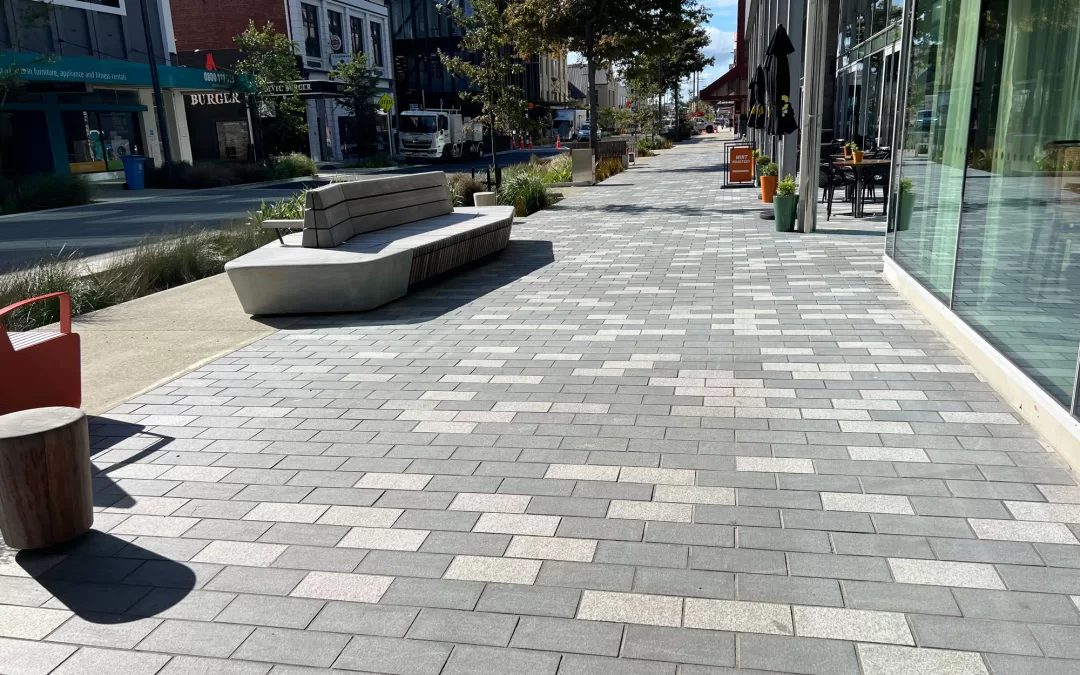
From a design point of view, though, the flexibility is what excites most architects. Different formats. Varying colours. Contrasting textures. You can create subtle zoning – almost invisible cues that guide people without a single signpost. I’ve seen schemes where the paving quietly shifts tone to mark a crossing point, or where a tighter block pattern signals a café spill-out area.
Clever. And dead practical.
The Engineering Beneath the Surface
Funny thing is, most people only see the top layer. The visual impact. But the real success of modular paving lies underneath.
In public realm schemes across the UK, build-ups are typically designed around a robust sub-base – often Type 1 or a similar engineered aggregate – compacted in layers to achieve load-bearing performance. On larger schemes, you might have:
| Layer | Typical Material | Purpose |
|---|---|---|
| Surface | Concrete or natural stone modular units | Aesthetic finish and wear layer |
| Bedding course | Sharp sand or mortar | Level adjustment and load distribution |
| Sub-base | MOT Type 1 or equivalent | Structural support |
| Geotextile | Woven or non-woven membrane | Separation and stability |
| Formation | Prepared ground | Base level for construction |
Now, that’s a simplified snapshot. Site conditions in, say, Nottinghamshire clay aren’t the same as coastal ground in Lincolnshire. Drainage strategy changes things. So does vehicle access. But the principle holds.
When these layers are designed and installed properly – no shortcuts, no “that’ll do” moments – modular paving becomes incredibly resilient.
And if you’re curious about how this fits into wider hard landscaping works, we deliver modular paving solutions for public realm projects as part of integrated town centre, highways and civic space schemes.
That page sits within the broader hard landscaping expertise delivered across public spaces and highways Hard Landscaping – NT Killingle…, which gives a sense of how paving integrates with kerbs, steps, street furniture and structural elements.
Visual Impact Without Compromising Strength
Here’s the odd bit. People sometimes assume that “decorative” means delicate. It doesn’t.
Concrete block systems now come in finishes that mimic natural granite or sandstone, with high compressive strengths and excellent slip resistance. You can introduce contrasting bands, circular features, even bespoke patterns without sacrificing performance.
In my experience, the most successful public spaces avoid over-design. A restrained palette – perhaps two complementary tones – tends to age better than an overcomplicated mosaic. I was going to say bold patterns never work… but that’s not quite fair. They can, if the context supports it. Think civic squares rather than narrow high streets.
And then there’s tactile paving. A legal requirement, yes. But it doesn’t have to look bolted on. Integrated properly, it becomes part of the visual language rather than an afterthought.
Handling Heavy Footfall and Occasional Vehicles
High footfall areas – transport interchanges, market squares, university campuses – demand something that won’t rut, shift or polish smooth over time.
Modular paving performs well here because loads are distributed across multiple units. Compare that with large format slabs. If one corner settles, the entire slab can rock. That rocking leads to cracks. Cracks lead to trip hazards. And then the maintenance budget starts groaning.
Block systems, by contrast, spread loads through jointing sand and interlock. Individual replacement is straightforward. You lift, reset, recompact. Job done.
Occasional vehicle loading – maintenance vans, refuse vehicles, emergency access – can be accommodated by increasing unit thickness or upgrading the sub-base specification. It’s about design foresight. Not guesswork.
Sustainability and Longevity – More Than a Buzzword
Let’s be honest, “sustainability” gets thrown around a lot. But in paving terms, it comes down to a few practical factors.
Firstly, lifespan. A well-installed modular paving scheme can last decades. That reduces replacement cycles and embodied carbon over time.
Secondly, repairability. Replacing a handful of blocks rather than an entire slab reduces waste.
Thirdly, permeability. Permeable block systems allow surface water to infiltrate, reducing pressure on drainage networks. In flood-prone towns – and there are plenty across the Midlands and Yorkshire – this is a serious consideration.
And yes, sourcing matters. Locally produced materials reduce transport miles. Recycled aggregates in sub-bases help too.
It’s not glamorous. But it adds up.
Common Questions About Modular Paving in Public Spaces
Is modular paving more expensive than standard slabs?
Upfront, sometimes. Especially when bespoke colours or finishes are specified. However, lifecycle costs often favour modular systems because of ease of maintenance and repair.
Does it require more maintenance?
Not necessarily. Regular sweeping and occasional joint re-sanding is typical. Weed growth can be an issue if maintenance is neglected – but that’s true of most surfaces.
Can it cope with British weather?
Yes. High-quality units are tested for freeze–thaw resistance and slip performance. Proper drainage design is key. Standing water is the enemy, not the paving itself.
What about accessibility?
Modular paving can meet stringent accessibility standards when laid to tight tolerances. Smooth transitions, consistent joint widths and integrated tactile elements make it suitable for inclusive design.
Integrating Paving with the Wider Hard Landscape
Paving never sits in isolation.
It interacts with kerbs, steps, retaining walls, planters, lighting columns, seating and tree pits. In fact, some of the most impressive schemes I’ve seen use paving to tie all these elements together – subtle alignment lines, coordinated colours, consistent detailing.
Within broader hard landscaping frameworks Hard Landscaping – NT Killingle…, modular paving often forms the backbone of the public-facing surface while structural elements handle level changes and load transitions.
Get the detailing wrong, and even the best paving units will struggle. Get it right, and the entire space feels coherent. Properly sorted.
Design Considerations That Make a Difference
Here are a few factors designers and contractors quietly obsess over:
- Joint width consistency – small deviations can create visual noise.
- Edge restraint strength – without it, the whole system can creep.
- Drainage falls – subtle gradients prevent ponding.
- Colour ageing – lighter tones can show staining; darker tones hide it better.
And then there’s phasing. Town centre projects rarely allow full closures. Working in sections, maintaining pedestrian access, coordinating with traders – it’s a logistical puzzle. Modular systems help because smaller areas can be completed and reopened quickly.
Bit of a faff at times. But manageable.
Case Study Snapshot – Typical UK Town Centre Upgrade
Imagine a mid-sized market town in Derbyshire. Ageing concrete flags. Frequent trip complaints. Patch repairs everywhere. Local authority wants a refresh that looks contemporary but respects heritage buildings.
Solution? Replace large flags with a modular concrete block system in two complementary tones. Introduce granite sett bands to frame crossing points. Upgrade sub-base where needed. Integrate new seating areas and tree pits.
Outcome? Improved durability. Cleaner visual lines. Reduced maintenance interventions. And traders noticing – quietly – that the place feels more inviting.
Hard to quantify exactly how much paving alone contributes to economic uplift. But perception matters. People linger longer in spaces that feel considered.
A Few Honest Realities
Not every site suits modular paving. Very large, open civic plazas sometimes benefit from larger format units for visual scale. Heritage settings may demand natural stone to match existing fabric.
And poor installation can ruin even premium materials. I’ve seen beautiful blocks laid on poorly compacted bedding that start to dip within months. It’s frustrating.
Quality control on site is everything.
Bringing It All Together
Designing public spaces isn’t just about how something looks on day one. It’s about how it performs on year five, year ten, year twenty.
Modular paving offers a balance that’s hard to beat – structural resilience combined with visual flexibility. It allows designers to shape movement, create character and respond to context, all while meeting the brutal demands of British weather and public use.
So yes, it’s “just paving”.
But done properly, it’s far more than that.
And in a world where town centres are fighting for relevance, where councils are scrutinising every pound spent, and where communities expect both durability and beauty, modular paving quietly delivers.
Sorted.

Killingley Insights is the editorial voice of NT Killingley Ltd, drawing on decades of experience in landscaping, environmental enhancements, and civil engineering projects across the UK.