When Are Full Tree Surveys Required? A Straight-Talking Guide for Planning and Construction

Trees don’t usually shout for attention. They just… sit there. Growing quietly. Until a planning application lands, a digger turns up, or a neighbour spots fencing going in and suddenly everyone’s very interested in that oak by the boundary.
If you’re working on a construction or development project in the UK, one of the most common questions is also one of the vaguest:
Do we need a full tree survey here?
The annoying answer is “it depends”. The useful answer is what this piece is about.
Because tree surveys aren’t just paperwork for planners. They’re about risk, responsibility, and avoiding a proper mess later on. And yes, I’ve seen more than one project grind to a halt over a tree someone thought was irrelevant.
Let’s get into it. Not too neatly.
First things first – what counts as a “full” tree survey?
Before we talk about when one is required, it’s worth clearing up what we’re even discussing.
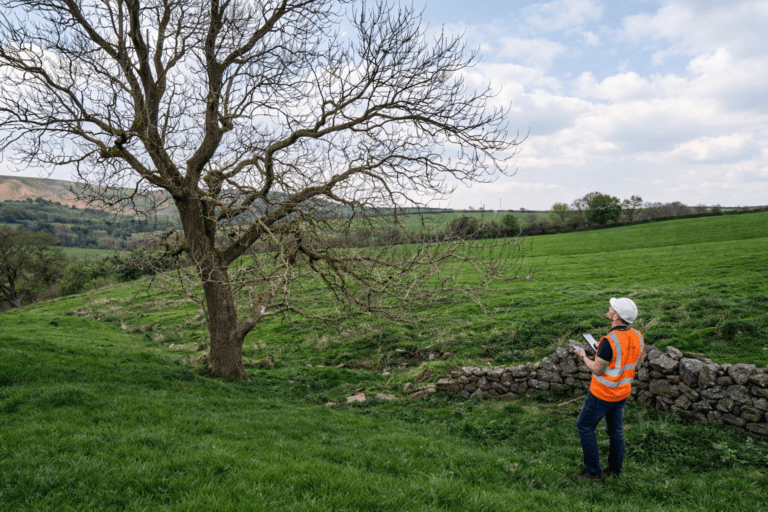
A full tree survey is a detailed, on-site assessment of trees that could be affected by development or construction works. Not just “there are trees here”. Much more than that.
It usually includes:
- Species identification
- Height, stem diameter and crown spread
- Physiological health and structural condition
- Estimated remaining life expectancy
- Constraints on development, including Root Protection Areas
- Recommendations tied to planning and construction stages
When planning is involved, surveys typically align with BS5837. Not because it’s trendy. Because local authorities expect it.
Anything less than that and you’re probably not meeting the bar. Which leads us neatly to…
Planning permission – the most common trigger
Planning is where tree surveys come up most often. And also where confusion sets in.
If you’re submitting a planning application and there are trees on or near the site, assume a survey will be needed unless proven otherwise. Councils don’t tend to gamble on trees being irrelevant.
Situations where surveys are routinely required:
- New housing developments, even small ones
- Commercial builds and extensions
- Change of use involving construction works
- Infrastructure projects – roads, services, drainage
- Development near boundaries with neighbouring trees
And it’s not just trees inside the red line. Overhanging canopies and underground root systems don’t respect ownership boundaries. Planning officers know that.
In practice, most local authorities will either request a tree survey at validation stage or flag it shortly after submission. Neither is ideal timing, by the way.
Conservation areas and Tree Preservation Orders
Things tighten up significantly when protection comes into play.
If your site sits within a conservation area, all trees with a stem diameter over 75mm (measured at 1.5m above ground) are protected by default. No exceptions. Even self-seeded trees that look… well, scruffy.
Tree Preservation Orders are even stricter. They apply to individual trees, groups, or woodlands, regardless of planning status.
In both cases, a full tree survey isn’t just advisable. It’s essential.
And not just to identify the trees, but to demonstrate how your proposals avoid or mitigate harm. Without that evidence, planning applications rarely get far.
Construction without planning – still relevant?
Here’s where people get caught out.
Just because a project doesn’t need planning permission doesn’t mean trees can be ignored. Permitted development rights don’t override tree protection legislation or health and safety duties.
Examples where surveys are still relevant:
- Extensions close to mature trees
- Groundworks near boundaries
- Utility installations or drainage works
- Temporary site compounds or access routes
I’ve seen projects rely on permitted development rights, start work, then receive enforcement notices because roots were damaged or protected trees affected. Not a good look.
At that point, surveys become retrospective. Which is never comfortable.
The role of tree surveys in construction risk management
Planning aside for a moment, there’s a practical reason surveys matter on site.
Trees fail. Branches drop. Roots heave. And when construction activity increases load, vibration, or soil disturbance, the risk profile changes.
A proper survey identifies:
- Structural defects that could pose a danger during works
- Trees requiring protection fencing or exclusion zones
- Areas where ground protection is needed
- Constraints on crane oversailing or scaffold positioning
Health and safety legislation doesn’t give much sympathy to “we didn’t think that tree was an issue”.
Risk assessments rely on baseline data. Tree surveys provide it.
Timing – earlier than you think
This is where I’ll be a bit opinionated.
Most problems I see with tree surveys come down to timing. They’re commissioned too late. Layouts are already fixed. Design work is “done”.
Then the survey lands and starts asking awkward questions.
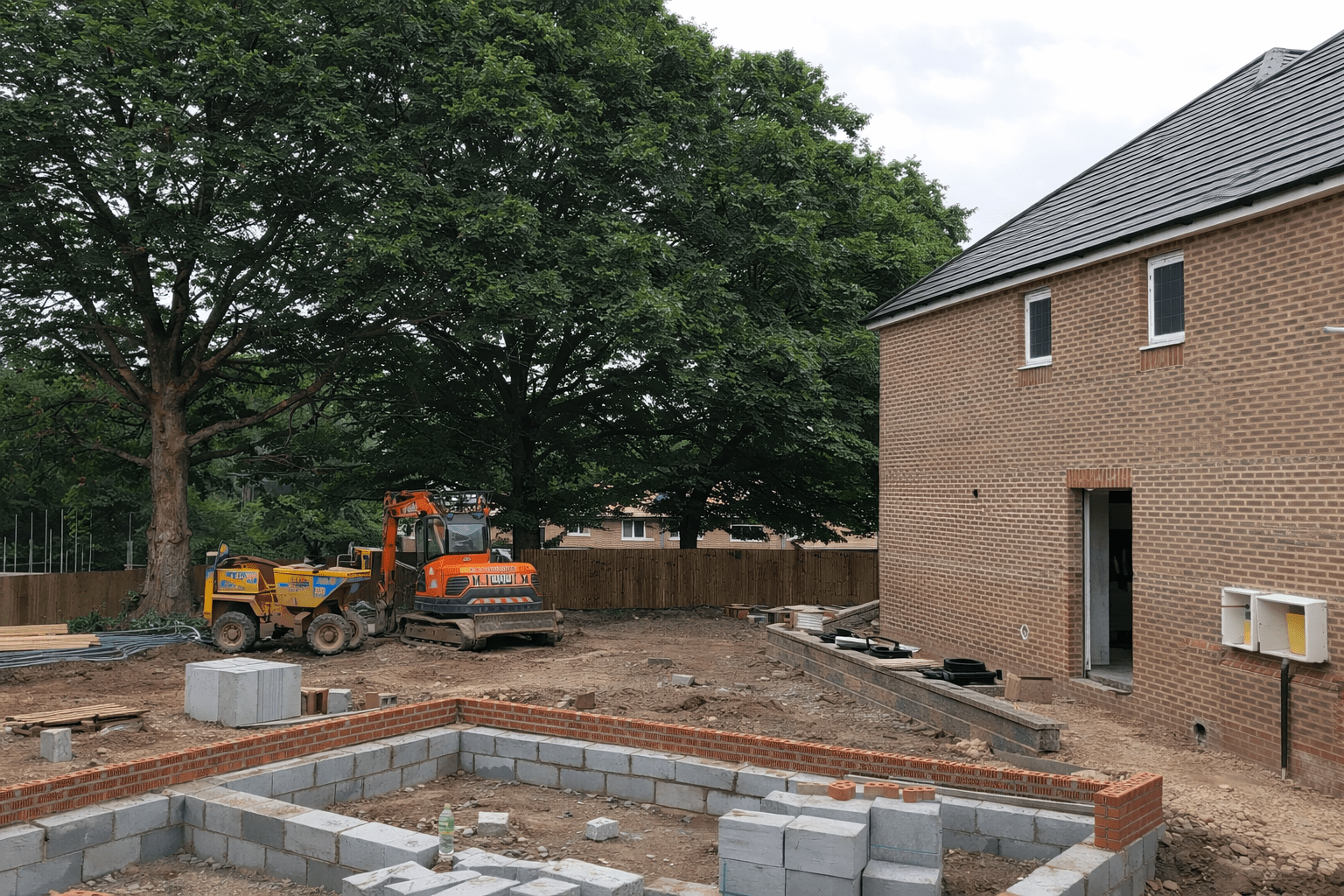
Root Protection Areas cutting through proposed footprints. Access roads running straight across retention zones. Drainage trenches where roots really don’t want them.
At that stage, everyone’s stressed. Changes feel painful. Costs creep.
Commissioning surveys early – before layouts are locked in – makes life easier. Designers can work with constraints instead of fighting them.
Simple idea. Rarely followed.
Domestic projects – do homeowners need to care?
Short answer: sometimes.
For small domestic works, surveys aren’t always required. But there are plenty of exceptions.
You’re more likely to need one if:
- Trees are protected or in conservation areas
- Large trees sit close to foundations
- Neighbouring trees could be affected
- Ground levels are changing
Planners are increasingly cautious with domestic developments, particularly in established neighbourhoods where tree cover contributes to character. Places like leafy parts of Nottingham, Sheffield, or suburban Derby – you know the type.
One overlooked beech can derail a loft conversion just as easily as a housing estate.
How local authorities decide when to ask for surveys
Councils don’t all behave identically, but patterns exist.
Factors influencing survey requirements include:
- Number and size of trees
- Visibility and amenity value
- Ecological considerations
- Proximity to proposed works
- Past issues in the area
Some authorities are more proactive. Others wait until issues arise. Either way, being prepared beats being reactive.
In my experience, planners respond better to applications that clearly demonstrate tree considerations upfront. It signals competence. And respect.
Statistics that explain the caution
Here’s a figure worth pausing on.
The UK loses thousands of mature trees each year to development-related damage, often unintentionally. Root severance during construction is one of the most common causes of long-term decline.
Studies by arboricultural bodies consistently show that trees subjected to poor construction practices can fail years later. Which raises liability questions long after the builders have left site.
From a risk perspective, surveys are cheap insurance.
What happens if you skip a required survey?
This bit isn’t theoretical.
Consequences can include:
- Planning delays or refusals
- Enforcement action
- Stop notices during construction
- Legal disputes with neighbours
- Increased insurance exposure
And occasionally… removal of trees that could have been retained if assessed properly. Which helps nobody.
I was going to say it’s not worth the risk, but that sounds preachy. Let’s just say it rarely ends well.
How surveys support design flexibility
Here’s something often overlooked.
A good survey doesn’t just restrict development. It can enable it.
By identifying which trees genuinely matter and which don’t, surveys provide clarity. Not all trees are equal in planning terms. Some can be removed with mitigation. Others demand respect.
Design teams armed with proper data can justify decisions. And planners like justification.
That’s why experienced developers tend to integrate tree surveys for planning and development into early feasibility stages rather than treating them as an afterthought.
Frequently asked questions (the real ones)
Do we need a new survey if plans change?
Often, yes. If the impact changes, the assessment needs updating. Old data won’t cover new risks.
Are surveys valid indefinitely?
No. Trees grow, decline, fail. Most authorities treat surveys as valid for around 12 months.
What about trees on neighbouring land?
They still matter if your works affect them. Ownership doesn’t remove responsibility.
Can pruning replace the need for removal?
Sometimes. Sometimes pruning worsens structural problems. Context matters.
Is a survey the same as an arboricultural impact assessment?
Not quite. Surveys feed into impact assessments. They’re related but not identical.
A quick reality check on costs
Compared to overall development budgets, tree surveys are relatively modest. Especially when set against redesigns, delays, or enforcement costs.
I’ve heard people argue they’re expensive. Usually right before spending ten times as much fixing a problem that could’ve been avoided.
Perspective helps.
Pulling threads together
So, when are full tree surveys required?
Whenever trees and development intersect in a meaningful way. Planning permission. Protected areas. Construction risk. Neighbouring impacts. Environmental responsibility.
Sometimes the requirement is obvious. Other times it sneaks up quietly. But ignoring it rarely works.
Trees don’t move fast. Planning processes don’t either. Best to understand both early, get things properly sorted, and keep projects moving without unnecessary drama.
Because the last thing any site needs is a problem rooted firmly in the ground.

Killingley Insights is the editorial voice of NT Killingley Ltd, drawing on decades of experience in landscaping, environmental enhancements, and civil engineering projects across the UK.