Safe Tree Removal in Confined Spaces: What Urban Sites Demand and Why Standard Methods Don’t Always Apply

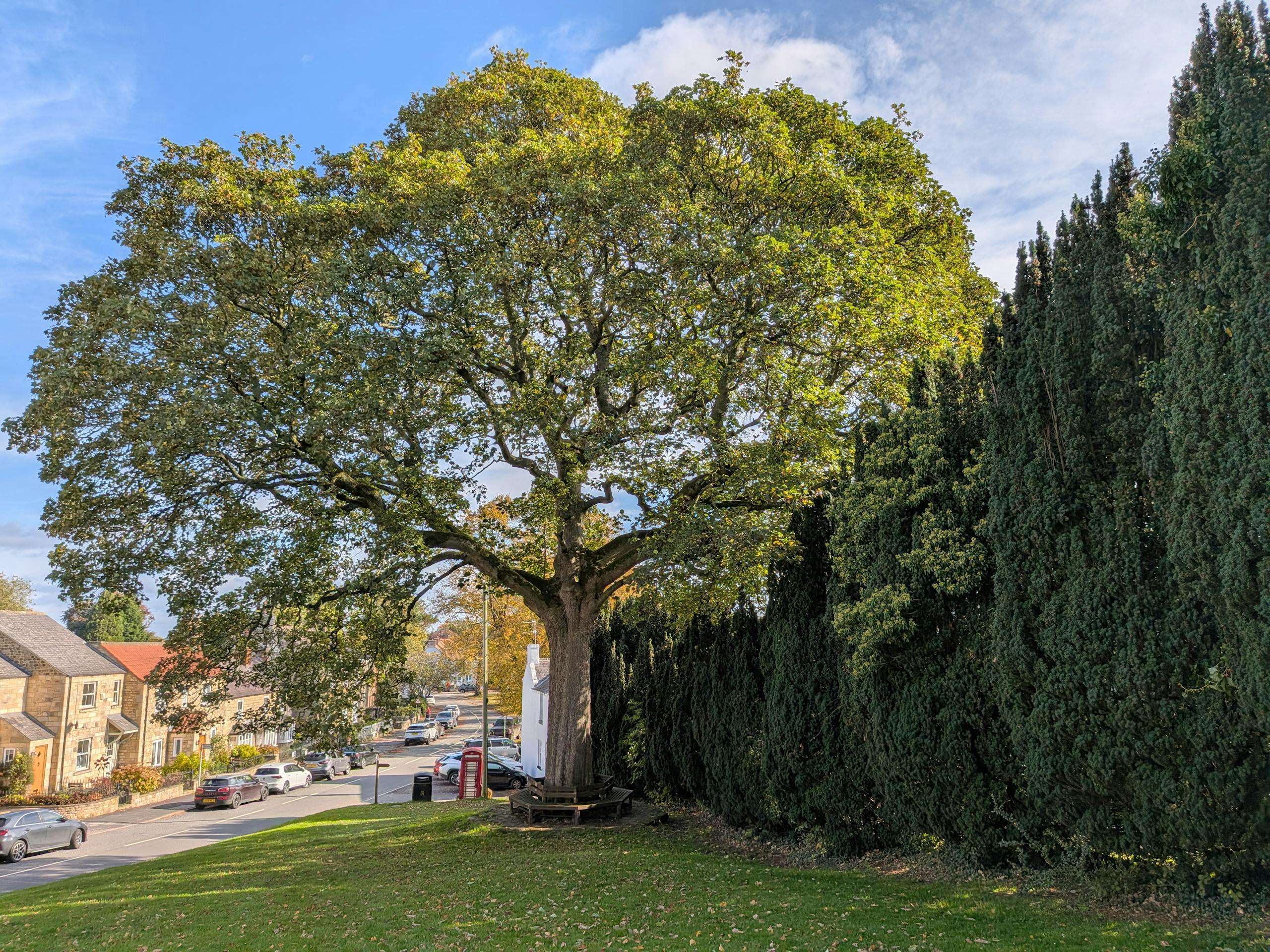
Britain has a particular talent for growing enormous trees in impossibly small spaces. A hundred-year-old beech wedged between a Victorian semi and its neighbour’s garage. A mature sycamore in the corner of a Midlands car park, its roots quietly undermining the tarmac for the past fifteen years. A row of limes along a pedestrianised high street in Chesterfield, now overdue for removal and surrounded by shopfronts, parked delivery vehicles, and passing foot traffic.
None of these situations allow for a standard fell. None of them should.
Urban tree removal is a different discipline to open-ground forestry work. The tree itself might be identical – same species, same age, same structural condition. But the environment around it changes everything. Access, clearance, ground surfaces, neighbouring properties, public proximity, overhead services. All of it has to be assessed, planned for, and managed before a chainsaw gets anywhere near the base.
Worth unpacking what that actually means in practice.
Why Urban Sites Are a Different Proposition
Space is the obvious constraint. But it’s rarely just one problem in isolation – it’s usually several stacked on top of each other. Limited access means heavy equipment either can’t reach the tree or would damage the surface getting there. Overhead lines complicate where sections can be swung or lowered. Neighbouring properties create liability questions the moment any debris crosses a boundary. Hard landscaping below means dropped sections can’t be allowed to fall freely.
And then there’s the public. Working on private land behind a fence is one thing. Removing a tree from a town centre location, a school, or a housing estate means coordinating around people who aren’t expecting to encounter falling timber. That requires physical exclusion zones, clear signage, and often liaison with local authorities or highway teams depending on where the work is happening.
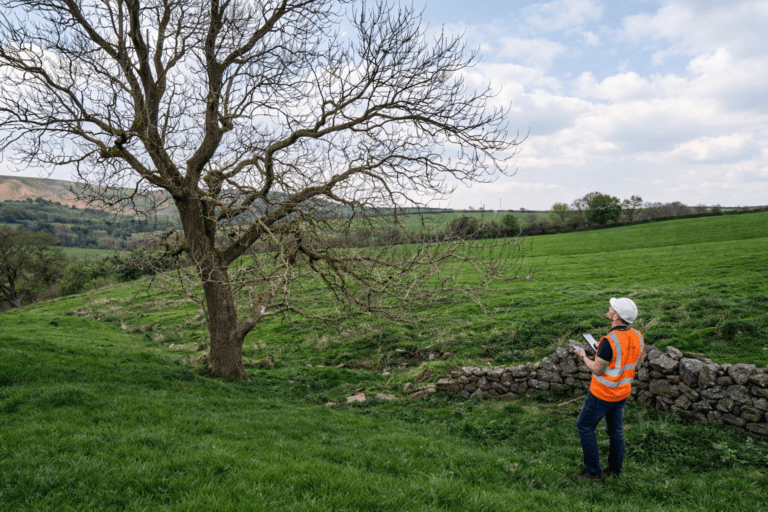
I find that the sites which take the most planning aren’t always the ones with the biggest trees. A modest-sized ash in a rear garden in Nottingham, backing onto three other properties, with a greenhouse on one side and a listed wall on the other – that can require more careful thought than a much larger specimen in open woodland. The size of the challenge isn’t always proportional to the size of the tree.
The Role of Controlled Dismantling
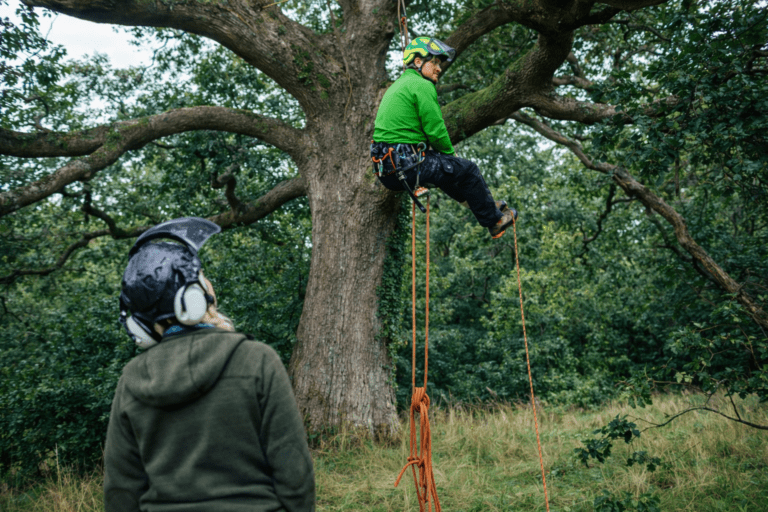
When felling isn’t possible – and in most urban settings, it isn’t – controlled piece-by-piece dismantling becomes the method. Climbers work from the crown downwards, removing sections that are either lowered on ropes or dropped into a carefully designated and cleared zone below. Nothing moves until there’s certainty about where it’s going.
Rope systems and rigging are what make it precise. Modern arboricultural rigging allows heavy sections of timber to be lowered in a controlled arc, guided from above and received below. It’s slower than felling, considerably more labour-intensive, but it’s what safe working in restricted environments actually requires. Those providing controlled tree dismantling in restricted spaces need a combination of technical climbing competency, rigging knowledge, and ground crew communication that simply doesn’t apply in open-ground forestry.
Some sections can be dropped – if there’s a clear zone below, if the section is small enough, and if the ground surface can take it. Others need to come down on rope. The climber makes those calls in real time, in consultation with the ground team. Good communication between the person above and the people below is probably the thing that separates efficient urban dismantling from chaotic urban dismantling.
Equipment on Constrained Sites
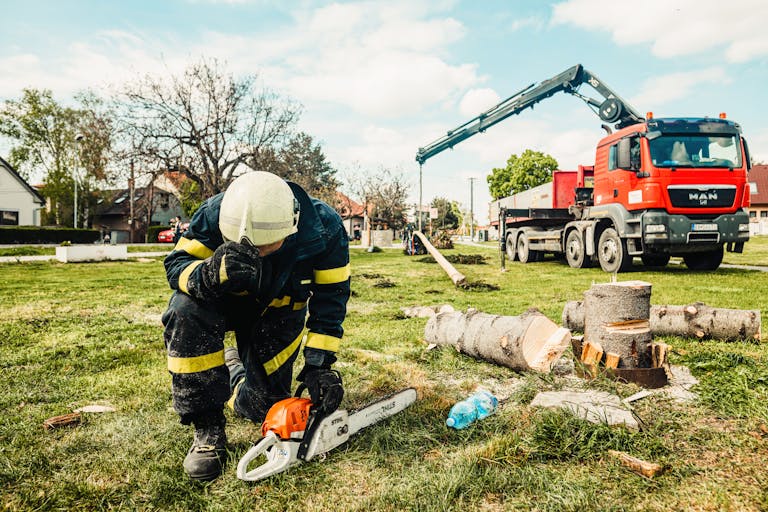
Not all urban sites allow for climbers. Trees that are structurally unsound, heavily decayed, or simply too hazardous to ascend require an alternative approach – and that’s where mobile elevated work platforms (MEWPs) come in. Cherry pickers and spider lifts can reach heights that would otherwise require climbing, and they provide a stable working platform for the operator.
Spider lifts – the narrow, tracked platforms rather than the wheeled articulated ones – are particularly useful in tight gardens and pedestrianised spaces. They can pass through a standard gate, work on slopes, and are far less damaging to ground surfaces than heavier machinery. Not cheap to hire, but on the right site, genuinely the difference between a job that’s feasible and one that isn’t.
Access for chipping and timber removal is another consideration that gets underplanned. You can dismantle a tree perfectly and then realise the chipper can’t get close enough to process the brash efficiently. On sites with difficult access, that might mean cutting brash small enough to be carried through a side passage in barrow loads – which adds time but is sometimes unavoidable. Worth confirming access logistics at the assessment stage rather than working it out on the day.
Urban Site Categories and Their Specific Challenges
Different urban environments bring different constraints. Here’s a rough breakdown of what tends to complicate things in each setting:
| Site Type | Common Constraints | Typical Solutions | |—|—|—| | Rear gardens (terraced/semi) | No access for machinery, neighbouring properties on 2-3 sides | Manual climbing, hand equipment, barrow removal | | Town centre / high street | Public footfall, highway proximity, overhead services | Road closures or TM plan, MEWP, section lowering | | School or hospital grounds | Safeguarding, public liability, site access controls | Out-of-hours working, exclusion zones, liaison with site manager | | Commercial car parks | Vehicles, hard surface, tight clearances | Cordoned zones, MEWP, rapid clearance of sections | | Housing estates | Mixed public/private land, parked vehicles, residents | Advance notice to residents, exclusion zones, phased working | | Listed buildings / heritage sites | Restrictions on surface damage, proximity to structure | Spider lifts, hand tools only, specialist rigging |
None of these categories is impossible. They just require a different level of preparation than a tree removal in an open field does.
Managing Neighbours and Third-Party Risk
Urban tree removal almost always involves someone else’s property boundary. Even if the tree is well within your land, the work zone may extend beyond it. Debris can cross boundaries. Noise affects neighbours. If a rope system is anchored to or over an adjacent property, that’s something to agree in advance rather than apologise for afterwards.
Talking to neighbours before the work starts is good practice and, in dense urban areas, just plain courtesy. Most reasonable people are fine with tree work once they know it’s coming. It’s the ones who come out mid-job, surprised, and start asking questions that slow things down. A brief note or knock on the door the day before costs nothing.
Third-party liability insurance is non-negotiable. On urban sites, the potential for incidental damage to adjacent property, vehicles, or surfaces is higher than on open ground. Contractors should carry public liability cover of at least £5 million – more for larger commercial operations. Ask for the certificate before work begins. Reputable contractors produce it without hesitation.
Overhead Lines – Still the Most Underestimated Hazard
Urban environments are crisscrossed with services – electrical distribution lines, telephone cables, broadband infrastructure running through or above the tree canopy. In older residential areas, many of these lines are uninsulated. Contact is a serious risk.
The Health and Safety Executive’s guidance on working near overhead lines is clear: maintain minimum safe distances (typically 6 metres for uninsulated lines at distribution voltages), and contact the network operator before work if there’s any uncertainty. For trees close to electrical lines, the network operator may need to arrange for temporary isolation or install protective equipment.
This isn’t something to manage informally on the day. If there are lines present, the assessment needs to establish their exact nature, voltage, and whether any protective measures are required. A few days’ lead time for coordination is usually sufficient – but it has to happen before the job is scheduled, not the morning of.
Ground Protection and Surface Damage
Hard landscaping, paved surfaces, ornamental gardens, root protection zones around other trees – all of these can be damaged by the wrong equipment or careless working practices. In urban settings, the cost of repairing incidental damage can rival or exceed the cost of the tree removal itself.
Ground protection boards spread the load of equipment and timber sections across a larger area, reducing point pressure on paving or compaction in soft landscaped areas. Rubber-tracked equipment is preferable on sensitive surfaces. And if there are other trees nearby whose root systems could be affected by equipment movement or ground compaction, that needs to be factored in – particularly where those trees have TPOs or are within conservation areas.
Root protection zones matter more than most people realise. Compaction from heavy machinery within the root zone of a protected tree can cause long-term damage that doesn’t show until the following season. Damage of that kind can attract enforcement action from the local planning authority, even if the TPO tree itself was never touched.
Planning, Permissions, and the Legal Framework
England and Wales have fairly robust protections for trees in urban areas. Tree Preservation Orders and conservation area legislation apply regardless of whether the tree is on private or public land. Removing a protected tree without consent carries criminal penalties – fines up to £20,000 per tree – and the defence that “it had to go” rarely carries much weight.
Local planning authorities handle TPO applications. Most process them within eight weeks, though urgent cases (imminent danger to people or property) can be handled more quickly. Conservation area notifications require six weeks’ notice. Neither process is particularly onerous once you know the route, but they need to start well before the planned removal date.
For commercial clients and local authorities, the documentation trail matters beyond just legal compliance. Method statements, risk assessments, site-specific safe systems of work – these aren’t bureaucratic box-ticking exercises. On complex urban jobs, they’re the planning tool that keeps the work on track and demonstrates due diligence if anything is later questioned.
Frequently Asked Questions
How far in advance should I book urban tree removal?
For a straightforward garden job, two to four weeks is usually sufficient. For anything involving road closures, MEWP hire, or permissions applications, eight to twelve weeks minimum. Trying to compress that timeline rarely ends well – it just means something important gets skipped.
Can tree removal happen in winter?
Yes, and for urban jobs, winter is often preferable. Leafless trees give climbers better visibility and access. Ground conditions can be firmer. And the nesting season restriction (roughly March to August) doesn’t apply, which removes one planning complication. Cold weather and short days can affect productivity, but the season itself isn’t a barrier.
What happens if the tree is an emergency – dead or dangerous?
Imminent danger to people or property can justify emergency removal without prior consent in most circumstances, though the local planning authority should still be notified as soon as possible. Keep records of the condition that justified emergency action – photographs, any surveys or assessments – in case it’s later questioned. Emergency doesn’t mean unplanned: even on an urgent job, a site-specific safe system of work should be prepared before work starts.
Do I need to notify anyone if the tree is in my own garden?
If it’s covered by a TPO or you’re in a conservation area, yes. Otherwise, for most private gardens, no formal notification is required. That said, checking with the local authority before proceeding is always worthwhile – it takes ten minutes and avoids any potential enforcement issues.
Pulling It Together
Urban tree removal done properly is genuinely skilled work. It’s not just tree surgery with added difficulty – it’s a separate discipline that draws on rigging, equipment selection, traffic management, neighbour relations, and regulatory knowledge that simply doesn’t feature in open-ground forestry.
Sites that look straightforward often aren’t. A tree that appears manageable from the street can look very different once you’re standing underneath it in the garden, working out where every section is going to land. That’s why assessment – proper, thorough, on-site assessment – is the foundation of every successful urban removal.
Get that right, and the rest tends to follow. Rush it or skip it, and you’re managing problems rather than preventing them. Britain’s urban trees aren’t going anywhere on their own – so when they do have to come down, they deserve a plan that matches the complexity of the site they’re on.

Killingley Insights is the editorial voice of NT Killingley Ltd, drawing on decades of experience in landscaping, environmental enhancements, and civil engineering projects across the UK.