Risk, Compliance, and Competence: What Professional Tree Felling Operations Must Get Right

Tree felling is one of the most statistically dangerous occupations in the UK. The Health and Safety Executive puts arboriculture and forestry consistently among the highest-risk industries for fatal and serious injuries – a rate roughly six to seven times the all-industry average, depending on which data set you’re working from. That’s not a scare statistic. It’s the kind of number that should shape how operations are planned, staffed, and managed from the start.
And yet – there’s still a tendency in some corners of the sector to treat risk management as paperwork. Something to produce for clients rather than something to actually work from. I was going to say that’s a minority view, but honestly it’s more common than it should be.
Getting compliance right in tree felling isn’t just about ticking boxes for insurers or local authorities. It’s about having a systematic approach that reduces the chance of something going badly wrong on a live site – and being able to demonstrate that approach if anyone asks.
The Legal Framework – What Actually Applies
Start with the basics. Tree felling operations in the UK fall under several overlapping pieces of legislation, and the relevant duties apply to employers, self-employed contractors, and anyone commissioning the work.
The Health and Safety at Work etc. Act 1974 is the foundation – general duties on employers and the self-employed to ensure the safety of workers and anyone who might be affected by the work. The Management of Health and Safety at Work Regulations 1999 add the specific requirement for suitable and sufficient risk assessment. Those two together cover the core obligation.
Then there’s the more specific stuff. The Work at Height Regulations 2005 govern climbing operations – which are central to most dismantling work. PUWER (Provision and Use of Work Equipment Regulations 1998) applies to chainsaws, chippers, and other machinery. LOLER (Lifting Operations and Lifting Equipment Regulations 1998) covers rigging systems used to lower sections. Manual Handling Operations Regulations 1992 apply when timber is being moved by hand.
On the planning side, TPO legislation sits within the Town and Country Planning Act 1990. Felling licences – required for removing trees over a certain diameter outside gardens – are governed by the Forestry Act 1967. Wildlife and Countryside Act 1981 protects nesting birds. Environmental permitting applies to certain waste streams from tree work.
It’s a lot. And it applies simultaneously, not sequentially.
Risk Assessment – Not Just a Form
A risk assessment for tree felling should reflect the actual site, the actual tree, and the actual methods being used. Generic templates have their place as a starting framework – but a template that hasn’t been reviewed and completed for the specific job is almost useless as a safety tool.
Proper site-specific risk assessment covers the hazards present and the controls applied to each. For tree felling, the typical hazard list includes:
– Uncontrolled tree fall (direction, windthrow risk, structural failure) – Chainsaw contact with operator or bystanders – Struck-by hazards from falling timber or debris – Falls from height during climbing operations – Contact with overhead utilities – Ground conditions (slopes, unstable ground, buried services) – Working near roads or public areas – Noise, vibration, and dust exposure
For each hazard, the assessment should identify who’s at risk, the likelihood and severity without controls, what controls are applied, and the residual risk. That process – done honestly rather than optimistically – is what actually helps crews understand the real risk profile of a job.
Method statements then translate the risk assessment into the actual sequence of work. Step by step. Who does what, when, in what order, using what equipment. Exclusion zones. Emergency procedures. Responsibilities. On commercial sites, clients will often ask for these documents as part of the procurement process – and rightly so. Those commissioning professional tree removal and site safety management should expect to see current, site-specific documentation before any work begins rather than generic paperwork prepared for a different job entirely.
Competence and Qualifications
The HSE is fairly clear: employers must ensure that people carrying out tree felling are competent. Competence means a combination of skills, knowledge, and experience – formal qualifications are the recognised way of demonstrating the first two.
Industry-standard qualifications sit within the NPTC (National Proficiency Tests Council) framework, administered by City & Guilds. The key certificates for chainsaw and felling work are:
| Certificate | Scope | |—|—| | CS30 | Safe use and maintenance of chainsaws | | CS31 | Chainsaw cross-cutting and manual handling of timber | | CS32 | Felling and processing trees up to 380mm diameter | | CS34 | Felling and processing trees over 380mm diameter | | CS38 | Aerial tree work – aerial rescue | | CS39 | Aerial tree work – chainsaw use in the tree | | PA1 / PA6A | Pesticide application (relevant for stump treatment) |
CS30 and CS31 are the baseline for anyone operating a chainsaw. CS38 and CS39 are required for climbing work. Operators should be able to produce current, valid certificates on request – not photocopies from five years ago.
Experience matters alongside certification. A newly qualified CS32 holder and someone with fifteen years of varied site experience both hold the same certificate. Supervision arrangements and job allocation should reflect actual experience level, particularly on complex or high-risk sites.
Safe Systems of Work – What Good Practice Actually Looks Like
A safe system of work (SSOW) for tree felling isn’t abstract. It’s the collection of procedures and controls that, taken together, make the job safe to carry out. Some elements are universal across most felling operations. Others are site-specific.
Exclusion zones are non-negotiable. The minimum recommended exclusion zone around a felling operation is two and a half times the height of the tree. On open ground, that’s relatively straightforward to establish and maintain. On constrained sites – near roads, adjacent to buildings – it requires more active management. Physical barriers, banksmen, temporary signage. On public land, coordination with the local authority or highways team may be needed to create that exclusion zone safely.
Communication between team members during active cutting is another area where discipline matters. When a chainsaw is running, verbal communication is difficult. Pre-agreed signals, consistent protocols, and everyone understanding their role during the critical phases of a fell are what prevent a moment of miscommunication from becoming an incident.
Planned escape routes are something that gets skimped on, in my experience. Every felling operation should have at least two pre-identified escape routes – 45-degree angles from the back of the stump, not in the line of fall or the potential kick-back direction. They should be cleared of obstacles before the cut is made. Not planned in theory. Cleared in practice.
Emergency procedures. First aid provisions. Nearest hospital with trauma capability. Emergency contact numbers. All of this should be established before work starts, particularly on remote or isolated sites where response times are long. It sounds basic. But on a job where something goes wrong, having to work this out in the moment costs time that might matter.
PPE – What’s Required and Why It Matters
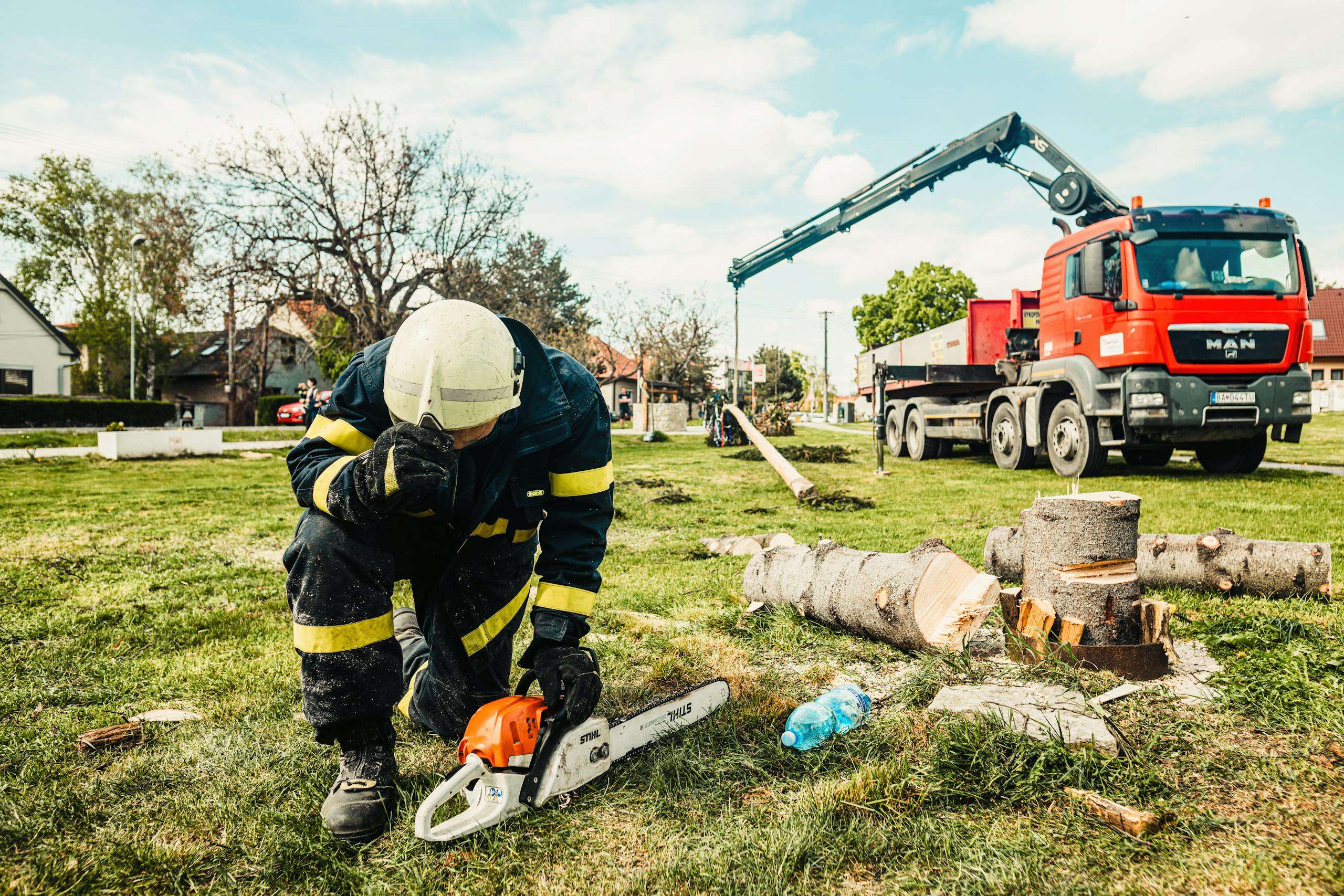
Personal protective equipment for chainsaw and arboricultural work is specified and not optional. Operators should be equipped with:
– Chainsaw-protective trousers or chaps (to EN 381-5 standard, appropriate protection class for the saw being used) – Chainsaw-protective boots (EN 17249) – Helmet with integrated face screen and hearing protection – Chainsaw gloves (EN 381-7) – High-visibility vest where working near roads or public areas
For climbing work, a full climbing harness, lanyard, and appropriate helmet are additionally required. Equipment should be inspected before each use and replaced when damaged or beyond its service life – chainsaw-protective clothing loses its cut-resistance over time and with wear, regardless of whether it has been contacted by a saw.
PPE is the last line of defence. If a risk assessment identifies a hazard that relies primarily on PPE as the control measure, that’s a flag that the hierarchy of controls hasn’t been properly worked through. PPE should supplement engineering controls and safe systems of work, not substitute for them.
Felling Licences and Regulatory Compliance
Outside domestic gardens, felling trees with a stem diameter over 8cm at 1.3m height generally requires a felling licence from the Forestry Commission (in England, managed through Forestry England). Exemptions exist – dead trees, trees with TPOs being removed with LPA consent, certain agricultural situations – but the default position is that a licence is required.
Restocking conditions are often attached to felling licences. Removing trees without meeting those conditions is a breach of the licence and can result in enforcement action. On larger commercial sites, the restocking plan needs to be agreed before felling begins, not worked out afterwards.
For urban and residential work, TPO consent from the local planning authority is the relevant process rather than a Forestry Commission licence. The two systems operate in parallel – knowing which applies to the specific trees and site is part of the pre-work assessment.
Insurance and Contractual Risk Allocation
Public liability insurance is the baseline. For most tree felling operations, £5 million minimum is standard – many commercial clients and local authorities specify higher limits, particularly for complex urban work. Employers’ liability cover is a legal requirement for anyone with employees. Professional indemnity cover becomes relevant where survey, assessment, or consultancy services are part of the scope.
Contracts should be clear about who bears responsibility for what. Who carries liability if an adjacent property is damaged? What happens if underground services are struck? What’s the process if a tree fails unpredictably during work? These questions are much better resolved in the contract than in the aftermath of an incident.
For local authority and commercial contracts particularly, pre-qualification checks on insurance, qualifications, and health and safety management are standard. Contractors who can’t produce current documentation cleanly and quickly are a risk flag. It’s not bureaucratic obstruction. It’s due diligence.
Frequently Asked Questions
Who is responsible for ensuring compliance on a tree felling job?
The contractor carrying out the work holds primary responsibility for health and safety compliance. But clients commissioning work also have duties – particularly larger organisations or local authorities who, under CDM Regulations in certain circumstances, take on client duties. In practice, ensuring you engage a qualified, insured, and properly equipped contractor is the client’s most important contribution to compliance.
What should I ask a contractor before signing off a tree removal job?
Request to see: current NPTC certificates for all operators on the job, public liability insurance certificate, a site-specific risk assessment and method statement, confirmation of TPO or felling licence status, and evidence of any relevant surveys (nesting birds, bat roosts if applicable). That covers the main bases. Any reputable contractor will have all of this to hand.
Are there situations where tree felling can proceed without a risk assessment?
No. The legal requirement for risk assessment under the Management of Health and Safety at Work Regulations applies regardless of job size. A smaller or simpler job may result in a shorter, less complex assessment – but an assessment is required. “We’ve done this a hundred times” is not a substitute.
Does weather affect compliance requirements?
Weather affects risk, which in turn affects the adequacy of existing controls. A risk assessment prepared for calm conditions may not be adequate if wind speeds increase significantly on the day of work. Strong winds – particularly above 20mph at tree height – substantially change felling behaviour and should prompt a review of whether work can safely proceed. Stopping when conditions deteriorate is a competence decision, not an inconvenience.
Putting It Into Practice
Compliance in tree felling operations isn’t complicated in concept – it’s about having a systematic approach, applying it consistently, and not cutting corners when time or budget pressure builds. The documentation exists to support the work, not obstruct it.
What makes the difference on complex sites is the combination of qualified people, thorough pre-work assessment, clear communication during the job, and a culture where stopping to reassess is treated as normal rather than a failure. Those are the conditions under which tree felling operations run safely and professionally.
Statistics don’t lie about the risk profile of this industry. But they also show that well-managed operations, with proper procedures and trained crews, complete work without incident routinely. The framework exists. Using it properly is what separates the operations that run smoothly from the ones that don’t.

Killingley Insights is the editorial voice of NT Killingley Ltd, drawing on decades of experience in landscaping, environmental enhancements, and civil engineering projects across the UK.