Planning Effective Snow Clearance Strategies for Roads, Car Parks and Pathways

Snow changes everything. Not in a dramatic, cinematic way – more in the quiet, disruptive sense. One heavy fall overnight and suddenly roads feel narrower, car parks lose all logic, and footpaths turn into obstacle courses. The same routes people walk or drive every day without thinking become points of friction. Risky ones.
I’ve always thought snow clearance sits in an odd space. Everyone agrees it’s important. Few people want to plan it properly until it’s already snowing. And by then, well… you’re reacting, not managing.
This article looks at how to plan effective snow clearance strategies across roads, car parks, and pathways. Equipment choices, route planning, coordination between teams – the practical stuff that keeps sites usable and people moving during severe winter weather. Not perfect. Just workable. And, ideally, calm.
Because panic is the least helpful thing when it’s already coming down sideways.
Snow isn’t the same as ice – treat it differently
Before getting into planning, it’s worth clearing up one thing. Snow and ice aren’t the same problem.
Ice is about prevention. Snow is about removal.
With ice, timing is everything. With snow, scale matters more. How much has fallen, how fast, and what’s likely to happen next. Light snow that melts by midday needs a different response to persistent snowfall that compacts under traffic and refreezes overnight.
In the UK, snow events are often short but intense. A few hours of heavy snowfall can cause more disruption than a week of light frost. Derbyshire, for example, regularly sees sharp contrasts – valley towns coping reasonably well while higher ground grinds to a halt.
Planning needs to reflect that variability, not assume one neat scenario.
Start with purpose, not equipment
There’s a temptation to begin snow planning by talking about kit. Ploughs. Spreaders. Shovels. But that’s back to front.
Effective strategies start with purpose.
What are you trying to keep open?
Who needs access, and when?
Which routes are critical, and which are optional?
Until those questions are answered, equipment choices are guesswork.
A hospital access road has a different priority to a staff overflow car park. A pedestrian route to a school entrance matters more than a rarely used service yard. Snow clearance doesn’t need to be equal everywhere. It needs to be intentional.
I was going to say “fair”. But fair is the wrong word. It’s about function.
Route planning – where most plans fall down
Route planning is the quiet backbone of snow clearance. And it’s where many otherwise decent plans fall apart.
Clearing everything at once isn’t realistic during heavy snowfall. Resources are finite. Time is limited. Conditions change while you’re working. Routes need to be prioritised and sequenced.
A sensible route plan usually looks at:
- Primary access routes first.
- Secondary routes once movement is possible.
- Peripheral areas only when time allows.
Sounds obvious. In practice, it gets messy. Vehicles block cleared areas. Snow gets pushed into paths you haven’t dealt with yet. People start using routes before they’re fully safe, compacting snow into ice.
One small detail that often gets missed – start where traffic enters the site, not where you’re based. Clearing outward can trap vehicles behind uncleared sections. That’s a proper headache.
Roads – keep them passable, not perfect
Private roads and access roads are often treated like public highways. They shouldn’t be.
The goal isn’t bare tarmac. It’s passability.
Trying to clear roads to summer condition during heavy snowfall is unrealistic and wasteful. Best practice focuses on keeping at least one usable lane open, managing junctions, and preventing compaction.
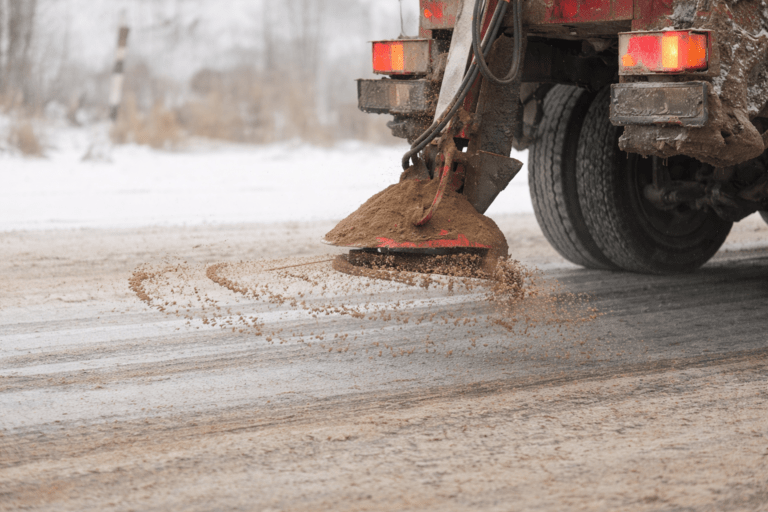
Ploughing early and often is usually better than waiting and doing one big clear. Once snow is compacted by vehicles, removal becomes harder and slower. And then you’re into grit, refreeze, repeat territory.
In business parks and industrial estates, coordination matters. If multiple occupiers clear independently, snow ends up piled in awkward places. Shared planning avoids that. Or at least reduces the chaos.
Car parks – the illusion of order
Car parks look simple. Big open spaces. Straightforward. They aren’t.
Snow hides markings. People park wherever feels right. Cleared bays get re-covered by snow pushed from drive lanes. Pedestrian routes vanish completely.
Effective car park clearance plans tend to work in phases:
- Open main drive lanes.
- Create safe pedestrian routes to entrances.
- Clear priority bays.
- Deal with remaining areas if conditions allow.
Trying to clear everything evenly just spreads effort too thin.
One thing I find often overlooked is snow storage. Where does it go? Piling snow against buildings, drains, or footpaths creates problems later. Melting snow refreezes overnight. Drains block. Water pools.
Planning snow storage areas in advance feels pedantic until you’ve watched a cleared car park turn into an ice rink two days later.
Footpaths – small areas, big consequences
Most injuries during snow events don’t happen on roads. They happen on footpaths.
Narrow paths. Steps. Ramps. Changes in surface texture. These are the danger zones. Clearing them takes time and often manual effort, which is why they’re sometimes neglected.
Best practice treats footpaths as priority routes, not afterthoughts. Especially those linking car parks to entrances, public transport stops, or shared facilities.
In public spaces, accessibility is non-negotiable. Dropped kerbs, tactile paving, ramps – all need attention. Snow clearance that ignores these features can make sites unusable for some people, even if everything else looks fine.
It’s fiddly work. A bit of a faff, frankly. But it matters.
Equipment – match tools to the job
Right, equipment. Let’s talk kit.
No single machine does everything well. That’s the reality.
Larger ploughs are great for roads and big car parks. They’re useless on narrow paths. Compact machines work well in tight spaces but struggle with deep snow. Hand tools are flexible but slow.
Effective strategies use a mix:
- Ploughs for primary routes.
- Smaller mechanical sweepers or ploughs for secondary areas.
- Manual clearance for steps, ramps, and awkward corners.
Maintenance matters too. A broken plough mid-snowfall is worse than no plough at all. Pre-winter checks aren’t exciting, but they prevent embarrassment later.
And yes, operators matter as much as machines. An experienced driver will clear more effectively with basic kit than an inexperienced one with the latest gear.
Coordination – the bit nobody wants to own
Snow clearance crosses boundaries. Facilities teams. Contractors. Local authorities. Tenants. Everyone’s involved, whether they like it or not.
Poor coordination creates duplication and gaps. One team clears a road, another blocks it moments later. A car park gets cleared but footpaths remain untouched because “that’s not our bit”.
Clear roles help. So does communication. Even something as simple as a shared contact list or a quick morning call during heavy snow can make a difference.
This is where external support often proves useful. Organisations that rely on a snow clearing service in Derbyshire typically do so not just for equipment, but for coordination. Someone watching conditions, dispatching resources, and keeping track while everyone else focuses on their core jobs.
Timing – when to act, not just how
Snow clearance isn’t only about action. It’s about timing.
Clear too early, and snow falls again. Clear too late, and compaction makes everything harder. During prolonged snowfall, multiple passes are often better than one big effort at the end.
Night-time clearance can be effective, especially for commercial sites that need early access. But it brings its own issues – visibility, safety, noise. Planning for those trade-offs matters.
I’ve noticed that the most resilient sites accept a degree of imperfection during active snowfall. They focus on maintaining access rather than aesthetics. Then tidy up once conditions stabilise.
That mindset saves effort and frustration.
Severe weather – when plans get stretched
Every few years, we get proper snow. Not the light dusting that melts by lunchtime. The sort that closes schools and fills news bulletins.
No plan survives those events untouched.
Best practice during severe weather is about adaptation. Scaling back objectives. Focusing on life safety and critical access. Letting non-essential areas go temporarily.
Communication becomes more important than clearance. Telling people what’s open, what isn’t, and why. Managing expectations.
And yes, sometimes the right call is partial closure. Forcing access where it can’t be maintained safely just creates bigger problems later.
Common questions people ask mid-snowstorm
These usually come up when it’s already falling.
Should we clear continuously or wait until it stops?
Depends on intensity. Continuous clearance prevents compaction but costs more.
Is it worth clearing if more snow is forecast?
Usually, yes. Early clearance reduces buildup.
Can we just clear roads and leave paths?
Not safely. Pedestrians are at higher risk.
What about liability if we don’t clear everything?
Reasonable precautions matter more than perfection.
None of these have absolute answers. Context is everything.
A simple comparison of approaches
Just to ground this:
| Approach | Likely result | Disruption level |
|---|---|---|
| No planning | Reactive chaos | High |
| Basic ad hoc clearance | Inconsistent access | Medium |
| Planned, coordinated strategy | Managed disruption | Low |
Low doesn’t mean none. Snow always disrupts. The aim is to control it.
Circling back to planning, again
I keep coming back to planning because it’s the part people skip. Understandably. Snow feels unpredictable. But the impacts aren’t.
Roads, car parks, pathways – they don’t change much year to year. The same pinch points reappear. The same shaded areas ice up. The same complaints come in.
Learning from previous winters, even informally, improves strategies over time. A note here. A tweak there. Suddenly things run smoother.
It’s not clever. Just attentive.
Conclusion – clear thinking beats clear ground
Effective snow clearance isn’t about heroic effort in the middle of a blizzard. It’s about calm preparation beforehand. Knowing what matters. Knowing where to start. Knowing when to stop pushing and wait.
Roads, car parks, and pathways all need different approaches, but they’re connected. Neglect one and the others suffer. Coordinate them, and disruption drops to manageable levels.
Snow will always cause inconvenience. That’s unavoidable. But with the right strategies, it doesn’t have to cause chaos. And that, in winter, is about as good as it gets.

Killingley Insights is the editorial voice of NT Killingley Ltd, drawing on decades of experience in landscaping, environmental enhancements, and civil engineering projects across the UK.