Temporary or Permanent? Choosing the Right Exclusion Fencing for Construction and Environmental Projects

On the face of it, the distinction between temporary and permanent exclusion fencing seems obvious. One comes down when the job’s done. The other stays. But the decision of which to use – and when, and where – involves more than just programme duration. Get it wrong and you’ve either spent money on a permanent installation that wasn’t needed, or you’ve removed fencing that should have stayed and created an ongoing management problem as a result.
Both have their place. The question is working out which is right for a specific site, a specific species, and a specific project context.
What Temporary Fencing Is Actually For
Temporary exclusion fencing is installed to serve a time-limited purpose – protecting a species or habitat during an active works phase, then removed once that phase is complete. The works might be construction, vegetation clearance, ground preparation, or any other activity that creates a temporary risk to wildlife or a retained habitat feature.
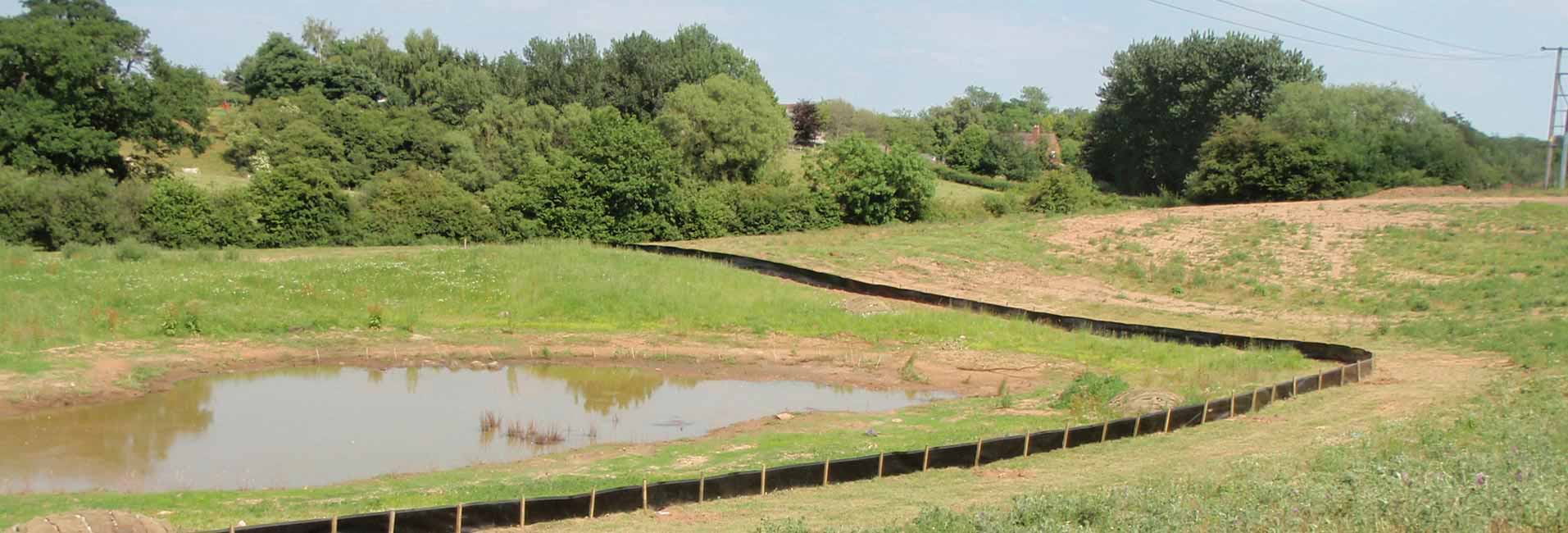
Temporary doesn’t mean flimsy or casual. A temporary great crested newt fence installed as part of a European Protected Species licence needs to meet exactly the same specification requirements as a permanent equivalent – correct burial depth, appropriate surface finish, no gaps at the base, pitfall traps included. The difference is that it’s designed to be removed cleanly after use rather than left in place indefinitely.
On construction projects, temporary exclusion fencing typically runs for the duration of the vegetation clearance and ground preparation phase – sometimes a matter of weeks on smaller sites, potentially one to three years on larger infrastructure schemes. The fencing creates the sterile working area within which licensed mitigation activities (trapping, translocation, pre-clearance checks) can be completed, and it maintains the separation between the working zone and retained habitat throughout active works.
Removal at the right point in the programme is important. Fencing removed too early – before clearance is complete or before the works phase is genuinely finished – leaves the previously protected area vulnerable. Fencing left in place too long after it’s needed creates ongoing management obligations and, for some habitat types, can start to affect the ecological value of the area it’s protecting through shading, vegetation disturbance at the fence line, or simply presenting a physical barrier to species that would naturally use the area.
When Permanent Fencing Makes More Sense
Permanent exclusion fencing is used where the management need doesn’t end when the construction phase does. Road schemes are the most familiar context – badger fencing along a new road corridor that permanently separates a badger territory, with crossing points provided, needs to be maintained indefinitely because the road is there indefinitely. Removing it post-construction would simply allow badgers to cross the road surface again, defeating the purpose of the mitigation entirely.
Long-term habitat protection is another driver. A nature reserve or receptor site where animals have been relocated may need a permanent perimeter fence to prevent encroachment from adjacent land uses – livestock, dogs, off-road vehicles. A wetland feature within a development site that needs to be protected from foot traffic and human disturbance over the life of the development. A woodland with significant bat roost features in a location where ongoing disturbance is a realistic risk.
Permanent fencing carries higher upfront material and installation cost, but also ongoing maintenance obligations – inspection, repair, vegetation management along the fence line. Those costs need to be planned for and assigned to someone with a clear responsibility and budget for the duration. Permanent fencing that’s installed and then forgotten tends to deteriorate fairly quickly, which eventually means it isn’t doing what it was put there to do.
Comparing the Two Approaches
Here’s a practical comparison across the main decision factors:
| Factor | Temporary Fencing | Permanent Fencing |
|---|---|---|
| Programme duration | Works phase only – weeks to a few years | Indefinite – tied to the ongoing land use |
| Typical materials | Polypropylene mesh, lightweight posts, reusable components | Galvanised wire mesh, timber or steel posts, durable fixings |
| Installation cost | Lower per metre; labour-intensive removal adds cost | Higher upfront; no removal cost |
| Maintenance requirement | Regular inspection during works period; removal on completion | Ongoing inspection and repair for the life of the fence |
| Ecological specification | Same species-specific requirements as permanent | Often more robust to withstand long-term weathering and disturbance |
| Typical contexts | Construction sites, vegetation clearance, licensed translocation | Road schemes, receptor sites, long-term habitat reserves |
| Removal planning | Must be planned – timing, condition of habitat on removal | Not applicable unless land use changes |
Worth noting that the ecological specification requirements are essentially the same regardless of whether the fencing is temporary or permanent. A temporary newt fence that doesn’t meet the burial depth and surface finish requirements of a permanent one is still a temporary newt fence that doesn’t work.
Mixed Schemes – Using Both on the Same Project
Larger or more complex projects often use both. A new road scheme in the East Midlands, say, running through a mixture of agricultural land and semi-natural habitat. Temporary exclusion fencing goes in along the full construction corridor to exclude badgers, reptiles, and amphibians from the working area during construction. Once the road is built, that temporary fence comes down – replaced on the road boundary itself by permanent badger fencing with underpasses, while the temporary fencing on the off-road sections is removed once habitat reinstatement is underway.
That kind of phased approach needs careful design. The handover points – where temporary fencing is removed and permanent fencing takes over, and in what sequence – have to be worked out before installation begins rather than improvised on site. A gap in the fence line during the transition, even a brief one, is a gap that animals can exploit.
Our wildlife exclusion fencing solutions cover both temporary and permanent installations, and part of what that experience brings is designing schemes where the two phases transition correctly rather than leaving a management gap between them.
Material Choices and Their Implications
Temporary fencing materials are chosen for ease of installation, reusability, and cost-effectiveness over a short to medium term. Polypropylene amphibian fencing – smooth-sided, UV-stabilised, available in rolls – is the standard for newt and reptile exclusion on construction sites. It goes up quickly, can be reused across multiple projects, and doesn’t require the more substantial post infrastructure that permanent fencing needs. The downside is that it degrades over time, is vulnerable to damage from site traffic, and doesn’t cope well with extended exposure to UV or aggressive vegetation growth pushing against it.
Permanent fencing uses more robust materials. Galvanised welded mesh or chain link for most applications, with timber posts (pressure-treated for longevity) or steel posts where greater strength is needed. The burial skirt – the horizontal section at the base that prevents animals from digging under – needs to be of sufficient gauge to resist both animal pressure and the forces involved in ground movement over years of frost cycles.
For badger fencing in particular, permanent installations are typically specified to a higher standard than the temporary equivalent – heavier gauge mesh, more robust posts, deeper and wider burial skirt – because badgers are strong, persistent, and will systematically investigate a fence line for weaknesses over a period of months. Finding one isn’t a matter of chance so much as a matter of time.
Environmental Projects Beyond Construction
It’s worth broadening the context a bit, because exclusion fencing in environmental projects isn’t exclusively a construction-related activity. Habitat management projects use fencing differently – and the temporary/permanent decision plays out differently too.
Grazing management for ecological benefit relies on stock fencing to control where livestock graze and for how long. That might be temporary electric fencing to manage rotational grazing on a grassland restoration site – moved seasonally to direct grazing pressure to the right areas at the right time. Or permanent stock fencing to exclude livestock from a riparian zone while still allowing them to graze the surrounding land. Neither of those is ecological exclusion fencing in the construction mitigation sense, but both involve the same fundamental question: where does the barrier need to be, for how long, and to what standard?
Deer exclusion for woodland creation is another context where the temporary/permanent question has a clear answer in most cases: permanent, because the deer pressure doesn’t go away once the trees are planted. Individual tree guards are a form of temporary exclusion – protecting each tree during establishment – but perimeter deer fencing on a woodland creation site is typically permanent, or at least remains for fifteen to twenty years until the trees have grown beyond browsing reach.
Frequently Asked Questions
How is temporary exclusion fencing removed without disturbing wildlife?
Removal is ideally done outside sensitive periods – nesting season, hibernation periods for reptiles and amphibians, or periods when the relevant species are most active at the fence line. A pre-removal check by an ecologist is standard practice on licensed mitigation sites to confirm no animals are sheltering adjacent to the fence that could be disturbed by removal activity. The fence posts come out first, then the mesh is rolled up, with checks along the base of the fence line as the mesh is lifted.
Can temporary fencing be left in place if the project overruns?
It can, but it needs to be inspected and maintained as if it were a permanent installation for as long as it’s in place. Materials designed for short-term use degrade and need to be checked more frequently as they age. If a project overruns significantly – beyond two or three years for polypropylene amphibian fencing, for example – replacement of the fence rather than continued repair may be more cost-effective and more reliable from an ecological standpoint.
Who is responsible for maintaining exclusion fencing during a construction project?
Typically the contractor, under the supervision of the ecological clerk of works or supervising ecologist. The construction programme and method statement should clearly assign maintenance responsibility and specify inspection frequency. On licensed mitigation schemes, the licence holder (usually the developer or their nominated ecological consultant) ultimately carries the compliance obligation, so clarity on the chain of responsibility is important.
Is permanent exclusion fencing subject to planning permission?
It depends on the height, location, and whether the land is in a designated area. In most cases, agricultural and environmental fencing doesn’t require planning permission. Fencing over two metres in height may need permission depending on location. Fencing within a conservation area, AONB, or adjacent to a listed building may have additional restrictions. Worth checking with the local planning authority if there’s any doubt, rather than assuming permitted development applies.
Making the Right Call
Temporary and permanent exclusion fencing both do the same fundamental job – they control where wildlife can and can’t go. The decision between them comes down to how long that control needs to be maintained and what the consequences are if the fencing fails or is removed at the wrong time.
On construction sites, temporary is usually right – but it needs to be specified, installed, and maintained to the same standard as permanent. On long-term habitat management and infrastructure schemes, permanent is usually right – but it needs ongoing maintenance and a clear budget for that over its lifespan.
Neither approach works well when it’s treated as an afterthought. Both work well when they’re designed into the scheme from the start, with the right specification for the target species and the right plan for the full duration they’ll be in use.

Killingley Insights is the editorial voice of NT Killingley Ltd, drawing on decades of experience in landscaping, environmental enhancements, and civil engineering projects across the UK.