Practical Heritage Conservation Methods for Infrastructure and Landscape Projects

What really works on site when history sits in the way
Infrastructure and landscape projects have a habit of wandering into sensitive territory. A culvert upgrade brushes past a listed bridge. A flood scheme skirts an old mill wall. A footpath realignment nudges a boundary that’s been there longer than anyone can remember.
None of it feels dramatic at first. Then someone mentions “heritage”.
And suddenly the job gets heavier. More scrutiny. More opinion. More risk if it goes wrong.
This piece is about the practical side of heritage conservation when you’re delivering real projects in the UK. Not theory. Not policy waffle. The nuts and bolts of materials, methods, sequencing, and decision-making when you’re working around listed or sensitive assets and still need to get the job done.
I’ll say this upfront: most heritage issues aren’t solved by clever wording in reports. They’re solved on site. By people who understand how old things behave, and how modern works can be threaded around them without making a mess.
First, a reality check
Heritage conservation on infrastructure and landscape schemes is rarely about perfection.
It’s about least harm. It’s about judgement calls. And it’s about understanding that old fabric doesn’t respond well to rushed programmes or brute-force solutions.
That doesn’t mean everything has to grind to a halt. But it does mean you need a different mindset from standard civils or landscaping work.
You’re not just building. You’re intervening.
Subtle difference. Big consequences.
Understanding significance before touching anything
Before materials, before methods, before plant selection. You need to know what matters and why.
Not everything old is equally important. Some elements carry architectural value. Others historic. Some are important purely because they define setting or character.
In my experience, problems start when teams treat all heritage as the same. Or worse, assume significance without checking.
A proper understanding usually comes from:
- Heritage statements that aren’t copied and pasted
- Historic mapping and records
- On-site walkovers with someone who knows what they’re looking at
- Listening to local context, not just policy extracts
Miss this stage and you’ll be firefighting later. Guaranteed.
Materials matter more than people expect
Sympathetic materials are one of the biggest make-or-break factors on heritage-adjacent schemes. And no, it’s not just about aesthetics.
Old structures breathe. Move. Weather differently. Introduce the wrong material and you can trap moisture, accelerate decay, or cause stress fractures that won’t show up for years.
Some common examples that crop up on UK sites:
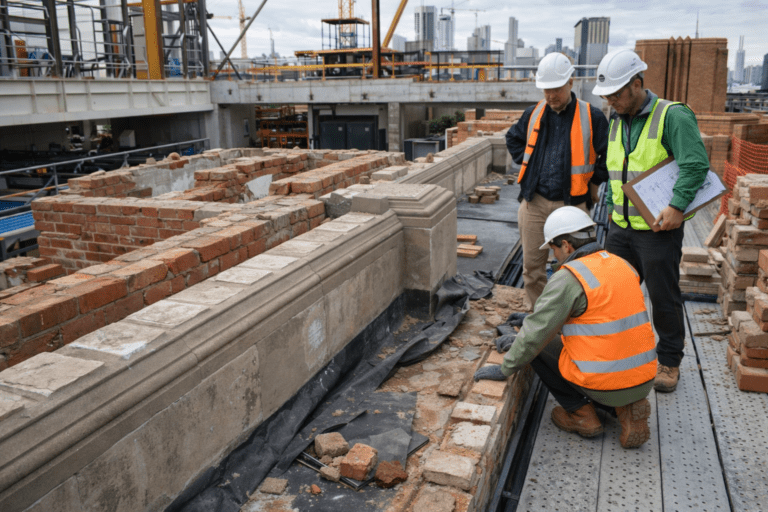
- Lime mortar instead of cement around historic masonry
- Natural stone repairs rather than concrete substitutes
- Timber edging instead of plastic near sensitive boundaries
- Permeable surfaces where historic drainage patterns matter
Cement mortar is a classic offender. Stronger than historic brick or stone, so it forces moisture through the weaker material instead. Looks fine initially. Then the faces start blowing. Cue long-term damage and awkward conversations.
I find it’s often cheaper in the long run to do it properly first time. Even if procurement grumbles.
Matching isn’t about perfection
There’s a misconception that repairs must be invisible.
They don’t. They need to be honest.
Overly perfect matching can be just as problematic as clumsy repair. New stone that looks artificially aged. Mortar tinted too precisely. It can end up reading as fake, which heritage officers tend to dislike more than subtle contrast.
A slight variation. A clear but respectful distinction between old and new. That’s usually spot on.
It’s a bit like extensions on period houses. You want harmony, not mimicry.
Sequencing works around sensitive assets
This is where practical heritage conservation really comes into its own.
Sequence badly and you risk vibration damage, accidental strikes, or environmental changes that destabilise old fabric. Sequence well and the heritage element barely notices what’s happening around it.
Some sequencing principles that tend to work:
- Stabilise heritage features early
- Protect before heavy works begin
- Avoid repeated loading near foundations
- Schedule intrusive works outside wet periods
- Monitor movement rather than guessing
Vibration is a big one. Old masonry doesn’t enjoy modern plant. Even relatively light machinery can cause cracking if used carelessly nearby.
I’ve seen projects pause major earthworks simply because monitoring showed subtle movement. Annoying at the time. Sensible in hindsight.
Temporary works are often overlooked
Permanent works get all the attention. Temporary works quietly cause most of the damage.
Access tracks cutting across historic landscapes. Storage compounds placed against old walls. Temporary fencing fixed into masonry because it was “just for a few weeks”.
You can guess how that ends.
Temporary measures around heritage assets should be:
- Reversible
- Non-invasive
- Properly briefed to site teams
- Checked regularly, not forgotten
It sounds obvious. Yet it’s still where many schemes slip up.
Working with archaeologists without losing momentum
Archaeology and infrastructure don’t have to be enemies.
Early engagement helps. So does honesty about programme constraints. Most archaeologists understand construction realities. They just don’t enjoy being brought in at the last minute and asked to work miracles.
Watching briefs. Strip-map-record approaches. Targeted evaluation. These tools exist for a reason.
When handled properly, archaeology becomes part of the workflow rather than a blocker. When handled badly, it becomes the thing everyone resents.
Neither outcome is inevitable.
Landscape works and heritage sensitivity
Landscape projects near heritage assets often look harmless. Trees. Paths. Planting. What’s the risk?
Roots. Drainage. Visual impact. Ground disturbance.
Planting the wrong species near historic walls can cause long-term damage. Deep-rooted trees placed without thought can undermine foundations decades later. Even changes in ground levels can alter moisture movement in ways that affect buried archaeology.
Good heritage-aware landscaping considers:
- Root behaviour and mature size
- Historic sightlines and views
- Traditional boundary treatments
- Ground level continuity
Sometimes the best decision is restraint. Less planting. Fewer interventions. Letting the site breathe.
That’s harder to sell than bold schemes, but often more appropriate.
Documentation is not the enemy
Nobody loves paperwork. But proper documentation protects everyone.
Photographic records. Method statements. Condition surveys. They’re not box-ticking exercises when heritage is involved. They’re evidence.
Evidence that damage wasn’t pre-existing. Evidence that agreed methods were followed. Evidence that changes were unavoidable and managed.
Without it, disputes become subjective very quickly.
Common techniques that work well on UK sites
Not a checklist. Just patterns that tend to succeed.
Soft edging solutions
Replacing concrete kerbs with stone setts or timber edging near historic assets can dramatically reduce visual and physical impact.
Hand-digging in sensitive zones
Slow, yes. But it avoids vibration and accidental strikes where services or archaeology might exist.
Trial pits before full excavation
Reduces surprises. Helps refine methods before committing fully.
Reuse of salvaged materials
Old stone, brick, or setts reused on site maintain continuity and reduce waste.
None of this is revolutionary. It’s just… thoughtful.
A quick comparison of approaches
| Aspect | Unsympathetic Approach | Heritage-Led Approach |
|---|---|---|
| Mortar | Cement-based | Lime-based |
| Access | Heavy plant everywhere | Defined routes, protection |
| Repairs | Full replacement | Minimal intervention |
| Planting | Fast-growing species | Context-appropriate species |
| Sequencing | Programme-driven | Asset-led |
Simple table. Big implications.
How heritage fits into wider environmental work
Heritage conservation doesn’t sit alone. It overlaps with ecology, drainage, landscape, and sustainability.
That’s why integrated delivery matters.
We provide heritage conservation services as part of broader environmental enhancements, which allows heritage considerations to be balanced alongside ecological gain, flood risk management, and landscape design rather than treated as an afterthought. When those conversations happen together, outcomes improve. Fewer compromises. Fewer surprises.
Heritage doesn’t get sidelined. It gets absorbed into the scheme.
That’s usually when it works best.
FAQs that tend to come up on site
Do all works near listed assets need listed building consent?
No. But many do. Early checks save time later.
Is using traditional materials always mandatory?
Not always. But alternatives need justification and testing.
Can modern techniques ever be acceptable?
Yes. If they’re reversible, discreet, and don’t harm significance.
Is heritage conservation expensive?
Poorly planned heritage conservation is expensive. Thoughtful planning usually isn’t.
A small tangent, but worth mentioning
British weather complicates everything.
Moisture movement. Freeze-thaw cycles. Long wet winters. All of it matters more on heritage assets than modern ones. Methods that work in dry conditions can fail spectacularly after a Midlands winter.
It’s why timing matters. And why shortcuts often come back to bite.
Bringing it back to delivery
At its core, practical heritage conservation is about respect.
Respect for materials that behave differently from modern ones. Respect for processes that need time. Respect for the fact that once heritage fabric is damaged, it can’t be un-done.
That doesn’t mean projects become fragile or precious. It just means they become smarter.
And when that happens, heritage stops being a risk and starts being a feature.
Conclusion: quiet competence beats grand gestures
The best heritage conservation work on infrastructure and landscape projects is often invisible.
No plaques. No big announcements. Just old assets sitting comfortably alongside new interventions, doing what they’ve always done.
Holding ground. Defining place. Carrying memory.
Get the materials right. Sequence the works carefully. Think before acting. Document properly.
Do those things and heritage conservation becomes less of a headache and more of a quiet success.
Which, frankly, is how it should be.

Killingley Insights is the editorial voice of NT Killingley Ltd, drawing on decades of experience in landscaping, environmental enhancements, and civil engineering projects across the UK.