Installing Exclusion Fencing That Works: Ecological Compliance, Site Safety, and the Details That Matter

There’s a particular type of problem that turns up on construction sites with some regularity. A great crested newt survey has flagged a nearby pond. An EPS licence has been obtained. Exclusion fencing is specified in the method statement. Someone installs it, ticks the box, and the programme moves on. Three weeks later, a newt turns up inside the exclusion zone during vegetation clearance – and everything stops.
Nine times out of ten, the investigation reveals the same thing. The fence was installed, but not correctly. A gap at the base where the mesh wasn’t properly secured. A join between two fence panels that was left unsealed. A section where the post spacing was too wide and the mesh had sagged. Small details, each of which seems minor until you’re standing on a halted site explaining to a client why clearance can’t resume today.
Installation quality is where ecological exclusion fencing either earns its specification or fails it. The design can be spot on. The materials can be right. And it can still not work if the installation isn’t done properly.
The Pre-Installation Stage – What Happens Before the First Post Goes In
Good exclusion fencing installation starts before the fence goes up. A site walkover to confirm the proposed fence line is appropriate – that it follows the correct boundary between retained habitat and the working area, that there are no access conflicts with the construction programme, that the ground conditions are suitable for the specified installation method. On sites where underground services run close to the fence line, service location checks need to happen before any digging or post driving begins.
The fence line itself needs to be clearly marked before installation – stakes or spray line indicating the exact route. On complex sites with multiple habitat features, curves in the fence line, or specific crossing points for access, that marking-out stage is where errors get caught before they become installation errors. A fence that’s installed a metre inside the intended line has effectively included a metre of habitat within the working zone that was supposed to be excluded.
Pre-clearance checks in the area where the fence is being installed are also needed on sites where protected species are already present. Installing a newt exclusion fence through habitat that might currently contain newts, without checking first, risks trapping animals on the wrong side of the fence or disturbing them during installation. The sequence matters: check the area, install the fence, then proceed with clearance activities within the fenced zone.
Installation Specifics – The Details That Determine Whether It Works
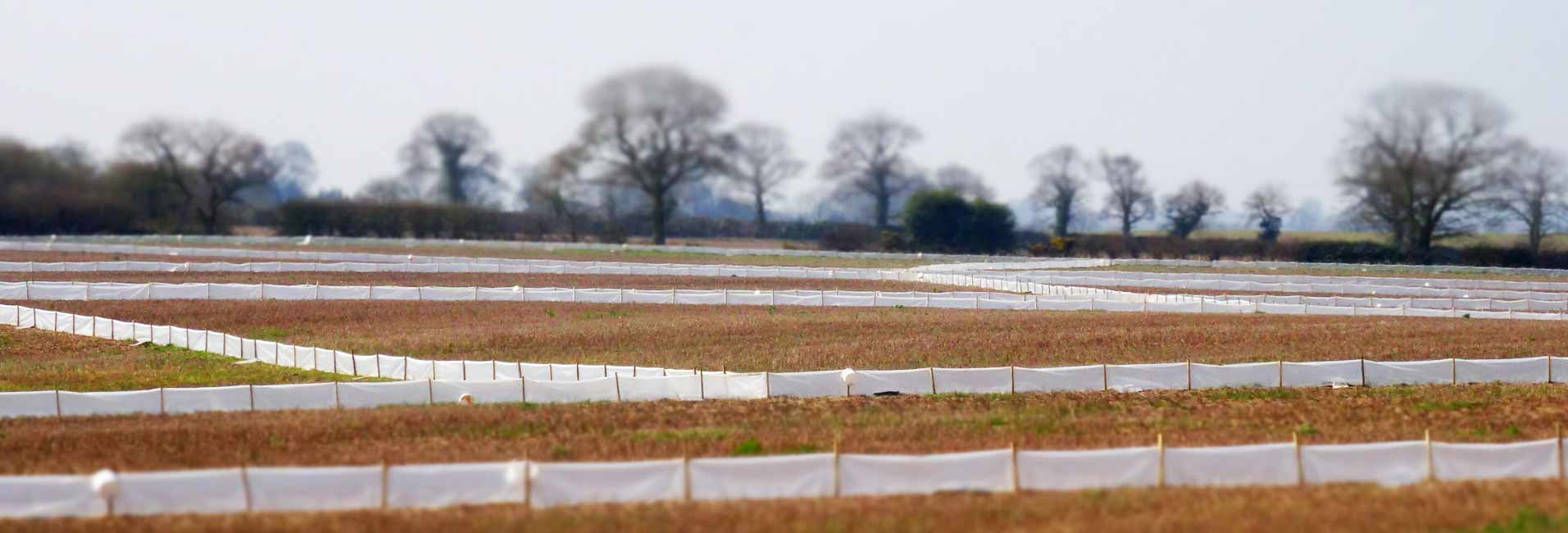
For amphibian and reptile fencing, the burial depth and base seal are the critical installation details. The standard for great crested newt exclusion fencing requires a minimum of 150mm of the fence buried as a horizontal apron at the base, facing away from the retained habitat. The purpose is to prevent animals digging under the fence from the habitat side. That apron needs to be laid flat and covered – not just pushed into a slot and left loose.
Post spacing for polypropylene amphibian fencing should be no more than 1.5 to 2 metres to prevent the mesh from sagging between posts. Sagging creates gaps at the base. Gaps at the base are where newts get through. This is not a complicated chain of causation, but it’s one that gets broken regularly when fencing is installed quickly under programme pressure with posts spaced at whatever the team considers “about right”.
Joins between fence panels need to be properly sealed – overlapping and secured, not just butted together. Panel ends at fence corners need to be folded and fixed rather than cut square and left with a gap. Gates and access points in the fence line need to be fitted with thresholds that eliminate the gap at the base when closed. Each of these is a potential failure point if it’s not addressed.
For badger fencing, the requirements are heavier in every respect. The mesh needs to be a minimum 13-gauge welded or woven wire, posts at no more than 3-metre centres, and a buried skirt of at least 300mm laid horizontally away from the badger side – wider on sites with confirmed sett activity nearby, where digging pressure will be greater. Badgers are systematic in their fence investigations. Any weakness gets found.
Pitfall Traps – An Integral Part of Amphibian Fence Systems
Pitfall traps – sunken buckets or containers set into the ground at the base of the fence – are a standard component of amphibian exclusion fence systems used as part of licensed mitigation. Their purpose is to trap any animals that attempt to move along the fence line and are caught between the fence and the working area. Trapped animals are checked by the supervising ecologist during daily pre-clearance inspections and either translocated or confirmed as not being the target species.
Trap placement, orientation, and maintenance are all specified – typically at no more than 10-metre intervals along the fence, installed flush with the ground surface, with a small ramp to allow animals to enter and partial cover to provide shade and reduce desiccation risk. They need to be checked every day during the active clearance period. Every day. Not most days. Every day, because an animal trapped overnight without water or shade in warm weather is at significant welfare and legal risk.
Trap records – date, trap location, species found, action taken – form part of the licence compliance documentation and should be maintained throughout the clearance period. If trapping results suggest higher-than-expected animal activity within the exclusion zone, that’s a flag to review fence integrity and potentially extend the trapping period before proceeding with clearance.
Ecological Compliance – Sign-Off and Documentation
On licensed mitigation schemes, the installed exclusion fence needs to be formally signed off by the supervising ecologist before any clearance or ground disturbance activity begins in the adjacent area. That sign-off is based on a physical inspection of the installed fence against the specification – checking burial depth, post spacing, panel joins, gate thresholds, trap installation. It’s not a desk exercise.
Our ecological exclusion fencing services include that installation verification as standard – because the compliance obligation doesn’t sit with the ecologist who designed the mitigation scheme if they haven’t had the opportunity to confirm the installation meets the specification it was based on. The sign-off is the point where specification and installation connect, and it needs to happen before activity proceeds rather than being assumed.
Documentation of the installed fence – photographs at regular intervals along the fence line, record of post spacing and burial depth checks, note of any site-specific variations from the standard specification and the justification for them – provides the audit trail that demonstrates due diligence in the event of any subsequent query or incident.
Site Safety Alongside Ecological Compliance
Exclusion fencing on construction sites sits within the broader site safety management framework. The fence line marks a boundary that operatives need to understand and respect – not just ecologically but for site management purposes. Clear signage indicating the ecological exclusion zone and its significance helps ensure that workers unfamiliar with the ecological context understand that the fence isn’t just temporary hoarding to be moved if it’s inconvenient.
Briefing site operatives – particularly plant operators and groundworkers whose activities are most likely to bring them into contact with the fence line – on the purpose of the exclusion zone and what to do if they find an animal within it is a standard induction item on ecologically sensitive sites. It’s a five-minute conversation that can prevent a programme-stopping incident. Worth doing properly.
The fence line should also be included in the site’s emergency and evacuation planning – access routes for emergency vehicles need to account for it, and gates in the exclusion fence need to be openable without specialist knowledge in an emergency. Those aren’t conflicts between ecological compliance and site safety; they’re planning considerations that need to be resolved at the design stage.
Common Installation Failures and How to Avoid Them
In the interest of being genuinely useful, here are the installation failures that come up most often and what prevents them:
| Common Failure | Consequence | Prevention |
|---|---|---|
| Insufficient burial depth of base apron | Animals dig under fence from habitat side | Check burial depth at regular intervals; use marked posts as reference |
| Wide post spacing causing mesh sag | Gap at base allows small animals through | Specify and check maximum post spacing; add intermediate stakes where ground is uneven |
| Unsealed panel joins | Animals pass through at join points | Overlap panels by at least 150mm and secure at both edges |
| Gap under access gates | Animals use gate threshold as crossing point | Install sealed threshold strip; check clearance with gate closed |
| Mesh sagging away from posts over time | Base gap develops between inspections | Use cable ties at post points and intermediate fixings; regular tension checks |
| Vegetation growth lifting base seal | Apron raised off ground by root pressure | Clear vegetation along fence line before installation; monitor and clear during works |
| Pitfall traps not flush with ground | Animals walk over rather than into traps | Set traps before final ground levelling; check flush installation at each inspection |
Most of these failures are avoidable through a combination of correct specification, competent installation, and regular inspection. None of them are exotic problems. They’re the ordinary results of ordinary shortcuts taken under ordinary programme pressure. The answer is a clear specification, an installer who understands why the details matter, and an inspection regime that catches problems before they become incidents.
Frequently Asked Questions
How long does installation typically take?
For a straightforward amphibian exclusion fence on accessible ground, an experienced two-person team can typically install around 100 to 150 metres per day. Badger fencing is slower due to the heavier materials and deeper burial requirement – perhaps 60 to 80 metres per day in good conditions. Difficult ground, rocky soil, underground services, or complex fence lines with multiple corners and access points will reduce those rates. Programme planning should allow realistic installation time rather than the theoretical maximum.
What qualifications should the installation team have?
Installers don’t need a specific licence to install exclusion fencing. But they do need to understand the specification and why it matters – which means either ecological training or a thorough briefing from the supervising ecologist before installation begins. Teams installing fencing as part of a licensed mitigation scheme should be familiar with the licence conditions, the target species, and the consequences of installation errors. Competence is demonstrated by the quality of the installation, not by a certificate.
Can exclusion fencing be installed in all weather conditions?
In principle yes, though heavy rain, frozen ground, and strong winds all create practical difficulties. Frozen ground makes burial of the base apron and driving posts significantly harder. Heavy rain can affect the integrity of soil backfilled over the apron. In practice, installation is easier and the result more reliable in dry, mild conditions. Where installation has to take place in difficult weather, the inspection before sign-off becomes even more important to confirm the burial and base seal are as specified.
What should be done if the fence is damaged by site activity?
Any section of fence that has been damaged – knocked by machinery, disturbed by material storage, pulled from its fixings – should be treated as a potential breach and repaired before further site activity proceeds in the adjacent area. The supervising ecologist should be notified and the affected section inspected before repair, in case an animal has moved through the breach during the period it was open. Repair should restore the fence to its original specification – not just reattach mesh that’s come loose, but confirm burial depth and base seal are intact.
It’s About the Outcome, Not the Installation
Exclusion fencing exists to produce a specific outcome – keeping wildlife safe and habitats protected during works that would otherwise harm them. The specification, installation, and maintenance are all in service of that outcome. When any part of that chain is treated as a box-ticking exercise rather than a genuine means to an end, the outcome suffers.
Genuinely effective exclusion fencing isn’t complicated. It requires the right specification for the species, proper installation to that specification, daily checks during active mitigation phases, prompt repair of any damage, and clear responsibility for all of the above. Projects that build all of that into their ecological management plan from the outset tend to have far fewer problems than those that leave it to be sorted out once the fence is actually needed.
And the ones that have problems because they cut corners? They spend a lot more time and money sorting those problems out than the proper installation would ever have cost.

Killingley Insights is the editorial voice of NT Killingley Ltd, drawing on decades of experience in landscaping, environmental enhancements, and civil engineering projects across the UK.