Exclusion Fencing Explained: How It Protects Habitats and Controls Wildlife Movement on Site

Most people’s first encounter with exclusion fencing is on a construction site, usually in the form of a row of orange plastic mesh staked into the ground around a tree root protection area or a damp corner that someone has flagged as potential great crested newt habitat. It looks minimal. Temporary. Easy to ignore.
Which is partly why it gets ignored – and partly why, when it does get ignored, the consequences can be considerably more serious than the fencing itself looked.
Exclusion fencing serves two related but distinct purposes: keeping wildlife out of areas where it would come to harm, and keeping it within areas where it needs to remain. Both matter. Both require the fencing to be correctly specified, correctly installed, and properly maintained for the duration it’s needed. And both involve legal obligations that don’t disappear just because a programme is under pressure or someone decides the fencing is “probably fine” moved a metre to the left.
Worth understanding what it actually does and why the details matter.
The Two Directions of Exclusion
Exclusion fencing either keeps animals in or keeps them out. Simple enough in principle. In practice, those two objectives require different approaches and, sometimes, different fence types.
Keeping animals out of an active working area – a construction zone, a vegetation clearance area, a road corridor under construction – is probably the more familiar application. You’ve identified habitat adjacent to the works that supports protected species. Those animals need to be prevented from moving into the working zone during operations, where they’d be at risk from machinery, vegetation clearance, or habitat disturbance. The fence creates a physical barrier between the working area and the retained habitat, in conjunction with pre-clearance checks and, in some cases, licensed translocation of any animals found within the work zone before clearance begins.
Keeping animals within a defined area is a different scenario – typically used when animals are being retained on a receptor site during mitigation. Great crested newt mitigation is the classic example: newts are translocated from a development site to a pre-prepared receptor site, and exclusion fencing around the receptor prevents them dispersing away from it before they’ve established. Same principle, opposite direction.
Some schemes need both at the same time – preventing animals from entering the development footprint while retaining translocated animals on the receptor site. On larger or more complex sites, that can mean two distinct fence systems operating simultaneously, which requires careful spatial planning and clear site management instructions.
Which Species, Which Fence
Different species require different fence specifications. A fence that works for great crested newts won’t necessarily work for badgers. A reptile fence is a different thing from a water vole barrier. Getting this wrong – specifying or installing a fence type that isn’t appropriate for the target species – means the fence doesn’t do its job, which means the mitigation is ineffective, which means the licensing condition isn’t met. That’s a problem.
Here’s an overview of the main species-specific approaches and what drives the specification differences:
| Target Species | Typical Fence Type | Key Specification Requirements |
|---|---|---|
| Great crested newt | Smooth-sided amphibian fencing – polypropylene or similar | Minimum 400mm above ground, 150mm buried apron, no gaps at base, pitfall traps incorporated |
| Common reptiles (grass snake, slow worm, common lizard, adder) | Fine mesh or specialist reptile barrier | Minimum 500mm above ground, buried skirt, smooth surface to prevent climbing, no gaps exceeding 2mm |
| Badger | Heavy-gauge wire mesh or specialist badger fence | Minimum 1m above ground, 300mm buried horizontally, robust posts, checked for sett activity before installation |
| Water vole | Fine mesh barrier, often combined with riparian habitat protection | Minimum 600mm above ground, 300mm buried, attention to water crossings and bank features |
| Hedgehog | Often low mesh or solid boarding depending on context | Mesh size critical – must prevent passage; gaps at base are a common failure point |
| Otter | Heavy stock fence with outward-facing overhang or electric deterrent | Usually combined with habitat protection along watercourses; electric systems require licence consideration |
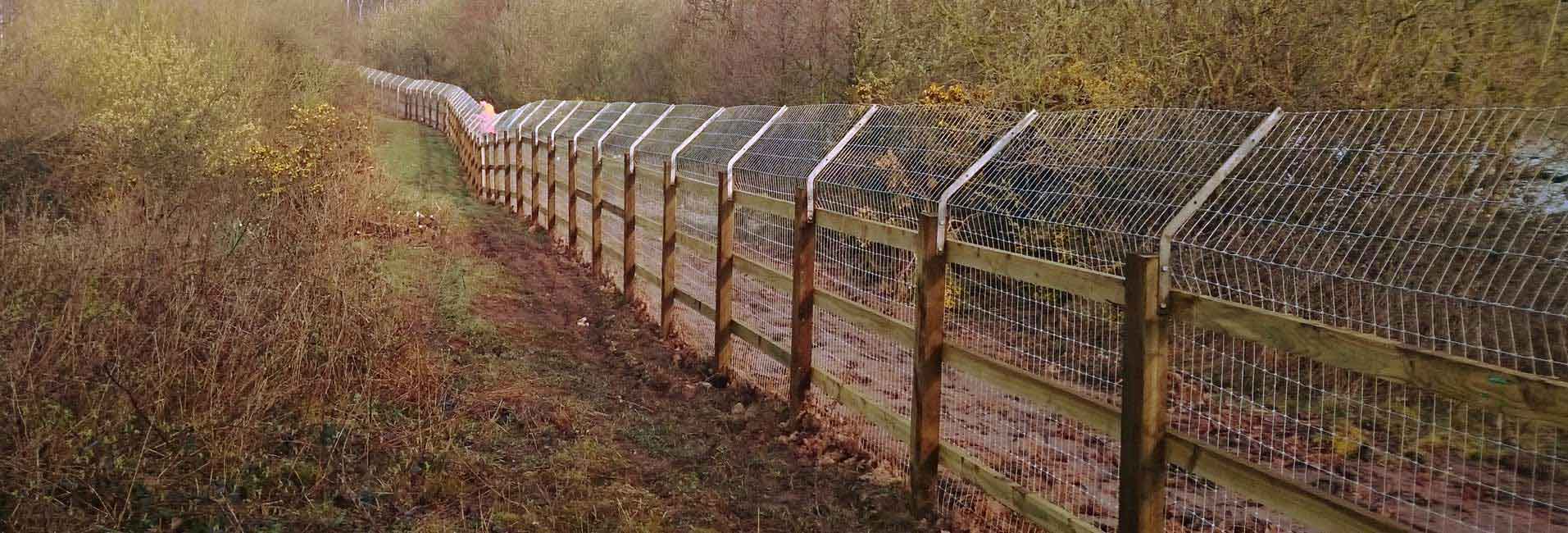
Material choice, post spacing, burial depth, and surface finish all affect whether a fence actually excludes the target species. These aren’t arbitrary specification details – they’re derived from the biology of the animal. A great crested newt can squeeze through a gap that looks impossibly small. Reptiles will find and exploit any discontinuity at ground level. Badgers, given sufficient motivation, will push through or under a fence that isn’t robust enough or deeply enough buried.
Habitat Protection – The Other Application
Exclusion fencing isn’t only about species. Protecting habitats from physical damage is an equally important function, particularly on construction and infrastructure sites where machinery movements, material storage, and general site activity can cause irreversible damage to habitats outside the development footprint if they’re not physically protected.
Root protection areas around retained trees are the obvious example. Planning conditions and arboricultural method statements frequently specify exclusion fencing at a defined radius from retained trees – typically calculated from the trunk diameter – to prevent soil compaction, root severance, and physical damage to bark and crown structure during construction. Orange Heras-style mesh on stakes is the most common approach, though for high-value or high-risk trees, more robust temporary fencing may be specified.
Watercourses, wetland features, species-rich grassland, and ancient hedgerows can all benefit from physical exclusion during construction phases. I find that sites where ecological features are physically fenced off from the outset tend to have far fewer incidental damage issues during works than sites where the protection relies solely on site briefings and management instructions. People are busy. Machinery operators are focused on the job. A physical barrier is considerably more reliable than an instruction to be careful.
Our exclusion fencing for habitat protection work covers both the species-specific mitigation fencing and the broader habitat protection function – because on most live construction sites, both are needed and they have to work together without creating conflicts in access or site management.
Legal Context – Why This Isn’t Optional
Protected species licensing in England sits under the Habitats Regulations 2017 and the Wildlife and Countryside Act 1981. Great crested newts, bats, water voles, and other European Protected Species require a European Protected Species (EPS) licence from Natural England before development activity that would disturb or harm them can proceed. That licence will specify mitigation measures – and exclusion fencing is almost always one of them.
Failure to install fencing as specified in the licence, or allowing it to fall into disrepair during the licensed activity period, is a breach of the licence conditions. The consequences range from suspension of licensed activities – which stops the development programme – through to prosecution under wildlife legislation. Neither is a good outcome.
It’s also worth noting that the ecological consultant who designed the mitigation scheme and the contractor who installed the fencing both have roles in ensuring compliance. If a fence is installed incorrectly and the licensed activity proceeds on the basis of that fence, the liability question becomes complicated. Proper sign-off of installed fencing by the supervising ecologist – before clearance or disturbance activities begin – is standard practice for good reason.
Wildlife Corridors and Managed Permeability
Exclusion fencing creates barriers. Barriers interrupt wildlife movement. On some sites and for some species, that interruption needs to be managed carefully to avoid creating long-term fragmentation effects – separating populations of animals that previously had connectivity across a landscape.
For infrastructure projects – roads, railways, utilities corridors – mitigation designs frequently include wildlife underpasses, culverts, or ledges that allow animals to cross the barrier at defined points. Badger crossing points in road schemes are a familiar example. Otter holts and ledges under bridges for riparian species. Amphibian underpasses beneath road crossings where newt populations straddle the route.
These features have to be integrated with the exclusion fencing design – the fence guides animals to the crossing point rather than simply blocking them. A fence without appropriate crossing provision for a species with an established movement route through the site is half a solution. Getting the whole system to function correctly requires the exclusion fencing, the crossing features, and the habitat on both sides to be designed as an integrated system rather than specified in isolation.
Maintenance During the Works Period
Installing exclusion fencing correctly is the first half. Keeping it in functional condition throughout the works period is the second – and it’s the half that tends to get less attention.
Construction sites are dynamic environments. Fencing gets knocked by machinery. Ground conditions change with weather (and the UK is not short of wet weather) causing posts to shift or the base seal to open. Access gates get left open. Material storage gets nudged against a fence line. Contractors unfamiliar with the ecological significance of fencing treat it as any other temporary hoarding.
Regular inspection – at minimum weekly, and after any incident that might have affected the fence – is standard good practice. Any breach needs to be repaired before further site activity proceeds in the adjacent area. On licensed mitigation schemes, the supervising ecologist typically carries responsibility for confirming that the fence remains in acceptable condition at agreed intervals.
A fence inspection log – simple enough, just a dated record of each inspection and any remedial action taken – provides the audit trail that demonstrates due diligence if the installation is ever questioned. It’s not a bit of a faff, it’s protection.
Frequently Asked Questions
Do I always need a licence to install exclusion fencing?
Not for the fencing itself – installing a fence doesn’t require a licence. The licence is required for the activity the fencing is enabling, which typically involves disturbing, handling, or displacing protected species. The fence is part of the method statement that justifies the licence application. That said, on sites where protected species are present, the installation of exclusion fencing should be supervised or signed off by a suitably qualified ecologist even where the fencing itself isn’t a licensed activity.
How long can exclusion fencing remain in place?
As long as the works require it – there’s no fixed maximum duration, though the licensed activity period will have a defined timeframe. For long construction programmes, fencing may be in place for one to three years. Condition of the fencing needs to be maintained throughout, and on extended programmes it’s worth reviewing whether the original fence specification remains appropriate as site conditions and activity patterns change.
What happens if an animal is found inside the exclusion fence?
Work in the affected area stops until a licensed ecologist has assessed the situation and either confirmed the animal has moved on or carried out a licensed handling operation to remove it safely. Finding a great crested newt inside a newt exclusion fence during active clearance work isn’t unusual – it means the pre-clearance checks need to be more thorough, and it usually prompts a review of fence integrity. Licensed ecologists have procedures for this. The important thing is that site operatives know to stop work and report it rather than proceeding.
Can exclusion fencing double as site security fencing?
Generally not without compromising one function or the other. Security fencing prioritises strength and anti-climbing properties. Ecological exclusion fencing prioritises a specific mesh size, burial depth, and surface finish suited to the target species. In some cases a robust ecological fence – badger fencing, for instance – can provide incidental security, but treating ecological fencing as equivalent to security hoarding typically leads to the ecological specification being compromised. They serve different purposes and should be specified separately.
Getting It Right from the Start
Exclusion fencing is one of those elements of ecological mitigation that looks simple, gets underestimated, and then causes disproportionate problems when it’s done inadequately. The specification matters. The installation detail matters. The maintenance matters. And the integration with the broader mitigation scheme – the surveys, the licence, the receptor site, the crossing points – matters.
None of that is especially complicated when it’s planned properly from the outset. The problems tend to arise when fencing is treated as an afterthought – procured at short notice, installed by operatives who haven’t been briefed on why it’s there, and left unmonitored once it’s up. On a site with a live EPS licence, that approach carries real risk.
Planned well, installed correctly, maintained properly – exclusion fencing does exactly what it’s supposed to. Which is a fairly quiet result, as these things go. But quiet is exactly what you want.

Killingley Insights is the editorial voice of NT Killingley Ltd, drawing on decades of experience in landscaping, environmental enhancements, and civil engineering projects across the UK.