Cut Haulage, Cut Waste: The Practical Case for On-Site Material Recycling in Earthworks

Earthworks generate material. A lot of it. A medium-sized housing development might move tens of thousands of tonnes of soil and arisings before a single foundation is poured – and historically, a large proportion of that material left site on the back of lorries, costing money to dispose of and being replaced by imported aggregate that cost money to buy in. It made sense in an era when tipping was cheap and aggregate was cheaper.
Neither of those things is reliably true any more.
Landfill tax in the UK now sits at £126.15 per tonne for non-inert waste and £4.05 per tonne for inert waste (as of the current financial year). Primary aggregate levy adds cost to virgin materials. Diesel prices have been volatile for long enough that anyone still treating haulage as a background cost rather than a line item worth scrutinising is probably leaving money on the table. On top of all that, planning authorities and clients with sustainability commitments are increasingly looking at material efficiency as part of project appraisal.
On-site recycling – treating and reusing excavated material rather than removing and replacing it – is a direct response to all of that. Worth looking at what it actually involves.
What Can Be Recycled On-Site
More than most people assume. The instinct on a lot of projects is to treat excavated material as a problem to be removed. But a proper materials appraisal at the start of a project usually finds that a significant proportion of what comes out of the ground can be treated and reused on-site in some form.
Clay and cohesive soils – the default problem material on sites across the Midlands and the North – can in many cases be stabilised with lime or cement binders and reused as engineered fill, capping layer, or structural platform. What arrives on site as an unworkable, over-wet material leaves as a properly specified, load-bearing layer. That’s genuinely useful.
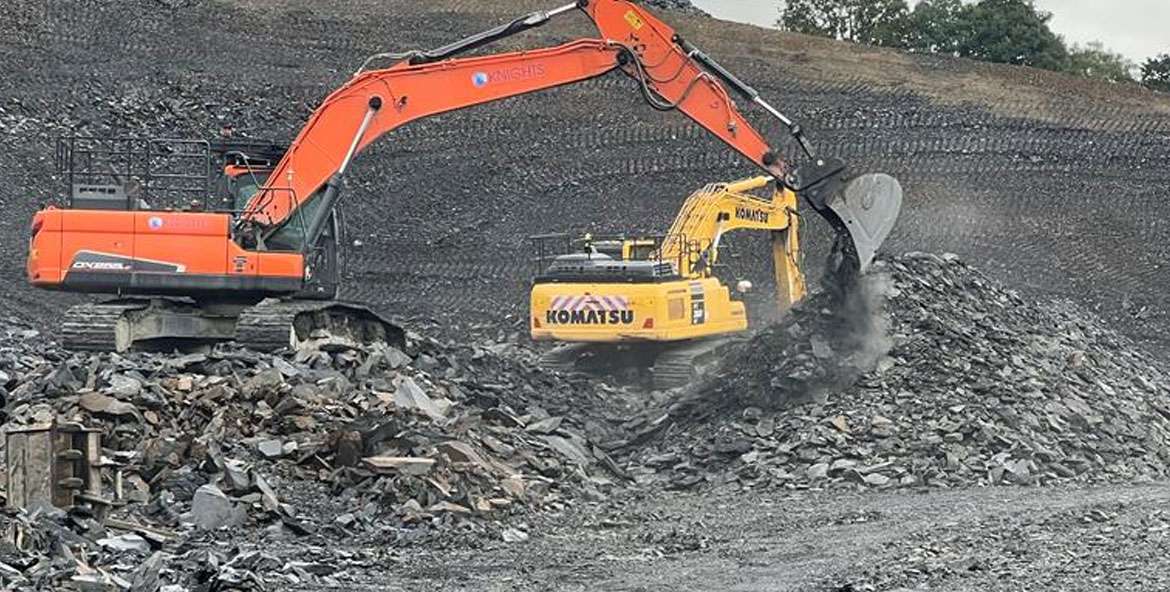
Concrete arisings from demolition – broken slabs, foundation rubble, old hardstanding – can be processed through mobile crushing plant to produce recycled aggregate. Depending on the specification required, that material might meet the grading requirements for sub-base, drainage blanket, or general fill. Not always – contamination or mix of material types can rule it out for structural applications – but often enough to justify the assessment.
Crushed brick and masonry from demolition works is similar. It produces a material that’s been used in road sub-base applications for decades. Granular material from excavations – sands and gravels – can sometimes be screened and reused directly without treatment. And topsoil, properly stripped and stockpiled, can be reused for reinstatement or landscaping rather than being replaced with bought-in material.
Those providing on-site materials reuse and recycling solutions can assess excavated material against the specification requirements for the specific application on that site – which is a more useful starting point than a generic assumption about what will or won’t work.
The Haulage Maths
Haulage costs on earthworks projects are genuinely significant and I think they get underappreciated at the estimation stage. Consider a standard 20-tonne articulated tipper. Add in the tipping charge, the loading time, travel time, and the programme impact of a large number of movements through a constrained site access, and the cost per tonne of material disposed of off-site is usually quite a bit higher than the headline tip price suggests.
Multiply that by the volume of material, add in the equivalent cost for incoming aggregate to replace what’s been removed, and the economic case for on-site recycling starts to look fairly compelling even before sustainability considerations enter the picture.
A rough comparison – these figures vary considerably by project size, material type, and location, but the order of magnitude is fairly representative:
| Activity | Typical Cost Range (per tonne) | Notes |
|---|---|---|
| Off-site disposal (inert) | £8 – £25+ | Tip charge plus haulage; gate prices vary widely |
| Landfill tax (inert) | £4.05 | Current rate; added to above |
| Primary aggregate (imported) | £12 – £30+ | Type 1 sub-base, delivered; varies by region |
| In-situ lime stabilisation | £8 – £18 | Approximate treatment cost; replaces disposal and import |
| Mobile crushing / screening | £5 – £15 | Processing cost only; subject to volume and material type |
So for a project disposing of, say, 5,000 tonnes and importing 3,000 tonnes of sub-base, the combined cost of disposal and import could be in the region of £150,000 to £250,000 depending on location and conditions. On-site treatment of that material – where viable – might cost a third to a half of that. The saving isn’t trivial.
Reducing HGV Movements – More Than a Cost Issue
HGV movements matter beyond the direct financial cost. Planning conditions on residential and commercial developments frequently include limits on the number of heavy vehicles per day or per hour, or restrictions on the hours within which lorry movements can take place. In urban areas particularly – think a brownfield site in Leicester or a regeneration scheme in Wolverhampton – those conditions can constrain the programme significantly if a large volume of material needs to move off-site.
Fewer HGV movements also means reduced road wear on the routes being used, lower community impact during works, and a better relationship with the local authority and nearby residents. None of those things directly show up on the project P&L, but they all affect how smoothly a project runs. I find that the projects with the most difficult community relations tend to be the ones where there’s a constant stream of lorries hammering through a residential area for weeks on end.
And there’s a programme point here too. On-site processing means material is being treated and made usable while earthworks are still ongoing – rather than a sequential process of remove everything, then bring everything back in. That overlap can compress programme quite meaningfully on larger sites.
What On-Site Recycling Requires
It’s not without its own requirements, obviously. Space is the main one. Mobile crushing and screening plant needs room to operate and room to stockpile outputs. In-situ stabilisation machinery needs an unobstructed working area. On highly constrained urban sites, that space simply might not be available – which limits the options or requires careful sequencing to create temporary working areas as the project progresses.
Material assessment is essential before committing to a recycling approach. Ground investigation data, chemical testing for contamination, plasticity index testing for soils proposed for stabilisation – these aren’t optional extras. They’re what tells you whether the material is actually suitable for the intended reuse application. Skipping that step and discovering on-site that the material isn’t what you assumed is the kind of thing that turns a cost saving into a cost overrun.
Equipment mobilisation also needs to be factored into programme. A specialist stabiliser or a mobile crusher isn’t always immediately available – lead times for plant of that type can run to several weeks during busy periods. That’s relevant to the procurement and programme planning, not just the technical approach.
The Waste Classification Dimension
Keeping material on-site and reusing it within the same project boundary simplifies the waste picture considerably. Once material crosses a site boundary, waste classification, carrier registration, consignment notes, and potentially environmental permits become relevant. None of it is unmanageable, but it adds administrative overhead and, depending on the classification, potential cost.
On-site reuse under the U1 exemption (using waste on the land it was produced) or the Excavated Materials Protocol removes or reduces most of that overhead. The Excavated Materials Protocol in particular allows uncontaminated, naturally occurring material to be transferred between sites without waste classification – but it has specific criteria that need to be met and documented. Worth getting that advice early, not mid-earthworks.
Frequently Asked Questions
Does on-site recycling affect the quality of the finished earthworks?
Not if it’s done properly. Treated and recycled materials used in structural applications need to meet the same specification requirements as any other fill – which means they’re tested and verified against those requirements before use. The finished layer needs to achieve the same compaction and strength targets regardless of where the material came from. Recycled doesn’t mean below-standard.
What if the recycled material doesn’t meet specification?
Then it either needs further treatment or it can’t be used in that application. That’s why the material assessment at the start matters – it avoids the situation of treating and placing material only to find out it doesn’t pass the acceptance testing. A properly structured earthworks specification includes hold points where material is tested before placement, which catches problems before they become expensive ones.
Can contaminated material be recycled on-site?
Depends on the nature and level of contamination, and what it’s being reused for. Some low-level contamination can be managed within a site-specific risk assessment that allows reuse in certain locations or applications. Higher-level contamination typically requires either off-site treatment or disposal. This is an area where the environmental consultant’s role is important – the decision needs to be based on a proper site contamination assessment, not a guess.
Does the approach work on small sites?
For in-situ stabilisation, the economics start to stack up from a few thousand square metres. For mobile crushing and screening, volumes of a few hundred tonnes start to become worth assessing. Below those thresholds, the mobilisation cost of specialist plant often outweighs the saving. Smaller sites aren’t entirely excluded – manual or smaller-scale recycling of material is always possible – but the really significant savings tend to be on medium-to-large schemes.
Worth Doing the Maths
The point isn’t that on-site material recycling is always the answer. Sometimes the ground conditions don’t support it. Sometimes the contamination picture rules it out. Sometimes the site is too constrained for the plant to work efficiently.
But on a large enough proportion of earthworks projects, there’s a genuine opportunity to reduce haulage movements, cut disposal costs, avoid the import of primary aggregate, and shorten programme – all at the same time. That combination doesn’t appear very often in construction. When it does, it’s worth taking seriously.
Running the numbers properly at the start of a project – rather than defaulting to the traditional dig-and-dump approach because that’s what the last tender assumed – is consistently the difference between projects that manage their earthworks costs well and those that don’t.

Killingley Insights is the editorial voice of NT Killingley Ltd, drawing on decades of experience in landscaping, environmental enhancements, and civil engineering projects across the UK.