On-Site Crushing and Screening: Reducing Waste and Haulage on Major Projects

You know that feeling when you stand by the gate and watch wagon after wagon trundle out, loaded with “waste”, while the procurement team is booking in fresh aggregate for next week? It’s not exactly inspiring. It’s also, on a lot of major schemes, quietly expensive.
On-site crushing and screening is one of the few levers that can reduce cost pressure, cut lorry movements and make a programme more resilient. Not in a glossy-sustainability-brochure way. In the day-to-day reality of muckshift, haul roads, stockpiles and someone asking why the site is backing up again.
Done well, it keeps usable material on site and turns it into a predictable product you can actually build with. Done badly, it’s a noisy bit of kit that creates dust, arguments, and a pile nobody wants. So let’s talk about what “done well” looks like, with UK site conditions in mind. Rain, tight access, neighbours, the lot.
Why “waste” becomes the default
Big projects generate big arisings. Demolition concrete. Old slabs. Kerbs. Bound pavement layers. Oversize from bulk excavation. It all stacks up quicker than you’d like, especially when you’re trying to hit production targets and keep temporary works under control.
At pre-con stage, disposal is often the easy assumption. It’s measurable. It’s familiar. You can put a number against it and move on. Reuse, on the other hand, asks awkward questions: Where’s the processing area? What’s the feedstock quality? What does the spec allow? Who’s testing it? It feels like a faff, so it gets parked.
And yet, the UK waste picture makes that approach hard to defend. Construction, demolition and excavation accounts for around three-fifths of total UK waste generation. Whether you quote 60% or 61%, the point’s the same. It’s the bulk of it. If you’re running major earthworks and you’re not thinking about material reuse, you’re ignoring the biggest pile on the table.
What on-site crushing and screening is, in plain terms
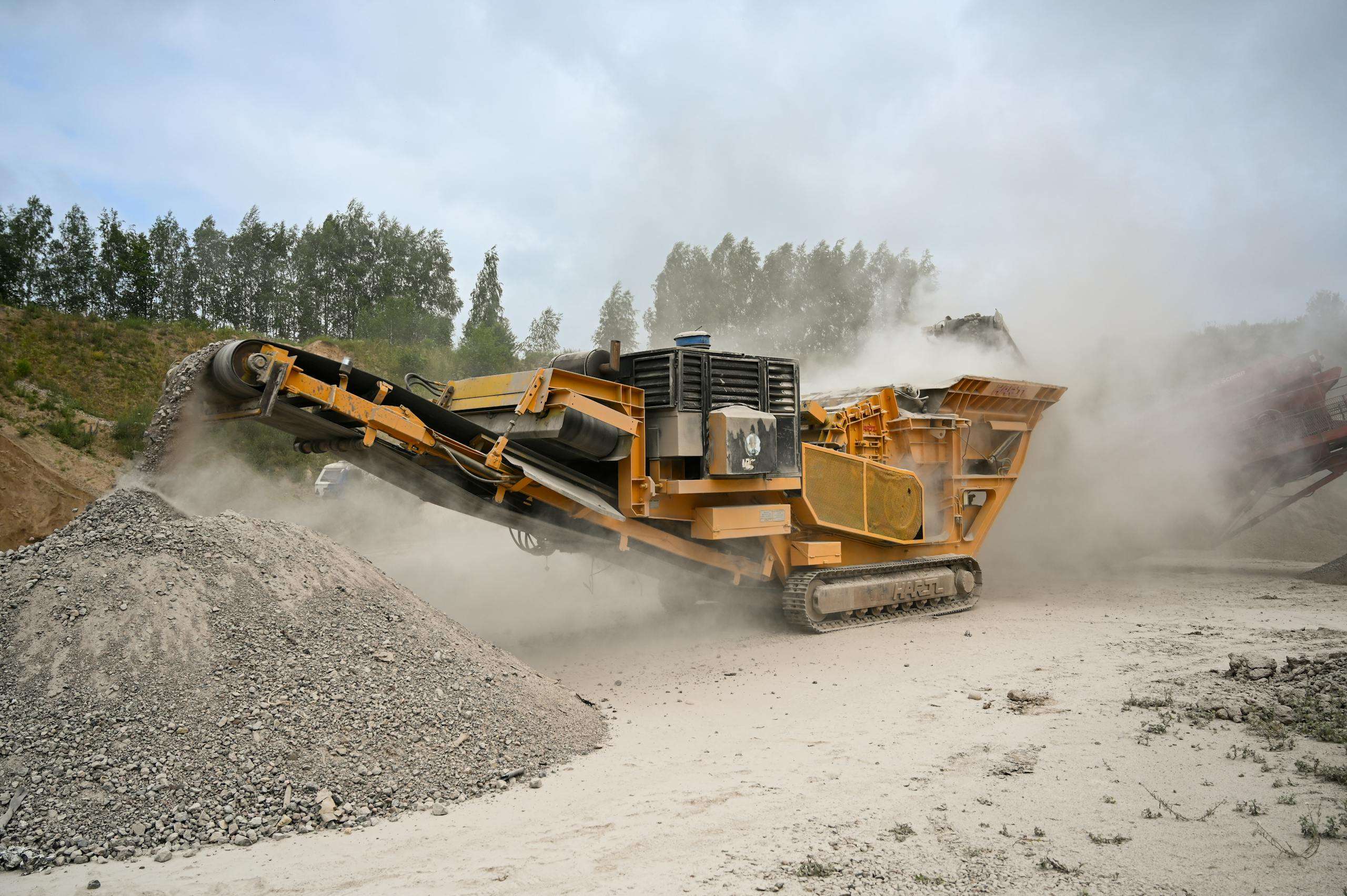
It’s not mysterious. Crushing breaks down hard materials such as concrete, brick and stone into smaller, usable aggregate. Screening separates that material into consistent size fractions, removes oversize, and helps control fines.
On site, the “useful outputs” usually land in a few practical buckets:
- capping and formation improvements (subject to spec)
- sub-base type material for roads and yards
- haul road construction and maintenance layers
- general engineered fill, where permitted and tested
Not every output suits every application. That’s the bit people gloss over. You don’t just crush something and magically get Type 1 every time. Feedstock matters. Process matters. Testing matters. Weather matters too, annoyingly.
Haulage is a cost line that behaves like a leak
Haulage doesn’t always look scary on day one. It creeps. A slightly longer run to tip because the nearest facility is full. A diversion on the A38. A slow-down at a pinch point near a housing estate because it’s school run time and the traffic management plan is being “reviewed”. You get the idea.
Fewer lorry movements isn’t just a saving on a spreadsheet. It’s fewer interfaces to manage. Fewer bookings. Less queuing. Less chance of a supplier calling to say the weighbridge is down and everything’s stopped for half a day. Less risk of neighbour complaints when the route runs past semi-detached streets or a village high street that was never meant for constant HGV traffic.
Somebody always asks, “How many wagons are we talking?” Fine. Here’s the simple logic: if you keep X tonnes on site and reuse it, you reduce export journeys, and you reduce import journeys. Two movements avoided for one decision. It doesn’t always go 1:1, but it’s a decent starting point.
Where the savings come from
It helps to be honest here. You don’t save money because a crusher exists. You save money because the material flow changes.
| Where the saving shows up | What changes | What it avoids |
|---|---|---|
| Disposal | Less material exported as waste | Tip fees, haulage, admin |
| Imported aggregate | Processed product substitutes virgin material | Purchase cost, delivery slots, delays |
| Double handling | Better stockpile control and sequencing | Extra plant time and rework |
| Programme resilience | Less dependency on external capacity | Stop-start days when supply or disposal is constrained |
| Stakeholder pressure | Fewer HGV movements through communities | Complaints, restrictions, reputational damage |
On a large scheme, you tend to feel the saving before you even fully “prove” it. The site runs smoother. The gate is calmer. The haul road isn’t constantly being chewed up by unnecessary traffic. Small things. But small things stack up.
Quality control – the boring part that keeps you out of trouble
Here’s the awkward truth: most failures in on-site processing are quality failures, not equipment failures. The machine usually works. It’s the feedstock and controls that don’t.
So, what does “control” mean in practice?
Segregation. Keep the right materials going into the crusher. Concrete and clean hard arisings in. Timber, plastics, gypsum, general rubbish out. If you’ve got any suspicion of asbestos risk from older structures, you deal with that properly and early. Nobody wins by ignoring it.
Removal of reinforcement and oversized contaminants. Steel is normal in crushed concrete feedstock, but it must be handled with the right magnets and picking. Otherwise you end up with sharp inclusions and a product that’s a nightmare to place and compact.
Grading and fines management. Too much fine material and your output behaves like mud when it’s wet, and like dust when it’s dry. Not ideal either way. Screening helps, but it needs maintenance and the right set-up. And yes, wet British winters make this harder. I was going to pretend it’s manageable with a perfect plan, but… no. Some days you’re fighting moisture, end of story.
Testing and compliance. Sampling schedules, lab results, traceability. If the spec demands certain performance, you prove it. If the spec is more flexible, you still document what you’ve produced and where it’s been used. The paperwork isn’t fun, but it’s what lets you reuse material confidently across the job.
Space, layout, and the difference between “works” and “works on paper”
A crusher and screen need room. That sounds obvious, but I’ve seen sites try to squeeze a processing operation into the corner of a compound as if it’s a generator. Then everyone acts surprised when it becomes a traffic hazard.
Think about:
- a dedicated processing area with safe exclusion zones
- clear plant routes and segregation from pedestrians
- stockpile positions that reduce double handling
- dust suppression that’s part of the set-up, not a token hose
Noise is the other reality. If you’re near houses, schools, or sensitive receptors, you plan operating windows and barriers. A managed operation can be acceptable. An unmanaged one becomes a problem quickly. And once it’s a problem, you spend more time dealing with it than doing the work. That’s the point where everyone starts muttering about “why did we bother”.
UK weather and the unglamorous truth about screening
Screening performance changes with moisture. In a dry spell, you can hit production rates that make you feel smug. In a week of drizzle, fines stick, decks clog, and output consistency wobbles. It’s not a reason to avoid screening. It’s a reason to plan it properly and not sell an unrealistic production rate internally.
Also, and this is a minor tangent, but it matters: when the weather turns, access routes suffer. If you’re importing and exporting constantly, you’re punishing your haul roads. If you can cut movements, you protect the site’s internal logistics. It’s one of those second-order benefits people forget to include in the “business case”.
When on-site processing makes the most sense
Volume is the big driver. If you’ve got meaningful hard arisings and meaningful aggregate demand, processing starts to look sensible. Typical project types where it often stacks up:
- major road and junction improvements
- utilities corridors and infrastructure upgrades
- flood alleviation and watercourse works
- large commercial and industrial developments
On phased housing developments, the benefits can be sneaky. Not just in saving import costs, but in keeping temporary haul roads serviceable over months of traffic, especially when half the site is clay and the other half is a bog after rain. You know the sites I mean. The ones where boots gain weight by the hour.
When does it not stack up? Tiny sites. Severe space constraints. Minimal hard arisings. Or schemes with restrictions so tight that you can’t operate plant within workable hours. Even then, you might still do it for programme reasons, but the cost case needs honesty.
Programme benefits you only appreciate once you’ve lived them
I’m going to be slightly opinionated here. The best argument for on-site crushing and screening isn’t “sustainability”. It’s predictability.
Predictable output. Predictable supply. Predictable sequencing. When you can produce and place material in the same week, you tighten the loop. You reduce waiting time. You reduce the number of days where the only thing happening is “waiting for wagons”. Those days are programme poison.
And yes, clients increasingly want sustainability metrics, and that’s fine. But project teams want fewer moving parts. On-site processing reduces moving parts. That’s why it’s valuable.
What to ask early, before someone books muckaway by default
If you’re still in planning stages, here are the questions that stop you drifting into the default “export everything” approach:
| Question | What you’re trying to confirm | Why it matters |
|---|---|---|
| How much hard arisings will we generate? | Concrete, bound layers, stone, brick | Volume drives viability |
| How much aggregate will we import? | Capping, sub-base, haul road stone | Reuse only helps if it replaces imports |
| What’s the local haul picture? | Tip distance, congestion, landfill capacity | Long hauls increase savings quickly |
| Do we have space and a safe layout? | Processing zone, stockpiles, segregation | Without space, it becomes a mess |
| What does the spec allow? | Acceptance criteria and testing regime | Compliance is the gatekeeper |
| What are the neighbour constraints? | Hours, noise, dust, traffic sensitivity | Controls must be realistic |
Ask those questions early and the decision becomes sensible. Leave it late and you end up trying to bolt on processing as a rescue plan, which is… not ideal.
So where do specialist contractors fit?
On-site processing is production work. It needs the right kit, competent operators, and a plan that ties into the earthworks programme. It’s not a “drop it in and hope” situation.
If you want it delivered as part of a wider earthworks operation, we provide crushing and screening services for earthworks for major schemes where reducing waste movement and haulage is a genuine project lever, not just a nice idea.
That line matters because on-site processing works best when it’s integrated. Crusher output should have somewhere to go. Screening should align with placement needs. Otherwise you’re just making a bigger stockpile. Nobody needs a bigger stockpile.
Frequently asked questions
Is on-site crushing and screening always cheaper?
No. It depends on volume, site constraints, haul distances and the spec. On large projects with meaningful arisings, it often is. On small sites, mobilisation and space limitations can make it poor value.
Can recycled output meet project specifications?
Yes, where feedstock is controlled and the output is tested and documented. The phrase to remember is “appropriate application”. Use the right product in the right place, backed by test results.
Does it reduce carbon in a meaningful way?
Usually, yes. Less transport. Less virgin aggregate imported. Less waste sent to landfill. You can quantify it through tonnage and haulage reductions, which is more useful than vague statements.
What are the main operational risks?
Poor segregation, inadequate dust control, unrealistic production expectations in wet weather, and weak compliance documentation. None of these are exotic problems. They’re avoidable with planning.
Conclusion
On-site crushing and screening isn’t a gimmick. It’s a practical material management strategy that can reduce waste export and imported aggregate on major UK projects. The biggest wins usually show up as fewer lorries, fewer interfaces, and a calmer programme.
It won’t solve every problem on site. Nothing does. But if you’re shifting serious volumes and you’ve got the space and the spec support, it’s one of the more straightforward ways to keep work flowing and get the job properly sorted.

Killingley Insights is the editorial voice of NT Killingley Ltd, drawing on decades of experience in landscaping, environmental enhancements, and civil engineering projects across the UK.