Great Crested Newts and Development: What You Need to Know Before Breaking Ground

Of all the protected species that development projects encounter, great crested newts are probably the one that generates the most questions – and, frankly, the most anxiety. Partly because they’re genuinely common across much of England and Wales in the right habitat. Partly because the legal protection afforded to them is among the strongest in UK wildlife law. And partly because finding them on or near a site, if you weren’t expecting it, can feel like the project has just acquired a significant new problem.
It doesn’t have to be that problem, though. Great crested newt mitigation is well-established, well-understood, and there are now multiple routes through the licensing process that didn’t exist ten years ago. The key – as with most ecological issues in development – is knowing about them early enough to plan around them rather than encountering them mid-programme.
Why Great Crested Newts Get So Much Attention
Great crested newts (Triturus cristatus) are a European Protected Species under the Habitats Regulations 2017, which implements the EU Habitats Directive into UK law. That status predates Brexit and has been retained in domestic legislation. The protection is comprehensive: it’s illegal to deliberately capture, injure, or kill a great crested newt; to deliberately disturb them (including disturbing them while they’re occupying a structure or place used for shelter or protection); and to damage, destroy, or obstruct access to any structure or place used for shelter or protection.
In a development context, that means that any works that destroy habitat used by great crested newts – clearing vegetation they shelter in, filling or damaging ponds, breaking ground in areas where they overwinter – requires a licence from Natural England before it can lawfully proceed. Doing those works without a licence is a criminal offence, and prosecutions have been brought.
Britain holds a significant proportion of the European population of great crested newts – estimates suggest somewhere between a quarter and a half of the total European population, depending on the source. That gives UK populations a particular international significance and is part of the reason the protection remains robust.
Where They’re Found and What Triggers a Survey
Great crested newts are pond-breeding amphibians. They require ponds for breeding – typically from February or March through to June – and use terrestrial habitat for the rest of the year, sheltering under logs, stones, and vegetation, and overwintering in frost-free refuges. The terrestrial range around a breeding pond can extend up to 500 metres, though most individuals stay within 250 metres of their pond.
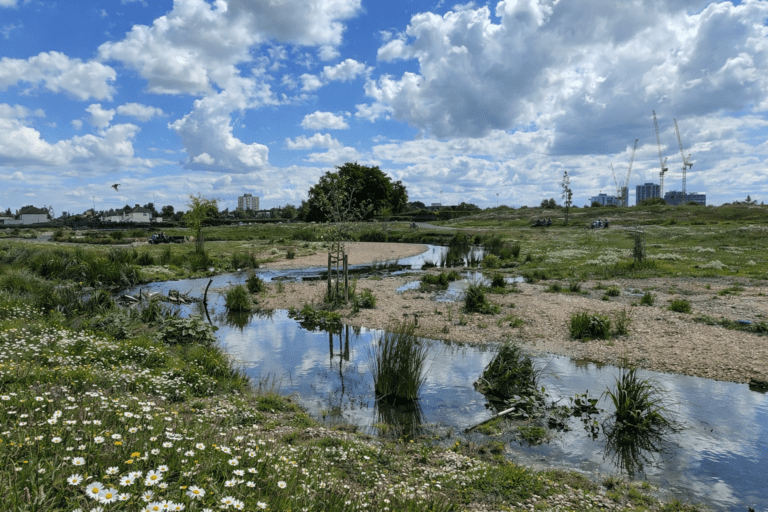
Any pond within 500 metres of a proposed development footprint triggers the need for great crested newt assessment. That’s a reasonably large radius and catches more sites than people often expect – particularly in rural and semi-rural areas of the Midlands, Yorkshire, and the South East where suitable pond habitat is prevalent. Garden ponds, farm ponds, ditches that hold water seasonally, flooded quarries – all qualify if they meet the habitat criteria for great crested newt ponds.
The Habitat Suitability Index (HSI) is used to assess the quality of ponds as great crested newt habitat. It scores ponds against criteria including water quality, pond size, surrounding habitat, shading, and fish presence (fish are predators of newt eggs and larvae and reduce pond suitability). Ponds with a high HSI score are more likely to support great crested newts than those with a low score, though absence from a high-quality pond is possible and presence in a medium-quality pond is not uncommon.
Survey Methods
Two main survey approaches are used to confirm presence or absence:
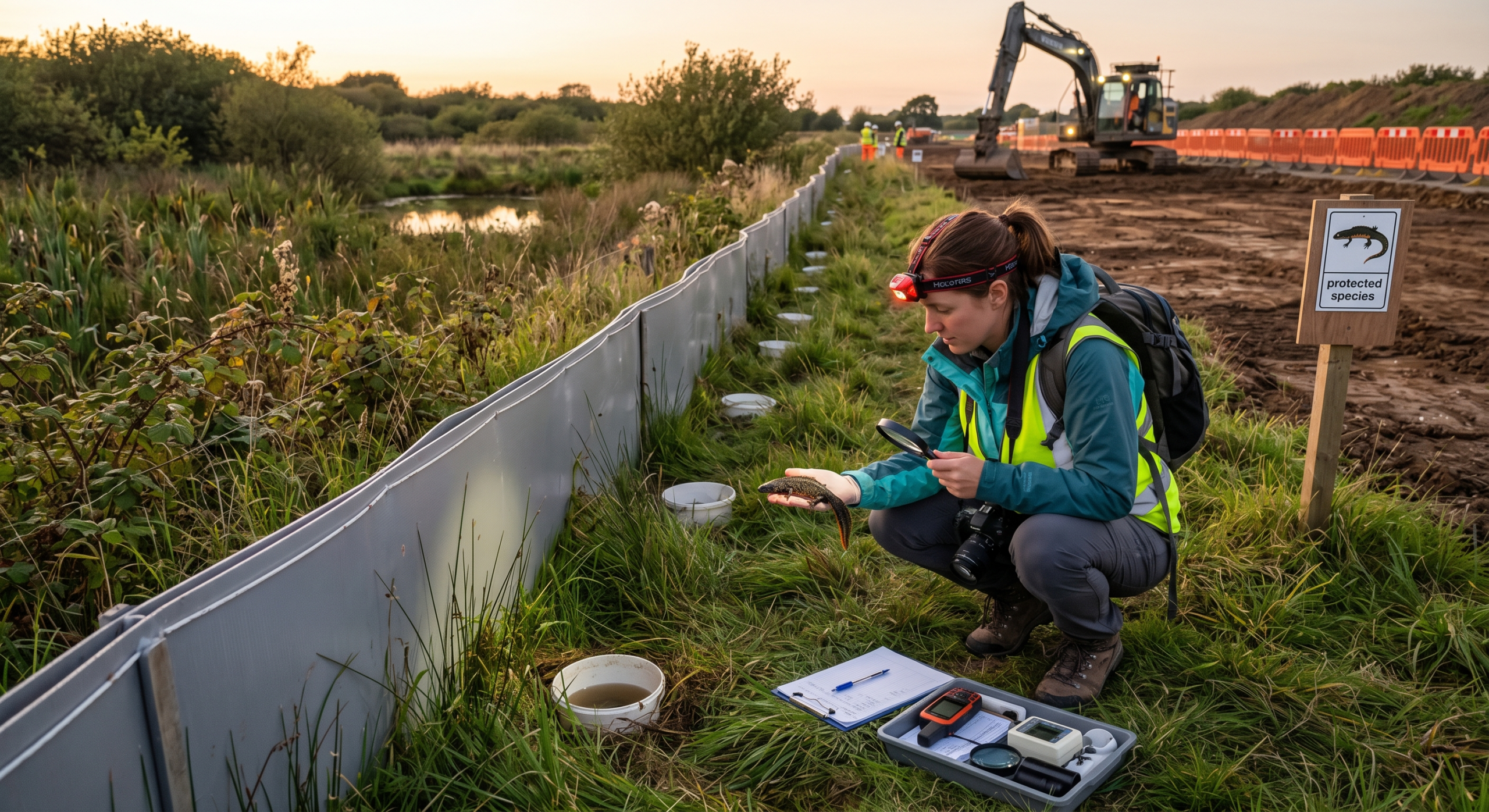
Traditional survey methods use four visits to each pond within the survey window (mid-March to mid-June, with at least two visits between mid-April and mid-May). Each visit uses a combination of torch survey (scanning the pond margins at night), bottle trapping (specially designed traps set at the pond margins overnight and checked before dawn), egg search (checking aquatic vegetation for the characteristic folded leaves containing eggs), and terrestrial search (checking refugia around the pond margins). The combination of methods across four visits produces a robust dataset for presence or absence determination and, if present, an estimate of population size class.
Environmental DNA (eDNA) surveys offer a faster alternative – a single visit to collect a water sample, which is then analysed in a laboratory for great crested newt DNA. Reliable within the window of mid-April to the end of June. eDNA confirms presence or absence but doesn’t give population size information, which is why it’s often used as a screening tool to confirm presence, followed by traditional surveys on ponds where newts are found.
Both methods require a licensed surveyor – great crested newt surveys require a Natural England survey licence, and the surveys must be conducted by or under the direct supervision of a licensed ecologist.
The Licensing Routes
When great crested newts are confirmed on or near a development site and the works would affect their habitat or disturb the animals, a licence is needed. There are currently two main routes:
The Traditional EPS Licence route involves a site-specific mitigation strategy – designed around the specific population on the specific site – submitted to Natural England alongside a licence application. The licence specifies the mitigation measures required, the method statement for works affecting newts (pre-clearance trapping, translocation to a receptor site, supervision of clearance), and the habitat creation or enhancement that compensates for habitat lost. Natural England determines the application, typically within thirty working days. This route is appropriate for sites where the development has a direct and specific impact on a known population.
District Level Licensing (DLL) is a newer and in many ways more efficient route, now available across large parts of England through Natural England’s District Level Conservation schemes. Under DLL, developers pay a conservation credit – essentially a contribution to a strategic habitat creation and management fund – rather than designing and delivering site-specific mitigation. In return, the site is licensed for development works affecting great crested newts. The strategic habitat creation is delivered by the conservation body running the scheme, typically creating and managing ponds and terrestrial habitat across a district-wide area. It’s faster, simpler, and removes the burden of site-specific mitigation design and receptor site identification from individual developers.
Our great crested newt surveys and mitigation cover both routes – from the initial habitat suitability assessment and eDNA or traditional surveys through to licence application and on-site mitigation supervision, whether that’s under a traditional EPS licence or through the DLL pathway.
What Mitigation Typically Involves
Under a traditional EPS licence, the mitigation package is site-specific but broadly follows a consistent pattern. Here’s what a typical scheme looks like:
| Mitigation Phase | Timing | What’s Involved |
|---|---|---|
| Receptor site preparation | Prior to clearance; ideally the season before | New or enhanced pond creation; terrestrial habitat establishment; exclusion fencing installation around receptor site |
| Exclusion fencing – development site | Autumn to early spring before clearance season | Amphibian-proof fencing installed around development footprint with pitfall traps |
| Pre-clearance trapping | Spring (March to May) or autumn depending on licence conditions | Pitfall traps checked daily; newts caught translocated to receptor site; area confirmed clear before clearance proceeds |
| Vegetation clearance | After area confirmed clear; within licence period | Supervised clearance of vegetation within exclusion fence; ecologist present to check for remaining animals |
| Pond management | Ongoing for duration of licence commitment | Enhancement or management of retained or created ponds; habitat monitoring and reporting |
| Monitoring | Annual for agreed period (typically 3-5 years) | Population monitoring on receptor site to confirm mitigation is functioning |
The trapping period is the part that most directly affects the construction programme. Trapping can only be carried out when newts are active and moving – broadly March to May in spring, September to October in autumn. If the licence requires pre-clearance trapping and the clearance needs to happen in November, the trapping period will have passed. Programme the mitigation works alongside the construction sequence, not as a separate afterthought.
What Happens If Newts Are Found During Works
Stop. That’s the answer. If great crested newts are found during works that haven’t been licensed – or during licensed works in an area that wasn’t expected to contain animals – work in that area stops immediately. The supervising ecologist is called. A licensed handler deals with the animal. Work doesn’t resume in that area until the ecologist confirms it’s safe to do so.
This is not an overreaction. Continuing works after a great crested newt has been found, without a licence and without proper mitigation, is a criminal offence. Site operatives need to know what great crested newts look like and what to do if they find one. That’s a site induction item on any site with a known or suspected newt presence, and it should be taken seriously rather than treated as a box-ticking exercise.
Great crested newts are distinctive – larger than common newts, dark brown to black with a bright orange underside and (in males during the breeding season) a pronounced crest along the back. Common newts are smaller and lack the crest. If someone on site isn’t sure what they’ve found, the default position is to stop work and call the ecologist. That’s always the right call.
Frequently Asked Questions
How long does it take to get a great crested newt licence?
Natural England’s standard determination period for an EPS licence is thirty working days from receipt of a complete application. In practice, processing times can vary. The licence application can only be submitted once the surveys are complete and the mitigation strategy is designed, which means the combined survey and licensing timeline typically runs to several months. Under District Level Licensing, credits can be purchased more quickly once eligibility is confirmed – often within a few weeks. Either way, this needs to be in the programme, not discovered as a bottleneck.
Does finding great crested newts mean development can’t proceed?
No. EPS licensing exists precisely to enable development to proceed where there is sufficient justification and appropriate mitigation. Great crested newts have been successfully mitigated on thousands of development sites across the UK. Finding them is a complication, not a prohibition. The question is whether the development can be designed to avoid or minimise impact, and whether what impact remains can be appropriately mitigated and compensated.
Is District Level Licensing available everywhere in England?
Not yet, though coverage has expanded considerably since the scheme launched. Natural England’s website maintains an up-to-date map of areas where DLL is available. Where it is available, it’s generally the faster and simpler route for most development sites. Where it isn’t available, the traditional EPS licence route applies.
What’s the difference between a small and large great crested newt population, and does it matter?
Population size class – assessed through traditional survey methods – affects the scale of mitigation required. A small population (fewer than ten individuals caught across surveys) requires less extensive mitigation than a large population (over one hundred individuals). Under DLL, the credit calculation accounts for population size and local habitat context rather than raw survey counts. The distinction matters for both mitigation design and licence conditions, which is why population assessment is part of the survey process rather than an optional extra.
Early Engagement Is Everything
The consistent thread running through great crested newt management on development sites is timing. Sites where the surveys were done early, the licensing route was confirmed before planning was submitted, and the mitigation programme was designed alongside the construction programme tend to move through without significant delays. Sites where newts were found late – during clearance, after planning was granted with a pre-commencement condition for survey, or discovered on a site where no survey had been commissioned – are the ones that generate the programme problems and the legal complications.
Survey early. Know the licensing route. Build the mitigation timeline into the programme. And brief site operatives on what a great crested newt looks like and what to do if they find one. None of that is complicated. All of it makes a meaningful difference to how smoothly the project runs.

Killingley Insights is the editorial voice of NT Killingley Ltd, drawing on decades of experience in landscaping, environmental enhancements, and civil engineering projects across the UK.